ENEnglish
 LTLietuviškai
 DEDeutsch
 FRFrançais
 RUРусский
 ESEspañol
 PLPolski
 ITItaliano
 UKУкраїнська
 CSČeština
 PTPortuguês
 JA日本語
 LVLatviešu valoda
 ETEesti
 HUMagyar
 IDBahasa Indonesia
 TRTürkçe
 HIहिन्दी
 ELΕλληνικά
 ARالعربية
 THไทย
 VITiếng Việt
 RORomână
 MSBahasa Melayu
 BNবাংলা
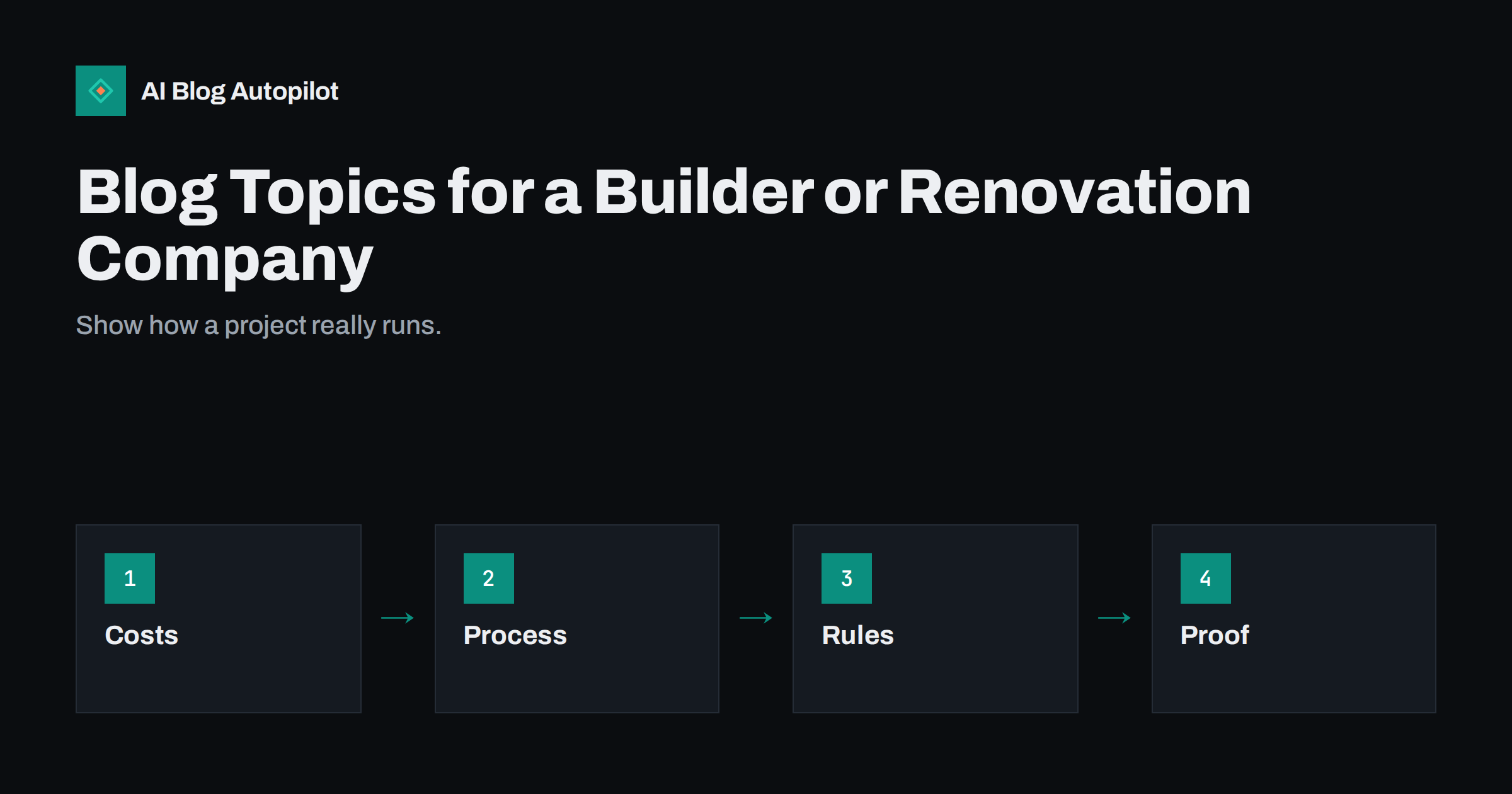
Short answer: a builder or renovation company should blog about the questions homeowners ask before they hire: what a project costs and why, how long each stage takes, which permits and rules apply, how quotes and payments work, how to avoid common problems and what a project looks like from the first visit to the final inspection. Use real photographs, name your area and keep every price range dated.
A building project is one of the largest and most stressful purchases a household makes. The homeowner is handing over a house, a budget and months of daily life to a stranger, often after hearing stories of delays, overruns and disputes. A contractor who explains the process openly, before any contract is signed, stands out from the rest.
This guide lists topic groups for a small or mid-sized builder, extension specialist or renovation firm, explains how to turn site conversations into pages and describes how to keep content honest and accurate. It does not replace the regulations that apply to you, which differ by country and often by town.
Write honestly about costs and quotes
Cost is the first question. Explain what drives the price of an extension, a loft conversion, a kitchen or a bathroom: size, structure, materials, access, finishes, services and the state of the existing building. Give ranges for typical projects, say when they were last checked and make clear that every house is different.
Describe how you prepare a quote. Explain what a site visit covers, what drawings or surveys may be needed, how long a written quote takes and what it includes. Say what is commonly missing from low quotes, such as skips, making good, scaffolding or permit fees. Honest warnings help readers compare fairly, and the guide on writing honest articles about what things cost offers a structure.
Explain allowances and variations. Many disputes come from items that were not fixed at the start, such as tiles, appliances or fittings. Describe how provisional sums work, how changes are priced and approved in writing and why a contingency of ten to fifteen per cent is wise for older houses. Readers who understand this feel safer.
Describe payment schedules. Say how deposits and stage payments usually work, what protects the homeowner, such as payment against completed work, and what you require for materials. Follow the rules of your country about deposits and consumer protection, and link to the official guidance.
Write about planning before the build. Many problems begin because a project started without a clear brief or budget. A guide on how to prepare, covering a wish list, a realistic budget, priorities, a decision on whether to stay in the house and who will make decisions, helps clients start well. It also shows that you care about results, not only about winning a contract.
Explain the roles of other professionals: architects, designers, engineers, surveyors, electricians and plumbers. Say who you coordinate and who the client hires. A short page that clarifies responsibilities removes a common source of confusion and friction.
Explain the process and the timeline
Take readers through a project from the first call to the handover: survey, design, permits, quote, contract, preparation, groundwork, structure, services, plastering, finishes, inspection and snagging. For each stage, say what happens, how long it typically takes and what the homeowner needs to decide or provide.
Be honest about delays. Weather, deliveries, hidden problems and changes of mind all affect the schedule. Explain what you do when a delay occurs and how you keep the client informed. A page that says this directly builds more trust than a promise that projects are always finished on time.
Describe daily life during a build: working hours, dust and noise, access to the house, toilets, parking, neighbours and security. Offer practical tips on living in a building site, such as setting up a temporary kitchen. These pages are shared by friends who are about to start their own project.
Explain how you communicate. Say who the site manager is, how often you meet, whether you use a shared photo log or a project app and how problems are reported. Clear communication is often what clients remember most, and it is easy to describe in advance.
Cover permits, standards and safety
Rules are a big worry. Write about when a permit or approval is needed, who applies, how long it takes and what drawings are required. Link to the official guidance for your area and show the date, since regulations change. If you handle applications for clients, explain what is included and what is charged.
Explain building standards in plain language: insulation, ventilation, fire safety, electrical and gas work, structural changes and damp control. Name the inspections that take place, who carries them out and what a certificate means. Avoid giving advice that depends on a particular building, and recommend a qualified surveyor or engineer where needed.
Describe your insurance, qualifications and memberships, and how to check them. Link to the register of your trade body and the public record where readers can verify that you are properly registered. Verification is a strong trust signal, and it filters out clients who want a cheap deal without the paperwork.
Write about safety on site, including how you protect the family and neighbours. Explain fencing, dust control, storage of materials and what children and pets should avoid. A thoughtful page on this subject shows professionalism and reduces anxiety for families who stay in the house.
Publish update notes while a project is in progress, if the client agrees. A short progress diary with photographs, covering the foundations, the frame or the first fix, shows how a build develops and answers questions about what happens when. Readers who are planning a similar project follow such series with interest.
Share lessons learned. After a finished project, ask the team what they would do differently, what surprised them and what the client liked most. These honest reflections make memorable posts and help you improve your own process.
Show real projects with context
Project galleries work best with a story. For each project, describe the starting point, the brief, the main challenges, the solution, the duration and the approximate budget range if the client agrees. Use real before and after photographs, taken by you, and add short notes about the details that mattered.
Ask permission. Photographs of a client’s home show private spaces, and you need written consent. Remove anything identifying, such as house numbers and personal items. Be honest when a project had problems and explain how you solved them. A calm account of a difficulty resolved is more convincing than a perfect gallery.
Use testimonials carefully. Ask clients for comments after the final inspection, record them in writing and show the date and first name only if they agree. The guide to testimonials in blog posts explains how to use them fairly and how to avoid editing that changes the meaning.
Write case studies for different budgets and styles, not only the largest jobs. A small bathroom refit that went well may attract more enquiries than a grand extension, since more homeowners have that kind of project. The guide on how to write a case study gives a structure.
Write about sustainability and running costs where relevant: insulation, heating, windows, solar panels and water use. Explain the benefits and limits honestly, with realistic figures and references to official sources. Many homeowners want to know whether a measure will pay back, and a calm, balanced page earns trust.
Help readers avoid common problems
Many searches are about trouble. Write pages on how to choose a builder, what to ask a contractor, how to compare quotes, which warning signs to notice and what to do if a project goes wrong. Be fair, since readers will recognise bias, and say that most disputes can be avoided with a clear written contract.
Explain what a good contract contains: scope, price, schedule, payment terms, variations, insurance, warranties and how disputes are handled. Link to model contracts from your trade body if available. A page that helps clients protect themselves also helps you, since it describes the way you work.
Cover maintenance and aftercare. Explain the warranty period, how to report a problem, what snagging is and how long it takes, and how to look after new work, such as plaster drying and wood floors. Clients who know what to expect are more likely to be satisfied, and they recommend you.
Write about alternatives. If a smaller project would solve the client’s problem, say so. A contractor who tells readers when a cheaper option is enough earns respect, and many such readers return for larger projects later.
Be easy to find and easy to call
Most clients search locally. Create pages for the areas you serve, with real examples of projects nearby, planning notes for the district and typical house types. Avoid copying the same text for every town. The guide on blog strategy for a local business explains how to keep these pages useful.
Keep your details identical across your site, listings and business profile: name, address, phone, registration numbers and opening hours. Describe how to arrange a first visit, whether it is free, how soon you can come and what to prepare. A quick, polite reply to enquiries often wins the job.
Review the blog twice a year. Update costs, regulations and photographs, remove outdated pages and add the questions that came up on site. Treat the blog as part of your quality control: if a page says something you no longer do, either change the page or change the practice.
How AI Blog Autopilot helps
AI Blog Autopilot can write and publish articles on your chosen topics, with FAQ sections, tags and SEO meta, and share them to your social networks. Give it your services and your area, and have an experienced member of the team check every cost, rule and timeline before each article goes live. See the pricing page for plans and monthly credits.
Related reading
- Blog Topics for Plumbers, Electricians and Home Services
- A Blog for an Architect or Interior Designer
- Blog Strategy for a Local Business
The bottom line
Explain costs, process and rules openly, show real projects with consent, help readers avoid common problems and make the first call easy.
FAQ
What should a builder blog about first?
Start with costs and quotes, how a project runs from first visit to handover and which permits apply in your area.
Should I publish prices?
Publish ranges with a date and explain what changes them, since every house is different.
Can I show photos of client homes?
Only with written consent, and without details that identify the family or the address.
How do I write about delays?
Explain the usual causes, how you respond and how you keep the client informed, rather than promising there are none.
How often should project pages be updated?
Review costs and regulations at least twice a year and whenever prices or rules change.