ENEnglish
 LTLietuviškai
 DEDeutsch
 FRFrançais
 RUРусский
 ESEspañol
 PLPolski
 ITItaliano
 UKУкраїнська
 CSČeština
 PTPortuguês
 JA日本語
JA日本語 LVLatviešu valoda
 ETEesti
 HUMagyar
 IDBahasa Indonesia
 TRTürkçe
 HIहिन्दी
 ELΕλληνικά
 ARالعربية
 THไทย
THไทย VITiếng Việt
 RORomână
 MSBahasa Melayu
 BNবাংলা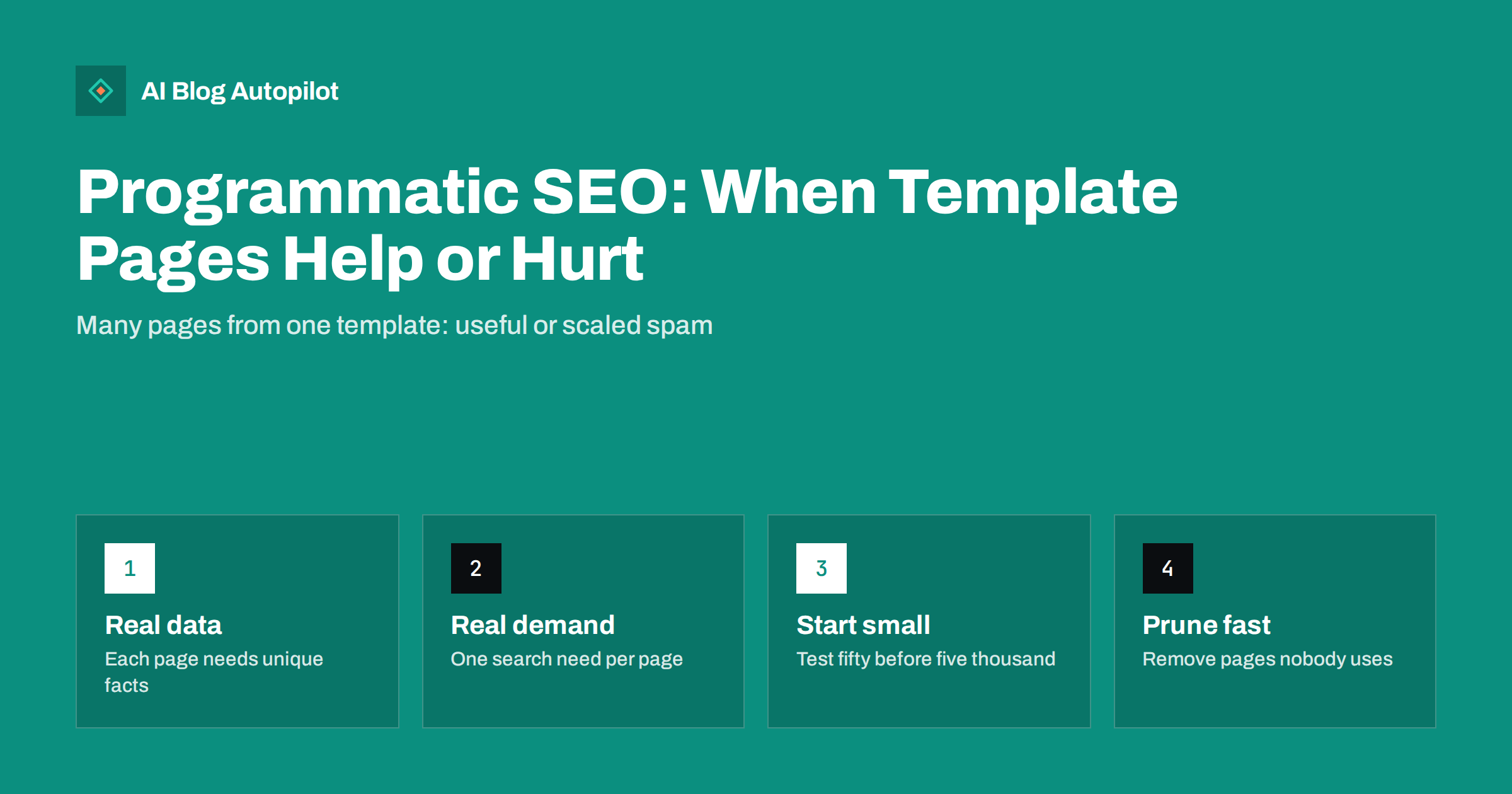
Short answer: programmatic SEO means generating many pages from a template and a structured dataset, such as one page per city, product integration or currency pair. It works when each page answers a distinct search need with genuinely different, useful information. It hurts when pages differ only by a swapped word, which search engines treat as low-value or even as scaled content abuse. Small sites should start with a small batch, check that each page earns impressions, and remove what does not.
Some of the best-known websites are built this way. Travel sites have a page for every route, job boards have a page for every role in every city, and software directories have a page for every tool comparison. It is tempting for a small business to copy the idea: one template, a spreadsheet of locations or keywords, and hundreds of new pages overnight. Sometimes that is a smart move. Often it creates a pile of thin pages that never rank and can drag the rest of the site down. This article explains the difference and how to decide.
What programmatic SEO actually is
A programmatic page has three parts:
- A template that defines the layout and the fixed text.
- A dataset with one row per page, containing the variable information: names, numbers, attributes, descriptions, images.
- A query pattern that the pages target, such as “[service] in [city]”, “[tool A] vs [tool B]” or “[unit] to [unit] converter”.
The value of each page comes almost entirely from the dataset. If the data is rich and specific to each row, the pages can be genuinely useful. If the dataset is just a list of names, every page says the same thing with a different word swapped in.
That is the whole method in one sentence: programmatic SEO is only as good as the data behind it. The template, the internal linking and the technical setup matter, but they cannot turn an empty spreadsheet into useful pages.
When it genuinely helps
Programmatic pages work when three conditions are met at the same time:
- There is real search demand for each variation. People really search “[your product] integration with [other tool]”, and each integration works differently.
- You have unique data for each page. Specifications, prices, availability, measured results, local details, compatibility notes or user reviews that differ per page.
- The page is the best format for the need. A person looking for a currency conversion or a shipping cost to a specific country wants a focused page, not a long article.
Good examples for small businesses include integration pages for a software product, spec pages for each product model, location pages for places where a business genuinely operates with real local information, and glossary pages with well-written definitions. Our guide to glossary pages covers that last case.
When it hurts
The pattern goes wrong in familiar ways:
- Doorway pages. Hundreds of “[service] in [town]” pages for towns where you have no office, no staff and nothing specific to say. Google’s spam policies name doorway pages explicitly.
- Scaled content abuse. Generating many pages mainly to manipulate rankings rather than to help people, whether by templates, scraping or automated text. The method does not matter; the lack of value does.
- Near-duplicates. Pages so similar that search engines pick one and ignore the rest, as described in the guide on duplicate content.
- Crawl waste. Thousands of low-value URLs take crawler attention away from your important pages, and many of them end up “crawled, currently not indexed”.
- Site-wide quality signals. A large share of weak pages can affect how search engines judge the site as a whole, including your good articles.
The risk grows with the ratio. Fifty template pages on a site with two hundred solid articles are a small experiment. Five thousand template pages on a site with thirty articles change what the site is, in the eyes of both search engines and visitors. Keep the programmatic part proportionate to the rest of the site, at least until it has proven its value.
The “swap test” for your template
Before building anything, take two rows from your dataset and write the two pages in full. Then compare them side by side:
- If you swap the variable words back, are the pages identical? Then the pages have no unique value.
- Does each page contain at least a few facts, numbers or recommendations that only apply to that row?
- Would a visitor who reads page A learn something new on page B?
- Could you honestly explain why each page deserves to exist to someone who does not care about SEO?
A practical example: a plumbing company considering pages for forty nearby towns. If every page says “We offer fast, reliable plumbing in [town]” followed by the same service list, the swap test fails immediately. If instead each page lists the engineers based nearby, typical response times for that area, common problems with local housing types and photos of real jobs there, the pages pass, and they are also far more convincing to a customer.
If the answers are uncomfortable, either enrich the dataset or do not build the pages. A single well-written article covering all the variations is often a better answer, especially for a small site.
What makes a template page useful
When the conditions are right, a few design choices separate useful programmatic pages from thin ones:
- Put the unique data first. The specific numbers, availability or answer should be visible without scrolling past generic text.
- Vary the text with the data. Conditional sections that appear only when relevant, such as a warning when two tools are not compatible, make pages genuinely different.
- Add human-written parts where it matters. For your most important variations, a short expert note, a real example or a photo adds value no template can.
- Link sensibly. Connect related pages, such as neighbouring locations or similar products, and link from relevant articles. Avoid footer blocks with hundreds of links.
- Keep titles and descriptions specific. Each page needs a title and meta description that reflect its actual content.
A careful rollout for a small site
- Validate demand for a sample of variations with search suggestions, Search Console data or customer questions.
- Build a small batch, perhaps twenty to fifty pages, choosing the variations with the clearest demand and best data.
- Publish and wait several weeks. Watch indexing in Search Console and impressions for each page.
- Review the results. If most pages are indexed and collecting impressions, expand gradually. If many are “crawled, currently not indexed”, improve the template and data before adding more.
- Prune regularly. Pages with no impressions after a reasonable period, or whose data is outdated, should be improved, merged or removed. The guide on content pruning explains the options.
Keeping the data honest over time
Programmatic pages have a maintenance problem that ordinary articles do not: when the underlying data changes, hundreds of pages become wrong at once. Prices change, integrations are discontinued, services stop being offered in some areas. Before building, decide:
- Where the data comes from and who updates it.
- How often pages are regenerated from the source.
- What happens to a page when its row is deleted: redirect, remove or keep with a clear notice.
- How visitors can report an error.
Outdated data on a programmatic page is worse than no page, because it misleads people at scale.
Add a visible “last updated” date that reflects when the data actually changed, not when the template was last regenerated. Readers use it to judge whether they can rely on the figures, and it keeps you honest about how current the pages really are.
Programmatic pages versus articles
Programmatic pages and blog articles solve different problems. Template pages are good for many narrow, factual queries with a consistent shape. Articles are better for questions that need explanation, judgement and context: how to choose, why something happens, what to do when things go wrong. The two also support each other: an article explaining how to choose between integrations can link to the individual integration pages, and each integration page can link back to the article for readers who need the bigger picture. Most small business sites get far more value from a steady stream of good articles than from a large set of template pages, and use programmatic pages only where they have a genuine dataset.
How AI Blog Autopilot fits in
AI Blog Autopilot is not a programmatic page generator. It writes individual long-form articles of 2,000 to 3,000 words, each planned around a real search query, with an FAQ and SEO meta, and it keeps a steady publishing pace per site rather than producing pages in bulk. An automatic quality check holds back weak articles instead of publishing them. See how Autopilot works on the home page.
Related reading
- Quality Control When You Publish at Volume
- Landing Page or Blog Post: Which Does a Query Need?
- Is AI-Generated Content Bad for SEO? What Google Actually Says in 2026
The bottom line
Programmatic SEO is a data project, not a shortcut. It helps when each page meets a distinct search need with information specific to that page, and it hurts when pages differ only by a swapped word. Run the swap test, start with a small batch, keep the data current and remove pages that do not earn their place.
FAQ
Is programmatic SEO against Google’s guidelines?
Not in itself. Generating pages from templates is fine when each page is useful. Google’s spam policies target doorway pages and scaled content created mainly to manipulate rankings, regardless of how it was produced.
How many programmatic pages should a small site start with?
A small batch, such as twenty to fifty pages built from the variations with the clearest demand and best data. Check indexing and impressions over several weeks before expanding.
Are location pages for every town a good idea?
Only for places where you genuinely operate and can say something specific, such as local staff, service details or examples. Pages for towns you do not serve, with only the name changed, are doorway pages.
What is the difference between programmatic pages and thin content?
Programmatic pages built on rich, specific data can be very useful. They become thin content when the dataset has little to say and every page repeats the same text with a different word inserted.
What should I do with programmatic pages that never get traffic?
Improve them with better data, merge them into a broader page, or remove them. Keeping large numbers of pages that nobody visits wastes crawl attention and can weaken how the site is judged overall.
Can AI-written text make template pages better?
Only if it adds accurate, specific information. Generic paragraphs that vary the wording but not the substance do not make pages more useful, and producing them at scale without added value is what spam policies describe.