ENEnglish
 LTLietuviškai
 DEDeutsch
 FRFrançais
 RUРусский
 ESEspañol
 PLPolski
 ITItaliano
 UKУкраїнська
 CSČeština
 PTPortuguês
 JA日本語
JA日本語 LVLatviešu valoda
 ETEesti
 HUMagyar
 IDBahasa Indonesia
 TRTürkçe
 HIहिन्दी
 ELΕλληνικά
 ARالعربية
 THไทย
THไทย VITiếng Việt
 RORomână
 MSBahasa Melayu
 BNবাংলা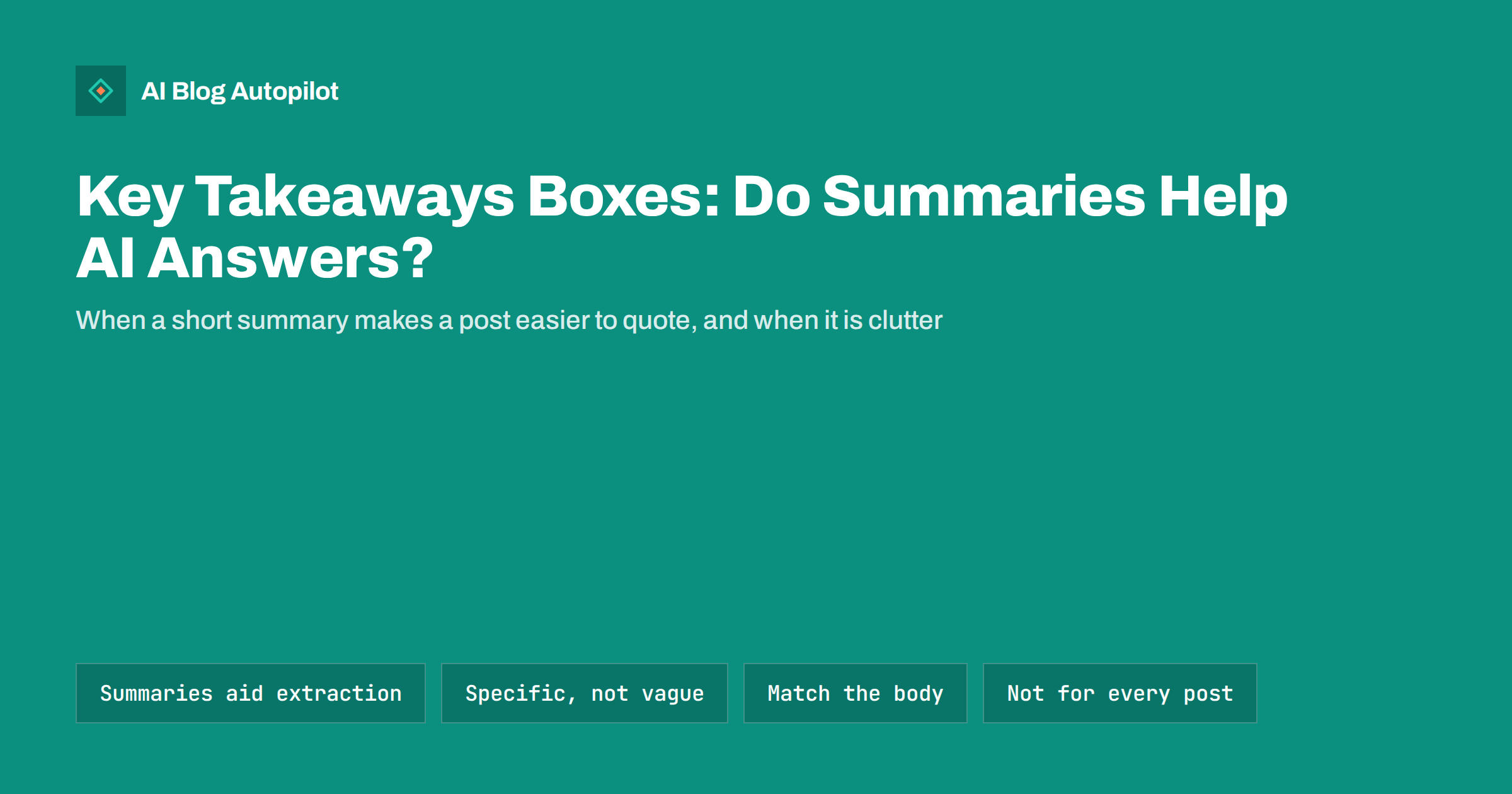
Short answer: a key takeaways box is a short list of the main conclusions of an article, usually placed near the top. It can help AI answer engines because it states the article’s core claims in clear, self-contained sentences that are easy to extract and quote. It only helps when each point is specific and fully supported by the body, and it adds little to short posts that already open with a direct answer. There is no guarantee that any summary will be cited, so write it for readers first.
Summary boxes have spread across blogs, news sites and documentation. Some publishers add them because readers skim, others because they hope AI systems will lift the summary into an answer. Both reasons can be valid, but a badly written summary helps neither.
This article looks at what a takeaways box actually does, how AI answer engines are likely to treat it, and how to write one that earns its place.
What a key takeaways box is
A key takeaways box is a compact block, usually three to six bullet points, that states what the reader should remember from the article. It often sits after the introduction or right below the title, visually separated by a border or background colour.
It differs from a table of contents. A table of contents lists what the article covers. A takeaways box states what the article concludes. “Section 3: Pricing” is a contents entry. “Most small teams spend more on setup time than on the licence itself” is a takeaway.
It also differs from an introduction. An introduction sets up the problem and invites the reader in. A takeaways box gives away the answers, on the assumption that a busy reader will decide whether to read further once they know the conclusions.
Why summaries can matter for AI answers
AI answer engines, whether built into search results or offered as chat assistants, typically work by retrieving passages from pages that look relevant and then composing an answer from them. How exactly each system chooses passages is not public, but a few principles follow from how retrieval works in general.
- Self-contained sentences travel well. A sentence that makes sense on its own, without “as mentioned above” or “this”, is easier to reuse accurately than one that depends on the paragraph around it.
- Clear claims are easier to match. When someone asks a direct question, a sentence that states a direct answer is a closer match than a paragraph that circles the point.
- Position helps readers and extraction. Conclusions near the top are found by readers who leave early and by systems that weigh the opening of a page.
A good takeaways box is essentially a set of such sentences. That is why it can help. But the same qualities in the body of the article help just as much, and a summary that contradicts or oversimplifies the body can hurt trust. Google’s guidance on AI features in Search makes a similar point: the same fundamentals that make content helpful to people apply, and there is no special markup required.
When a takeaways box helps
Not every post benefits. Summaries earn their space in some formats and add clutter in others.
- Long guides. Articles of 2,000 words or more cover many points. A summary lets readers and systems see the conclusions without reading every section.
- Research and analysis. If an article reaches findings, such as what you learned from testing tools or reviewing your own data, a takeaways box states them plainly.
- Comparisons and decisions. “Choose A if you need this, choose B if you need that” is exactly the kind of statement readers look for and answer engines can reuse.
- Explainers of contested topics. Where readers bring misconceptions, a list of clear corrections near the top prevents misunderstanding.
When it adds nothing
- Short posts. An 800-word article that opens with a direct answer does not need a second summary a few lines later.
- Step-by-step tutorials. The steps are the content. A summary of steps is either the steps again or too vague to use.
- Opinion and narrative pieces. Stories and arguments rely on progression. Bullet points strip out the reasoning that makes them persuasive.
- Posts with an answer-first opening. If your first paragraph already gives a quotable answer, a takeaways box should add something the opening does not, or be left out.
How to write takeaways worth quoting
The difference between a useful box and a decorative one is almost entirely in the wording. These rules cover most cases.
- State conclusions, not topics. “We cover pricing” is a teaser. “Most plans charge per user, so costs scale with team size” is a takeaway.
- Make each point stand alone. Avoid pronouns that refer back to earlier text. Name the subject in each bullet so it still makes sense when quoted in isolation.
- Keep it specific. Include the condition, number or example that makes the point useful. “It depends” is not a takeaway unless you say what it depends on.
- Be honest about uncertainty. If something is typical rather than universal, say so. Overconfident summaries are the part most likely to be quoted out of context.
- Limit the count. Three to five points is usually enough. A box with ten points is a second article.
- Keep sentences short. One idea per bullet, ideally one sentence. Long, multi-clause bullets are hard to scan and hard to reuse accurately.
- Write it last. Draft the article first, then extract the conclusions. Writing the summary first tends to produce promises the body does not keep.
A before and after example
Imagine an article on choosing a note-taking app for a small team. A weak takeaways box might read: “Note apps are useful”, “There are many options”, “Consider your needs”. None of these can be quoted as an answer to anything.
A stronger version might read: “For teams under ten people, shared folders and search matter more than advanced formatting”, “Apps that store notes in open formats make it easier to switch later”, and “Offline access is the feature most often missing from free plans”. Each point is a claim a reader can act on and an answer engine could reuse, provided the article actually supports it.
Markup and placement
A takeaways box does not need special structured data. It is ordinary HTML: a heading such as “Key takeaways” followed by a list. Use a real list element, not a series of paragraphs styled to look like bullets, so its structure is clear to browsers, assistive technology and crawlers.
- Place it early. Directly after a short introduction works for most articles. Placing it at the very top, above any context, can confuse readers who arrive not knowing what the article is about.
- Keep it in the main content. Boxes injected by scripts after the page loads, or hidden behind a click, are less reliable for crawlers than content present in the HTML.
- Do not duplicate the FAQ. If your article ends with an FAQ, make sure the takeaways and FAQ answers do not simply repeat each other. Takeaways state conclusions. FAQs answer specific follow-up questions.
- Style for scanning. A subtle border or background is enough. Heavy colours and icons draw attention away from the words.
Keeping summaries accurate over time
The biggest long-term risk with summary boxes is drift. An article gets updated, a section changes, and the takeaways at the top still say what the old version said. Because the summary is the most quotable part, stale takeaways can spread outdated information further than the rest of the page.
- Review the takeaways whenever you edit the body.
- Avoid dates and prices in takeaways unless you plan to maintain them.
- Where a point depends on something that changes, such as a platform policy, phrase it so it stays true or remove it.
- If you update a post substantially, reread the summary as if you were a stranger and check that every point is still supported.
Common mistakes with summary boxes
- Teasers instead of answers. Points such as “Find out which option wins” hold back the conclusion the box exists to give.
- Claims the body does not support. A bold summary backed by a vague section damages trust with readers, and quoting systems cannot tell the difference.
- Keyword-stuffed bullets. Repeating the target phrase in every point makes the box read like a list of search terms rather than conclusions.
- Adding a box to every post by template. A box on a 700-word news item or a recipe-style tutorial is clutter that pushes the useful content down the page.
How AI Blog Autopilot fits in
AI Blog Autopilot writes long-form SEO articles, publishes them to your WordPress blog and shares each one to your social networks. Its articles include an FAQ, tags and SEO meta, and pass an automatic quality check on length, structure, keyword and meta before going live. The writer is instructed never to invent statistics, quotes or sources, which matters most in the sentences answer engines are likely to reuse. If you want a takeaways box on certain posts, you can add it in the editor or ask for that structure through your topics and tone settings. You can see how it works on the AI Blog Autopilot home page.
Related reading
- How to Get Your Blog Cited by AI Search
- Blog Post Structure That Works for Readers and Search
- Writing for Decision-Makers Who Skim
The bottom line
A key takeaways box is worth adding to long, conclusion-driven articles and worth leaving out of short, step-based or narrative ones. When you use one, write specific, self-contained conclusions that the body fully supports, keep it to a handful of points, and update it whenever the article changes. That makes it useful to skimming readers and a clean source of quotable claims for answer engines, without promising either that it will be cited.
FAQ
Does a key takeaways box help with AI Overviews?
It can make an article easier to quote because it states conclusions in clear, self-contained sentences. There is no special markup or guarantee involved, and the same clarity in the body of the article matters just as much.
Where should a key takeaways box go?
Usually right after a short introduction, so readers know the context before they see the conclusions. Keep it in the main HTML content rather than loading it with scripts or hiding it behind a click.
How many points should a key takeaways box have?
Three to five is usually enough. Each point should be one short sentence that states a conclusion. If you need more than six points, the article probably covers too much or the points are not really conclusions.
Is a takeaways box the same as a TL;DR?
They are close relatives. A TL;DR is usually a single sentence or short paragraph, while a takeaways box is a list of separate conclusions. Both should state answers rather than describe what the article covers.
Do I need schema markup for a takeaways box?
No. A heading followed by a normal HTML list is enough. What matters is that the text is in the page content, clearly structured and accurate.