ENEnglish
 LTLietuviškai
 DEDeutsch
 FRFrançais
 RUРусский
 ESEspañol
 PLPolski
 ITItaliano
 UKУкраїнська
 CSČeština
 PTPortuguês
 JA日本語
JA日本語 LVLatviešu valoda
 ETEesti
 HUMagyar
 IDBahasa Indonesia
 TRTürkçe
 HIहिन्दी
 ELΕλληνικά
 ARالعربية
 THไทย
THไทย VITiếng Việt
 RORomână
 MSBahasa Melayu
 BNবাংলা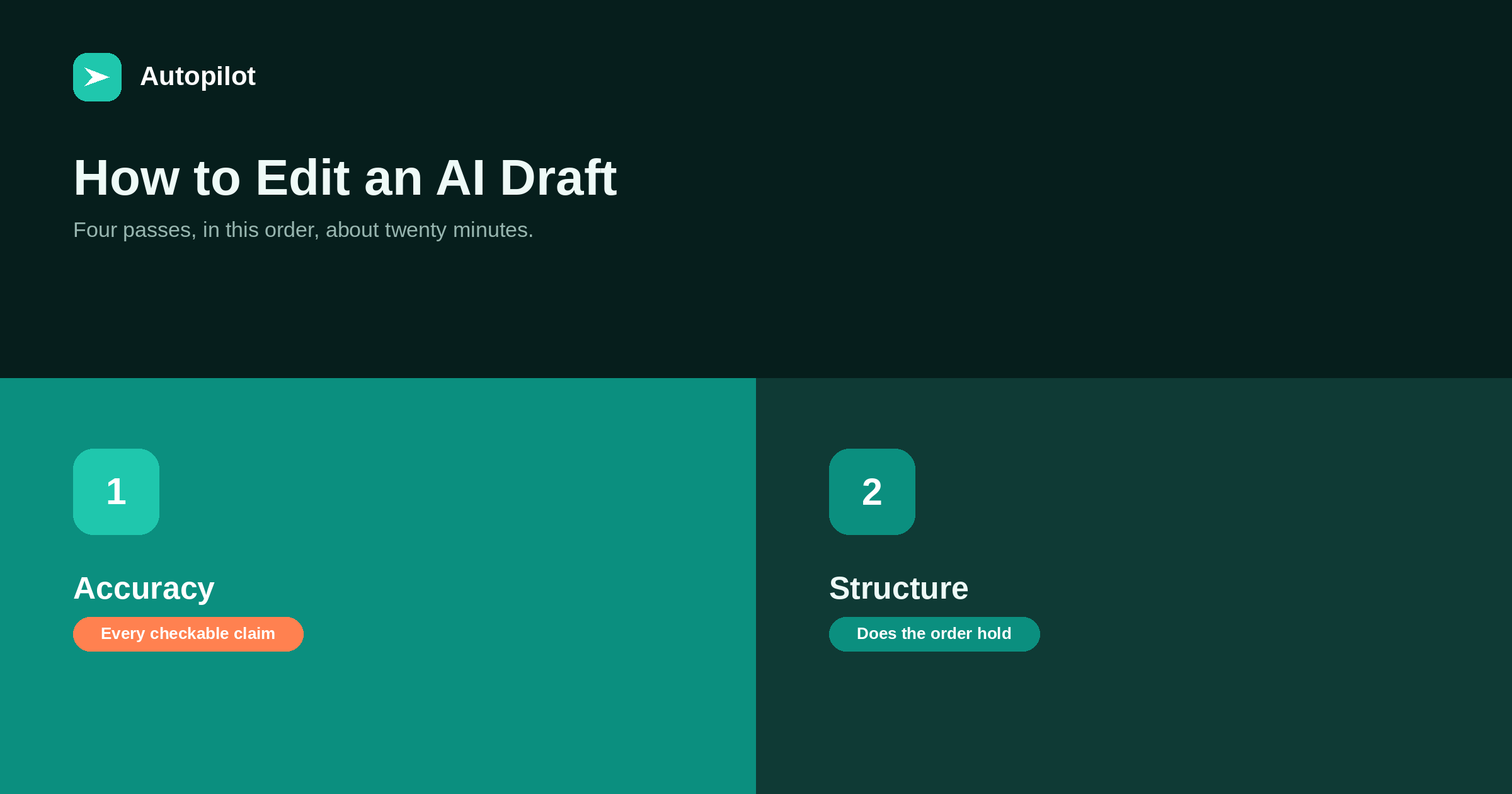
Short answer: edit in four passes and keep them separate. First accuracy: check every claim a reader could verify and delete what you cannot confirm. Second structure: make sure the article answers its question early and the sections run in a sensible order. Third cuts: remove the padding, which is usually a quarter to a third of the words. Fourth a read aloud, which catches the sentences your eye slides past. Doing them in this order matters, because polishing prose you are about to delete is the most common way to waste an hour.
The common complaint about machine-written drafts is that they need so much editing you may as well have written them yourself. Usually that is true of the editing process rather than the draft.
People edit line by line from the top, fixing wording in paragraphs they later cut, checking nothing, and finishing exhausted with an article that still says little. Four separate passes, each looking for one kind of problem, takes less time and produces a better page.
Pass one: accuracy
Start here, always, and start before you have grown fond of any sentence.
Go through the draft and mark every statement a reader could check: numbers, dates, prices, version numbers, names of standards, legal deadlines, anything described as recent or current, and any sentence that begins with a phrase like studies show.
Then deal with each mark in one of three ways. Confirm it against a source you trust and leave it. Correct it. Or delete it. There is no fourth option, and in particular there is no option where you soften a claim you cannot verify into something vaguer and publish that. A vague unverifiable claim is the same liability as a precise one, minus the usefulness.
This pass is covered properly in fact-checking before you publish, because it is the one that carries real risk.
Pass two: structure
Now read only the headings and the first sentence of each section. Ignore the prose entirely.
Three questions answer themselves quickly. Does the article answer its own title in the first hundred words, or does it warm up for four paragraphs first? Do the sections run in the order a reader would ask about them? Is there a section that exists because the outline said seven, with nothing in it a reader needed?
Fix those by moving and deleting whole blocks, not by rewriting. Move the answer up. Reorder two sections. Delete the empty one. Structural problems are invisible when you read sequentially from the top, which is exactly why this pass reads out of order.
Pass three: cuts
Most drafts are a quarter longer than they need to be, and the excess is predictable.
- Restating the heading. A section called Why page speed matters that opens with a sentence explaining that page speed matters.
- Announcing what comes next. In this section we will look at five factors. The reader can see the five factors.
- Both sides of a decision you already made. Two sentences saying it depends, followed by the actual recommendation. Keep the recommendation.
- The closing paragraph that repeats the opening. One conclusion, with something in it, or none.
- Adjective stacking. Powerful, comprehensive and robust solutions. Delete all three words; nothing is lost.
Cutting is where the word count question comes in, and the answer is not a target. A tight 1,400-word article beats a padded 2,200-word one, and how long a post should be is about matching the length to the question rather than to a number someone reported as ideal.
Pass four: read it aloud
This is the pass people skip and the one that most reliably catches the remaining problems.
Reading aloud exposes sentences that are grammatically fine and unreadable: the thirty-word one with three subordinate clauses, the paragraph where every sentence is the same length, the transition that does not follow. Your eye forgives all of that; your mouth does not.
You are listening for two things specifically. Sentences you stumble over, which need splitting. And anything that does not sound like your company — a register that is too breezy or too corporate for the rest of your site. If that second problem shows up in every article, the fix is not editing but writing down your brand voice, once, so the drafts arrive closer.
What not to edit
Two habits waste time without improving the page.
Do not rewrite for the sake of authorship. If a sentence is clear, accurate and sounds like you, changing it to a sentence you would have written is a preference, not an improvement. It also has no effect on how the page performs, whatever you may have read about detection — see what AI detectors measure.
Do not add keywords. Inserting a phrase three more times into finished prose makes the page worse and does not help it. If the article genuinely does not address the query, that is a structure problem from pass two.
Add the thing a draft cannot have
The one edit worth spending real time on is addition rather than correction: put something in the article that could only come from you.
A sentence about what happened when your team tried this. The number you actually charge. The mistake a client made last month. A screenshot of your own dashboard. The reason you disagree with the common advice.
Two or three of these change an article from competent to worth linking to, and they are the part no tool can supply. This is also most of what experience, expertise and trust means in practice, and it is why a review step exists at all.
How long this should take
For a 1,500-word article on a subject you know, the four passes should take fifteen to twenty-five minutes once you are used to them.
| Pass | Looking for | Roughly |
|---|---|---|
| Accuracy | Checkable claims | 5–10 minutes |
| Structure | Order and empty sections | 3 minutes |
| Cuts | Padding | 5 minutes |
| Read aloud | Sentences and register | 5 minutes |
| Additions | Something only you know | As long as it is worth |
If it is taking an hour, the problem is upstream. Either the brief was too vague, which writing a brief an AI can use deals with, or the subject is one nobody on your side can check, in which case it probably should not be on your blog. And if most articles need little more than pass one and a sentence of your own, that is worth knowing too: it is the point at which draft, approve or full auto becomes a real question rather than a theoretical one.
Related reading
If this was useful, these cover the questions that usually come next.
- Fact-checking before you publish — the first pass, in more detail
- Writing down your brand voice — so fewer sentence edits are needed at all
- Writing a brief an AI can use — the fix for problems you keep editing out
The bottom line
Accuracy, structure, cuts, read aloud, in that order, and add one thing only you could know. Keep the passes separate and the whole edit takes twenty minutes instead of an hour, mostly because you stop polishing paragraphs you are about to delete. If the same correction keeps appearing, fix the brief rather than the article.
FAQ
How long should editing an AI draft take?
Fifteen to twenty-five minutes for a 1,500-word article on a familiar subject, once the four passes are habit. If it regularly takes an hour, the brief is usually the problem rather than the draft.
Do I need to rewrite every sentence so it sounds like me?
No. Rewriting a sentence that is already clear, accurate and in your register is a preference rather than an improvement. Spend that time adding something the draft could not contain, such as your own numbers or a specific example from your work.
What is the one pass I should never skip?
Accuracy. Structure, cuts and polish affect how good the article is; an unchecked claim about a price, a date or a statistic affects whether you can stand behind the page at all.
Should I add keywords while editing?
No. Inserting a phrase repeatedly into finished prose makes the writing worse without helping the page. If the article does not really address the query, restructure it or write a different article.
Can I publish without reading the draft at all?
You can, and for low-risk subjects some teams do. But you are then publishing claims nobody has checked under your own name, which is a business decision rather than a technical one. Deciding which categories can run unattended is worth doing deliberately.
Does editing help the article rank better?
Editing makes the page more useful and more accurate, which is what search engines say they reward, and it removes claims that could embarrass you. Nobody can promise a specific position for any page, whoever writes or edits it.