ENEnglish
 LTLietuviškai
 DEDeutsch
 FRFrançais
 RUРусский
 ESEspañol
 PLPolski
 ITItaliano
 UKУкраїнська
 CSČeština
 PTPortuguês
 JA日本語
 LVLatviešu valoda
 ETEesti
 HUMagyar
 IDBahasa Indonesia
 TRTürkçe
 HIहिन्दी
 ELΕλληνικά
 ARالعربية
 THไทย
 VITiếng Việt
 RORomână
 MSBahasa Melayu
 BNবাংলা
Short answer: awareness days and hashtag holidays are calendar dates that many accounts post about. They can give you a ready-made topic and a bit of extra visibility, but only when the theme fits your business and you add something real. Join in rarely, plan ahead, check that the topic is serious or lighthearted and skip any date where you have nothing useful or respectful to say.
Every day of the year seems to have a name, from serious health campaigns to cheerful days for foods and pets. Social tools and content calendars list them, and it is tempting to fill empty slots with a post for each. The result is often a feed full of generic messages that nobody remembers. This article helps you decide which dates to use, how to prepare a post that sounds like you and how to avoid the common traps.
What these days are
Some dates are official or institutional, such as international days announced by organisations and campaign months run by charities. Others are informal and exist because a hashtag caught on, for example a day for a food or a hobby. There are also seasonal and cultural moments, such as holidays and sporting events, which attract large amounts of posting.
The difference matters. A date linked to a serious cause carries expectations. People who are affected by the topic are watching, and a careless post can cause offence. A light-hearted hashtag day is lower risk, but it has less lasting value. Know which type you are dealing with before you write a word.
Dates also vary by country. A day that is well known in one place may mean nothing in another, or may be marked at a different time. If your audience is international, check where the date is relevant.
It is worth asking what the audience expects. Followers of a professional account often want expertise, news about the business or practical advice. A burst of cheerful date posts may please some followers but feel off-topic to others. Look at past reactions and see whether themed posts earn real comments or only quick likes.
Why businesses join in
The appeal is simple. A date gives you a topic, a hashtag and a moment when people are more likely to search for or talk about the theme. For a small team that has to post regularly, it can remove the stress of finding an idea. If the theme is close to your work, it can also prompt a useful post that you might not have written otherwise.
But the crowd is large. On a popular day, thousands of accounts post similar messages with the same image style, and a generic post is lost. Visibility comes from being specific, not from using the hashtag. A post that says something only you could say, such as a practical tip, a behind-the-scenes photo or a real story, stands out.
Think of the date as a prompt, not as the content. The value lies in what you add, which could be advice, a small action, a donation or a clear point of view. Our guide to the right social media content mix explains how occasional themed posts fit among the rest.
A simple test helps: imagine the post without the hashtag and without the date. If it would still be worth reading, publish it. If it would only make sense because of the calendar, think again. This one habit removes most of the forced posts before they reach the audience.
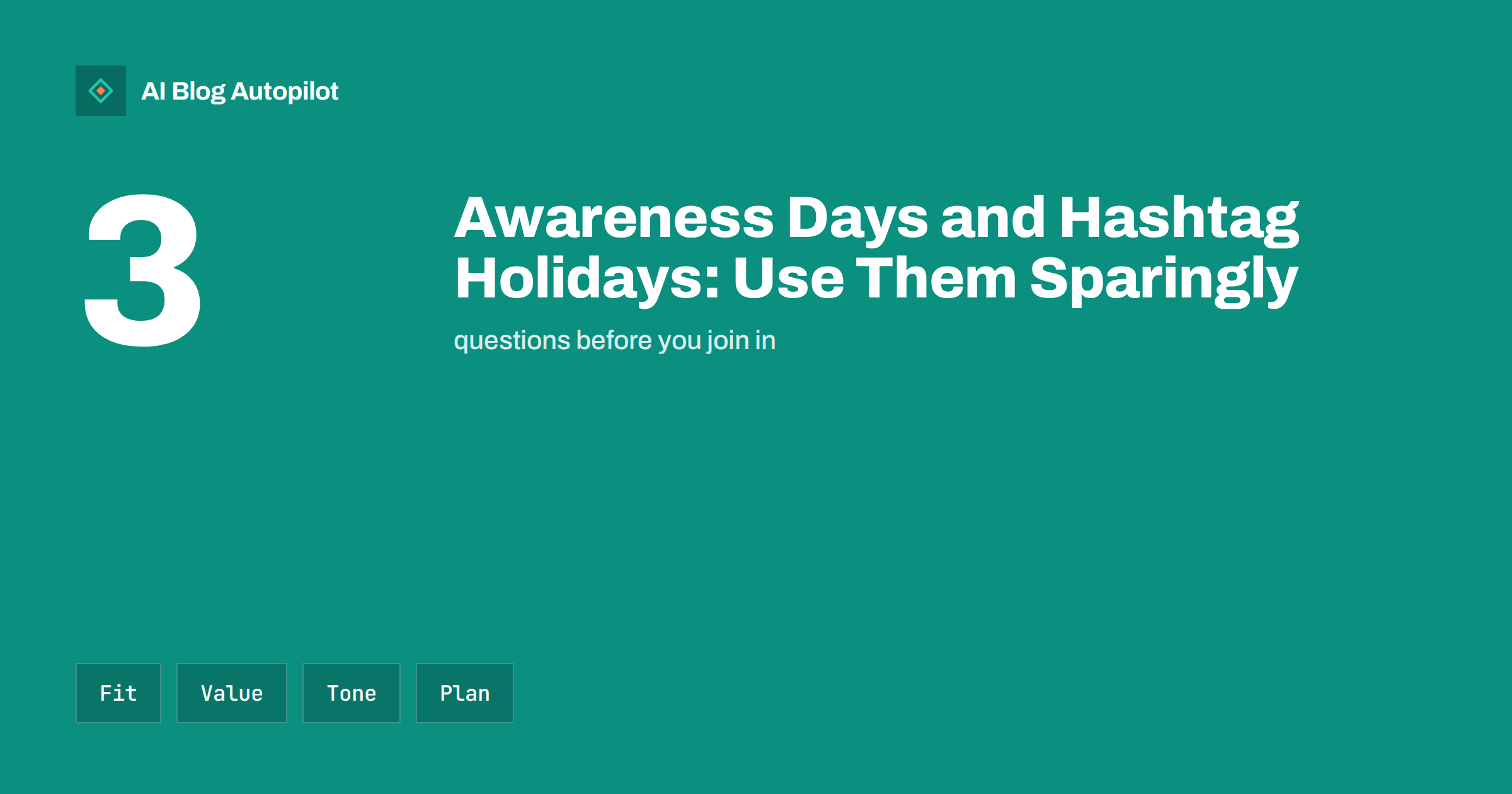
Three questions before you post
First, does it fit? Ask whether the theme is connected to what you do, what you sell or what your customers care about. A bakery can talk about bread day. A software company talking about a food day may seem forced. Fit is the strongest filter, and it keeps your feed consistent.
Second, what do you add? If the post would be the same for any business, it is not worth publishing. Add a tip, a number from your own work, a story, a photo or a small commitment. If you cannot think of anything, let the day pass.
Third, is the tone right? A cause that deals with illness, loss or injustice calls for care and simple language, not clever wordplay. A fun day allows humour, but check that the joke would still work if someone read it on a bad day. When you doubt, ask a colleague who is not close to the project.
Serious causes need care
If you want to mark a serious day, do it only if you have a real link to the topic or you are willing to take a real action. That might be a donation, a policy change, a service for those affected or a long-term partnership. A post that only uses the hashtag may look like using a cause for attention, and audiences are quick to notice.
Be accurate. Check numbers, names and the wording of the campaign on the organiser’s own page before you quote them. Do not invent statistics or borrow a graphic without permission. If the cause has an official message or a request for how to take part, follow it.
It is also fine to say nothing. A business that does not post about every cause is not uncaring. A calm, steady presence is better than a series of rushed posts. The same attitude is described in the context of news events in newsjacking for small blogs.
Customer content can make these days easier. Invite followers to share their own photos or stories with a tag, and reply to the best ones. The post then becomes a conversation, not a broadcast, and you spend less time creating material from scratch. Always ask permission before reposting someone else’s picture.
Light-hearted days
For the playful days, the rules are simpler but the same ideas apply. Choose the ones that fit your brand voice and your audience. A pet shop can enjoy a day for dogs, and a coffee roaster can enjoy a day for coffee. Use your own pictures, your own jokes and your own customers.
Keep it short and consistent. One post is enough. If you try to run a long series for every light-hearted day, you will tire your team and your audience. Fewer, better posts are easier to keep up.
Avoid forcing a link to your product. If the post feels like an advert dressed as a celebration, it will probably be ignored. Add a small, natural mention only if it fits the story. A soft touch builds more goodwill than a hard sell.
Share the list with everyone who posts for the business. When two people choose dates separately, the account can end up with themes that do not match, or with two posts about the same day. A shared note with owners and deadlines avoids confusion and gives each date a clear person who decides.
Prepare a small calendar
Do not scan the whole year. Pick six to ten dates that really match your business and your audience, and note them in your content plan with the reason. Add a line about what you could say and what you would need to prepare, such as a photo, a quote or a link. Planning in advance lets you check facts and tone without pressure.
Review the plan every quarter. Some dates will not work as you expected, and new ones will appear that fit your changing work. The approach is similar to the one in seasonal content planning, where a few reliable moments matter more than a long list.
Leave room for flexibility. If something happens in the world that makes a planned post look insensitive, pause it. Having a simple process for pausing scheduled posts saves you from embarrassment.
Finally, think about accessibility. Hashtags that join several words should use capital letters at the start of each word, because screen readers can then read them as separate words. Put them at the end of the post, so that the main message is not broken up by tags.
Keep one rule for yourself: never join a trending hashtag that you do not fully understand. Read what other people are posting under it first. If the mood is sad, angry or political, a cheerful brand post will look careless.
Hashtags and timing
Use the official hashtag for the date, spelled exactly as the organiser writes it, and add at most a couple of other relevant tags. Do not use a hashtag that you have not checked. Sometimes a tag has another meaning in other places or is used for something you do not want to be linked with. See hashtags for blog posts for general guidance.
Post on the day itself, or just before it, and avoid pushing the same message again and again. If you also have a blog post that relates to the theme, link it only when it adds real depth. A useful article is a better reason to click than a general slogan.
Afterwards, look at the results. Compare the reach and responses with a normal post. If the themed posts do no better than your regular posts, you can reduce them without losing anything. Let the data guide how many dates you keep.
How AI Blog Autopilot helps
AI Blog Autopilot writes full SEO articles for your WordPress blog from the topics, keywords, audience and tone you set, with FAQ sections, tags and SEO meta included, and it shares each one to your social networks. When a date does fit your business, you can add it as a topic, and approval mode lets you read the article before it is published and shared. See the pricing page for plans.
Related reading
The bottom line
Choose only the dates that fit your work, add something real to each one and stay silent when you have nothing useful or respectful to say. A short list of well-prepared dates beats a post for every day.
FAQ
Should my business post on every awareness day?
No. Choose a few dates that fit your work and add something real. Posting on every date makes your feed generic.
Do hashtag holidays increase reach?
They can give a small boost, but crowds are large. A specific, original post stands out more than the hashtag itself.
Is it risky to post about serious causes?
It can be if the post is shallow. Join in only with a real link or action, check facts and keep the tone respectful.
How far ahead should I plan these posts?
A few weeks is enough for a short list of dates. Leave room to pause a post if events make it inappropriate.
Can I use awareness days for blog content too?
Yes, if the topic fits and you add depth. A useful article is a better reason to click than a short slogan.