ENEnglish
 LTLietuviškai
 DEDeutsch
 FRFrançais
 RUРусский
 ESEspañol
 PLPolski
 ITItaliano
 UKУкраїнська
 CSČeština
 PTPortuguês
 JA日本語
JA日本語 LVLatviešu valoda
 ETEesti
 HUMagyar
 IDBahasa Indonesia
 TRTürkçe
 HIहिन्दी
 ELΕλληνικά
 ARالعربية
 THไทย
THไทย VITiếng Việt
 RORomână
 MSBahasa Melayu
 BNবাংলা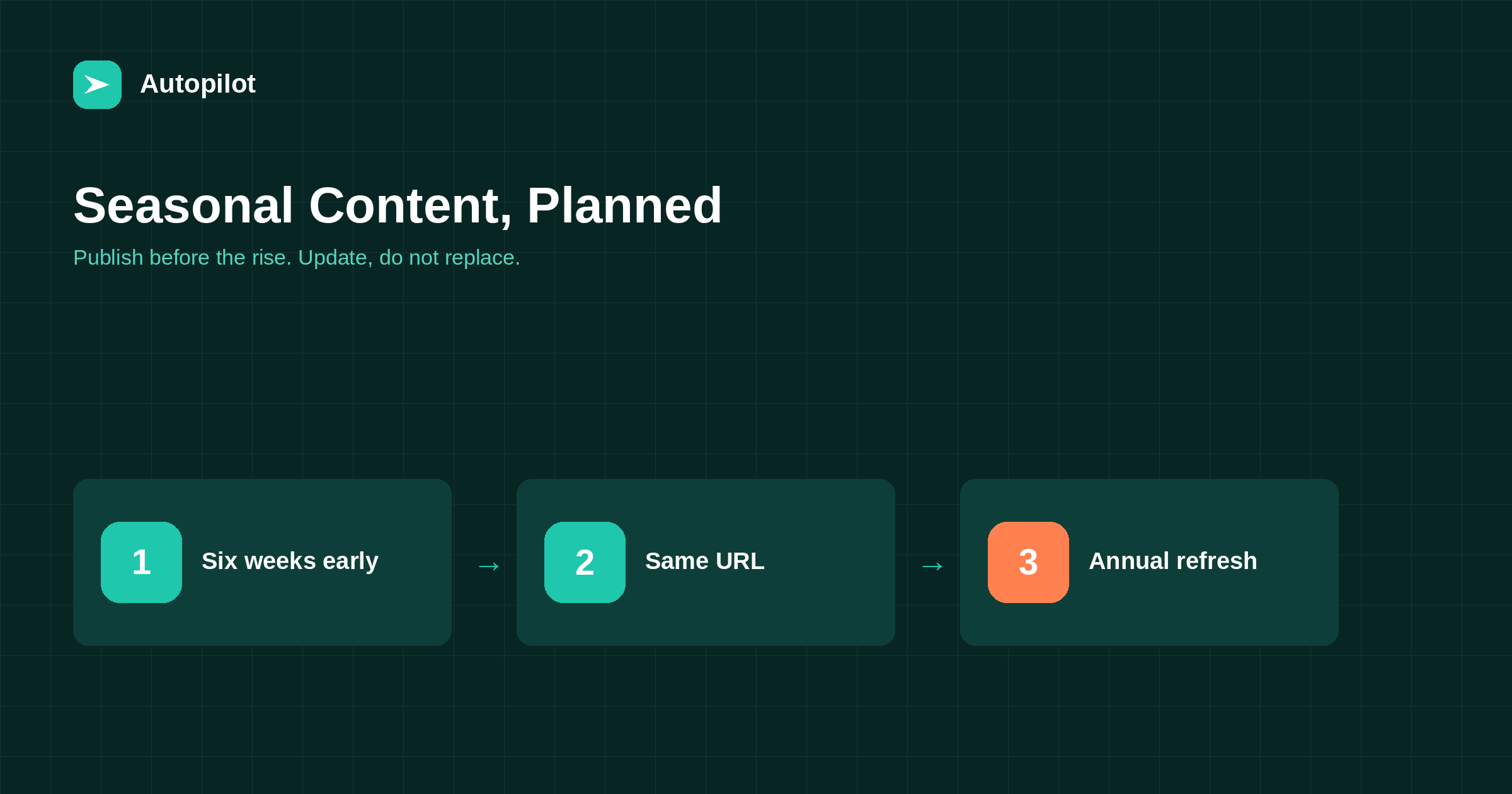
Short answer: list the moments in your customers’ year when their questions change — deadlines, holidays, budget cycles, busy seasons — and publish an article for each several weeks before demand starts to rise, because new pages take time to be found. Keep each seasonal article at the same URL every year, without the year in the slug, and update it rather than writing a new one. The page then accumulates history and links each season instead of starting from zero.
Seasonal content is the most predictable content a business can publish. You know exactly when customers will ask about year-end deadlines, holiday preparation or annual planning, because they ask at the same time every year.
Yet most blogs publish these articles late, in a rush, as new posts with the year in the title — and then do it again the following year from scratch.
Find your seasons
Every business has moments when customers’ questions change. Some are universal; many are specific to the industry.
- Regulatory and tax deadlines that affect your customers.
- Budget and planning cycles — the end of the financial year, annual planning periods.
- Holidays and events relevant to your market.
- Busy and quiet seasons in your customers’ own businesses.
Your own data shows them: look at when enquiries, support tickets or sales rise and fall over a year. Search Console shows the same pattern for queries once you have a year of history.
Publish before demand rises
A new page takes weeks to be discovered, indexed and settled — how long a new post takes to rank explains why. An article published the week demand peaks has missed most of the season.
Aim to publish six to eight weeks before the rise. For an existing seasonal article, the annual update should happen on the same schedule, so the refreshed version is indexed before people start searching.
One URL, updated every year
The most common seasonal mistake is writing a new article each year: year-end checklist 2025, then year-end checklist 2026, each at its own address.
Each new URL starts from zero, while last year’s version, with its links and history, sits outdated. They also compete with each other for the same query.
Instead, keep one URL without the year — year-end-checklist — and update it each season. The title can carry the year if searchers expect it; the slug should not, for the reasons in writing URL slugs. The page then builds on itself every year.
What the annual update involves
An update is usually quick, because the structure stays the same.
| Check | Typical change |
|---|---|
| Dates and deadlines | New year’s dates |
| Rules and thresholds | Any change since last year |
| Prices and product details | Current figures or a link to the live page |
| Screenshots | Replace if interfaces changed |
| FAQ | Add questions customers asked last season |
| Title and description | Update the year if the title carries it |
Add what you learned last season: the question customers kept asking, the mistake several of them made. That addition is what makes the page better every year rather than merely current.
A seasonal calendar
Put the seasons into a simple yearly calendar with two dates for each: when to update or publish, and when demand peaks.
It takes an hour to build once and removes the annual scramble. When topics are planned a month at a time, as in planning a month of articles, the seasonal items slot in automatically six to eight weeks ahead.
Keep the calendar with the list of articles each season relates to, so the update is a matter of opening a known page rather than searching the blog.
Supporting articles around the season
A single seasonal article can anchor several related ones: a checklist, a guide to one tricky step, a common mistakes piece. Linked together, they form a small cluster that serves the whole season.
These supporting pieces are often evergreen in themselves — how to handle one part of the process — and only the anchor needs yearly dates. The approach is the same as in clusters and pillar pages, on a smaller scale.
Measuring a season
After each season, look at how the article performed while the details are fresh.
In Search Console, compare the article’s impressions and clicks across the season with the same period last year. Note when demand actually started rising — it often begins earlier than expected — and adjust next year’s update date accordingly. Record which questions customers asked that the article did not answer, and add them to the FAQ for next time.
Ten minutes of notes after each season is what turns a seasonal article from a recurring chore into a page that improves every year.
Promoting seasonal content
Seasonal articles benefit more than most from active distribution, because timing matters.
Share the updated article when demand starts rising, again closer to the peak, and include it in any newsletter that goes out in the period. Resharing is appropriate here in a way it is not for most articles, because the audience genuinely needs a reminder — automatic sharing to social media covers automating it.
Seasonal traffic can be substantial, but no timing guarantees it; publishing early simply gives the article the best chance to be found when it is needed.
Related reading
If this was useful, these cover the questions that usually come next.
- Evergreen against news content — where seasonal content fits
- Planning a month of articles — fitting seasonal pieces into the plan
- Writing URL slugs — why the slug should not contain the year
The bottom line
Map the moments when your customers’ questions change, publish or update six to eight weeks before each, and keep every seasonal article at one URL without the year in the slug. Update dates, rules and specifics each year, add what last season taught you, and support the anchor article with a few evergreen pieces around it.
FAQ
When should I publish seasonal content?
Six to eight weeks before demand rises. New and updated pages need time to be discovered and indexed before people start searching.
Should I create a new article each year?
No. Keep one URL and update it each season. A new article each year starts from zero and competes with the old one.
Should the year be in the URL?
No. Keep the slug year-free so the same address can be updated indefinitely. The title can include the year if searchers expect it.
How do I find my seasonal topics?
Look at when enquiries, support tickets and sales rise and fall over a year, and at seasonal patterns in Search Console queries once you have a year of data.
What should an annual update include?
New dates and deadlines, rule or price changes, current screenshots, new FAQ questions from last season, and anything you learned from customers during it.
Is it acceptable to reshare seasonal articles?
Yes. Timing matters for these, and a reminder as demand rises and again near the peak is useful to followers rather than repetitive.