ENEnglish
 LTLietuviškai
 DEDeutsch
 FRFrançais
 RUРусский
 ESEspañol
 PLPolski
 ITItaliano
 UKУкраїнська
 CSČeština
 PTPortuguês
 JA日本語
 LVLatviešu valoda
 ETEesti
 HUMagyar
 IDBahasa Indonesia
 TRTürkçe
 HIहिन्दी
 ELΕλληνικά
 ARالعربية
 THไทย
 VITiếng Việt
 RORomână
 MSBahasa Melayu
 BNবাংলা
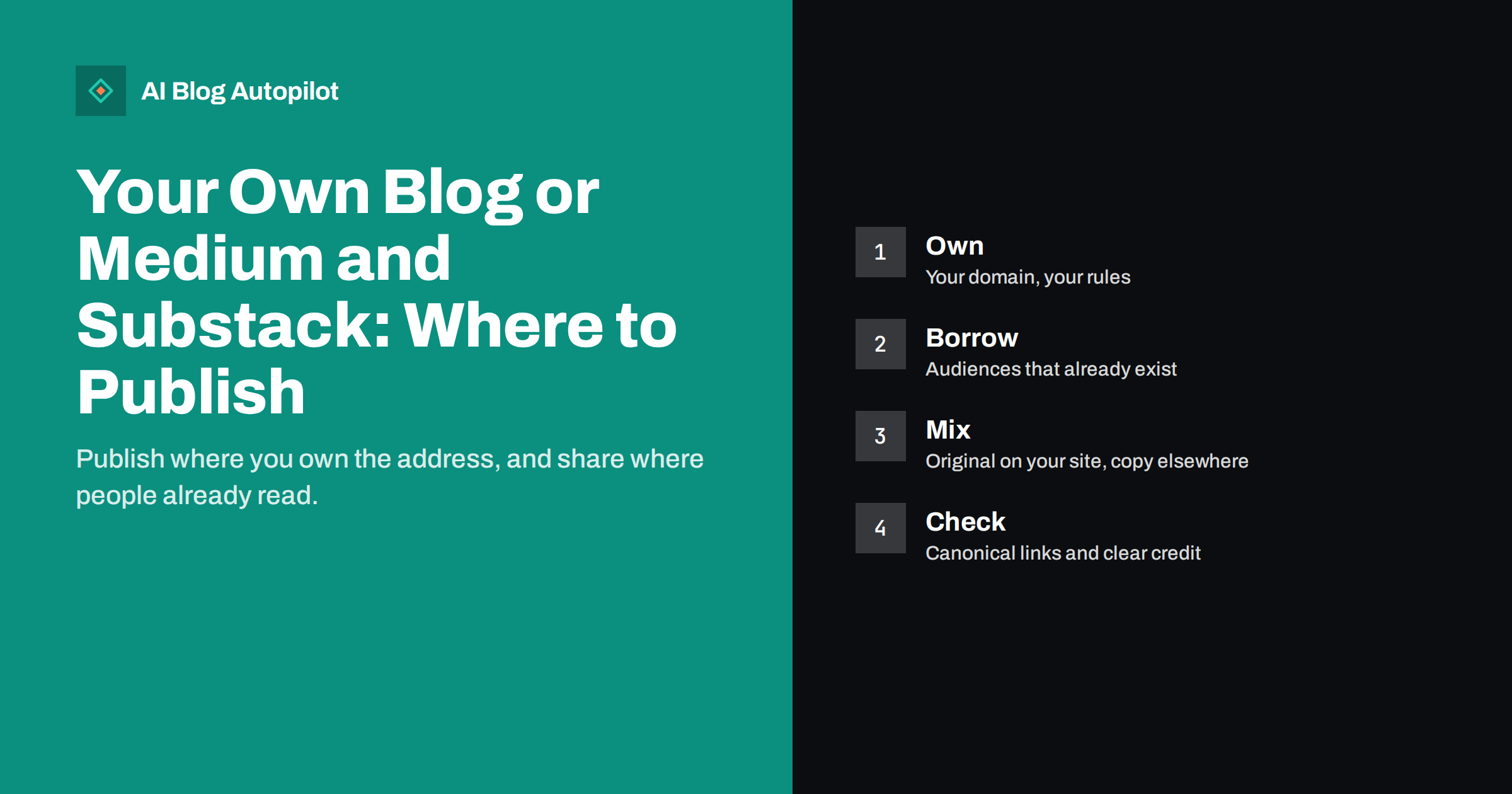
Short answer: for a business, the main home for articles should be its own website, because it owns the address, the design, the data and the long-term search value. Publishing platforms such as Medium and Substack can add reach, newsletters and a ready audience, but they are better used as secondary channels that point back to your own pages. Publish the original on your site first, then adapt or republish elsewhere with a canonical link and clear credit.
The choice is rarely all or nothing. A business needs a place that it controls, and it benefits from places where readers already gather. The question is how to divide the work so that the effort of writing builds an asset you keep. Platforms change their rules, algorithms and fees, while your own domain stays yours as long as you keep it. That difference matters more each year a blog runs.
What you own on your own blog
On your own domain you control the address, the layout, the navigation, the internal links and the way each page is structured. Every article adds to the authority of that single site. You choose the analytics, the sign-up forms, the products you link to and the tone of the surrounding pages. If you change platform, you can move the content and redirect the old addresses, which our guide to migrating a blog without losing its traffic explains in detail.
The cost is effort. You need to set up hosting, security, backups, design and updates, and you start with no audience. Search traffic takes time to build, and a new domain begins with little authority. That is the main reason people are tempted by platforms with built-in readers. The question is whether the early convenience justifies giving up long-term ownership, and for most businesses the answer is that it does not, as long as the site is promoted well.
What publishing platforms offer
Platforms provide simple writing tools, a clean reading experience, built-in sharing and, in some cases, an existing readership and recommendation features. Newsletter-focused services add subscriber management and sometimes paid subscriptions. For a person or business with no website, they can be a fast way to start. They suit thought-leadership essays, personal stories and writing aimed at a broad community more than product or service pages.
The trade-offs are control and dependence. The platform decides how pages look, which links are allowed, how readers are shown your work and what happens to your account. Terms, fees and discovery features can change at any time. Your articles sit under the platform’s domain, so the search authority they earn mostly benefits the platform rather than your own site. Read the current terms before you invest, and check how export works.
Cost is the other practical difference. A site needs a domain, hosting and some upkeep, and a platform may be free at the start but charge a share of subscription income or fees for features you want later. Compare the real totals over two or three years, including your own time. For many small businesses, the annual cost of a well-run site is modest next to the cost of rebuilding an audience that depended on someone else’s rules.
How search treats the two
Articles on large platforms can rank, because those domains are well established, but you cannot count on it, and the benefit goes to the platform’s domain. An article on your own site builds the authority of the domain that sells your product or service. Over months, the same effort adds up to stronger rankings for the pages that matter to your business. Our article on where a blog should live on your domain explains how structure affects that authority.
Duplicate content is the other issue. If the same article appears on your site and a platform, search engines pick one version to show. You can influence the choice by publishing on your own site first and using a canonical link or a clear link back from the copy. Our guide to content syndication without SEO harm describes the routine in detail. Do not copy whole articles to several places on the same day without a plan.
Think about the type of reader you want. A platform’s readers often browse for general interest and may not be looking for what you sell. Visitors from search on your own site arrive with a particular question and a clearer intent, which usually converts better for a business. A mix of both can work, but judge each by what it brings to the business rather than by how many people see a post.
Audience, email and relationships
An email list is an asset that you can take with you. Newsletter platforms make it easy to start, but check that you can export your subscriber list in a standard format, and that you have collected consent in a way that you can document. If you build a list on your own site, you control the forms, the wording and the data, which helps with privacy rules. Our article on building a newsletter from your blog posts shows a simple setup.
Audiences on platforms are borrowed. They follow the writer on that platform, not necessarily the business. If you want those readers to become customers, you need a clear path from the platform to your own website, such as a link in the profile, a mention at the end of each piece and an offer that is worth a visit. Without that path, a large number of followers can produce few customers.
Control, branding and risk
On your own site, you choose the brand voice, the design and the tone of surrounding content. On a platform, your work appears within someone else’s design, next to other publishers’ articles and sometimes advertising. That can be fine for a thought piece, but it dilutes a brand that wants to look professional and consistent. There is also account risk: platforms can suspend accounts, change policies on topics or links, or close.
Keep a backup of everything you publish elsewhere, and keep the original text on your own site. Store images, headlines and publication dates in a simple archive. If a platform changes or disappears, you will be able to restore the content and keep the audience you built through your own channels.
Keep a simple record of what you publish where. A short table with the title, the date on your site, the date on each platform, the address and the canonical setting prevents mistakes, such as publishing a copy before the original or forgetting to link back. Review it every quarter, and look at which copies actually sent readers to your site. If a platform brings no visits after six months of steady posting, stop spending time there and put the effort into your own channels.
A sensible mix
For most businesses, a good pattern looks like this. Publish the full article on your own site first, with the best title, structure and internal links. A few days later, share a shortened or adapted version on a platform where your audience reads, with a link back to the original and a note that it first appeared on your site. Use the newsletter service or your own mailing tool to send a summary to subscribers. Keep the process light and repeatable, and measure results by visits and enquiries rather than follower counts.
Adapt each version to the audience. A platform article may have a different title and introduction, fewer internal links and a different call to action, while the substance remains the same. Do not post identical text everywhere, and always credit the original clearly. If a platform does not allow a canonical link, rewrite enough of the piece to make it a distinct summary.
Pay attention to timing as well. Wait a few days before posting the adapted version, so that search engines find the original first. Use the delay to improve the platform version based on how readers responded to the first one. Questions in comments, social replies or emails often show which parts of the article were unclear, and the adapted version can fix them. This gives the second version a real reason to exist, not just a second copy of the same text.
When a platform alone can make sense
There are cases where publishing only on a platform is reasonable: an individual testing whether a topic has an audience, a writer whose product is the newsletter itself, or a project with no budget for a site. Even then, buy your own domain early, point it to the profile where possible and keep a copy of the content. If the project grows, you will be able to move to your own site without starting from zero.
How AI Blog Autopilot helps
AI Blog Autopilot writes full SEO articles for your WordPress blog from the topics, keywords, audience and tone you set, with FAQ sections, tags and SEO meta included, and it shares each one to your social networks. That keeps your own site as the original home of each article, while social posts bring readers from the places where they already spend time. Approval mode lets you read each article before it goes live, and you can adapt a version for a platform of your choice yourself. See the pricing page for plans.
Related reading
- Content Syndication: Republishing Posts Without SEO Harm
- Subdomain or Subfolder: Where Should Your Blog Live?
- Building a Newsletter From Your Blog Posts
- WordPress or Another Platform for a Business Blog?
The bottom line
Own the original, borrow the audience. Publish each article on your own site first, then share adapted versions on platforms with a clear link back, keep your email list portable and back up everything. A mix like that gives you the reach of other platforms and the lasting value of an address that is yours.
FAQ
Is Medium or Substack better than my own blog?
For a business, usually not as the main home. They can add reach and newsletters, but your own site keeps the address, the data and the search authority.
Can I republish my articles on another platform?
Yes, if you publish on your own site first, credit the original clearly and use a canonical link where the platform allows it.
Will duplicate content get me penalised?
Search engines usually pick one version to show rather than penalise. You can guide the choice by publishing first on your own site and linking back from copies.
Can I take my subscribers with me if I leave a platform?
Check before you start that you can export the list in a standard format, and keep records of how consent was collected.
Should a new business start on a platform because it has readers?
It can help test ideas, but register your own domain early, keep copies of everything and build the path from the platform to your own site.