ENEnglish
 LTLietuviškai
 DEDeutsch
 FRFrançais
 RUРусский
 ESEspañol
 PLPolski
 ITItaliano
 UKУкраїнська
 CSČeština
 PTPortuguês
 JA日本語
JA日本語 LVLatviešu valoda
 ETEesti
 HUMagyar
 IDBahasa Indonesia
 TRTürkçe
 HIहिन्दी
 ELΕλληνικά
 ARالعربية
 THไทย
THไทย VITiếng Việt
 RORomână
 MSBahasa Melayu
 BNবাংলা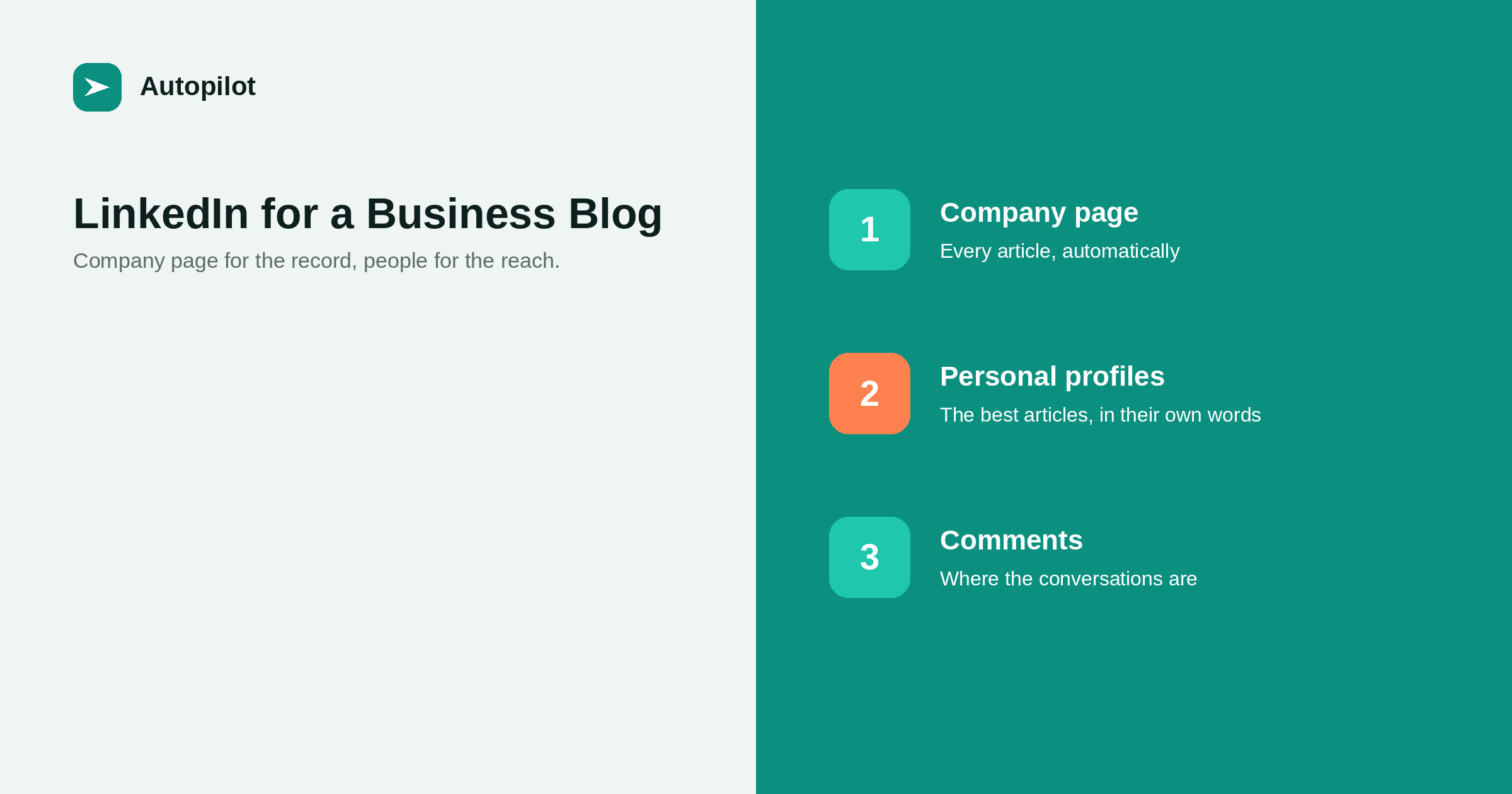
Short answer: post every new article to your company page, automatically, so the page is an up-to-date record. For reach, rely on people: employees and founders sharing your best articles in their own words, with their own view, usually reaches far more of the right people than the company page does. Lead each post with one useful idea rather than the title, keep links in context, reply to comments, and do not ask colleagues to share every article or to post identical text.
For a business selling to other businesses, LinkedIn is frequently where articles meet the people who make buying decisions. It is also where company pages post into a void while individual people reach thousands.
Using it well means understanding that difference and building a routine around it.
Company page and personal profiles do different jobs
A company page is the official record. It should carry every article, consistently, so anyone who visits sees an active business. Its organic reach is usually modest.
Personal profiles — founders, specialists, sales staff — reach their own networks, which are often exactly the people a business wants to reach. A thoughtful post from a person typically travels much further than the same article from the company page.
So the routine has two parts: automate the company page, and help people share selectively in their own words.
Automating the company page
Posting each new article to the company page is routine work: the link, the featured image, an opening line. It automates well and should not depend on someone remembering.
AI Blog Autopilot shares each new article to the social networks you connect, automatically. Whatever you use, check that the preview card shows the right image and title, which depends on the article’s featured image and meta tags — featured images for automated posts covers the image.
Helping people share
Colleagues will share articles that make them look knowledgeable to their network. They will not share a corporate announcement, and they should not be asked to share everything.
Pick one or two articles a month that fit a particular person’s expertise. Send them the article with two or three ideas from it they might comment on, and let them write the post themselves, with their own view. A founder adding a sentence on why the subject matters to them is more persuasive than any copy you could supply.
Never hand out identical text for everyone to paste. It is obvious, and it undermines the people posting it.
Writing a post that gets read
The first two lines are what show before the see more fold, and they decide whether anyone reads on.
| Element | Guidance |
|---|---|
| Opening line | One useful statement from the article |
| Body | Two to five short paragraphs expanding it |
| The writer’s view | One sentence on why it matters to them |
| Link | In context, as the way to read more |
| Length | Short enough to read on a phone in a minute |
The same principles as any social post apply — turning an article into social posts — with more room for professional context and a personal view.
What to share and what not to
The articles that do best with business audiences tend to be practical and specific: how to handle a particular decision, what something really costs, a mistake businesses commonly make, a table comparing options.
Original material does especially well: a number from your own work, a customer situation, a reasoned disagreement with common advice — see adding something original. Generic explainers of basic terms rarely travel, because the audience already knows them.
Comments are the channel
Much of LinkedIn’s value lies in comments rather than posts. A thoughtful comment on someone else’s post, from a person with relevant expertise, is seen by that post’s whole audience.
When a discussion touches a subject you have written about, a substantive comment that adds a point — and mentions the article only if it genuinely adds more — builds credibility. Replying to comments on your own posts matters too; it keeps the discussion going and shows there is a real person behind the account.
Newsletters and articles on the platform
LinkedIn also lets people publish articles and newsletters directly on the platform. It is tempting to republish blog posts there in full.
A short summary with the key point and a link back usually serves a business better. The full article on your own site is where readers can find related articles, contact you and subscribe, and it is the version that builds your site’s visibility over time. If you do republish in full, wait until the original is indexed, and say clearly where it was first published, so the two do not compete — the issue covered in duplicate content.
Measuring it
LinkedIn shows impressions and engagement for posts, and your analytics shows visits from LinkedIn to each article.
For a business blog, the more meaningful signals are enquiries that mention LinkedIn, connection requests from relevant people, and comments that turn into conversations. Record these alongside the other measures in measuring whether a blog is working.
Reach on LinkedIn changes as the platform adjusts how it shows posts, and no approach guarantees it. What reliably helps is useful content shared by real people with something to say about it.
A monthly rhythm
Every new article goes to the company page automatically. Once or twice a month, one strong article goes to one or two colleagues whose expertise it fits, with a few suggested ideas. Someone spends a few minutes a day on comments, both on your posts and on relevant discussions elsewhere.
That is a sustainable routine for a small team, and it uses each part of the platform for what it does best.
Related reading
If this was useful, these cover the questions that usually come next.
- Turning an article into social posts — writing the post itself
- Promoting a blog post — the full promotion routine
- Traffic against leads — why business readers matter more than volume
The bottom line
Automate every article to the company page as a record. For reach, ask one or two colleagues a month to share an article that fits their expertise, in their own words and with their own view. Lead with one useful idea, keep the link in context, and treat comments as the main channel rather than an afterthought.
FAQ
Should a business post every blog article on LinkedIn?
On the company page, yes, ideally automatically. Personal profiles should share selectively, one or two articles a month that fit the person’s expertise.
Why do company page posts get so little reach?
Company pages typically reach fewer people organically than individual profiles. Posts from real people with relevant expertise usually travel much further.
Should employees post the same text?
No. Identical posts are obvious and undermine the people posting them. Give them the article and a few ideas, and let them write in their own words.
What kind of articles work best on LinkedIn?
Practical, specific articles with a clear point: costs, decisions, common mistakes, comparisons, and especially original material from your own work.
Where should the link go in a LinkedIn post?
In context, as the way to read more after the post has given something useful. The opening lines should stand on their own.
Can LinkedIn posting be automated?
Company page posting can be. Personal posts and comments should be written by the people themselves; that is where their value comes from.