ENEnglish
 LTLietuviškai
 DEDeutsch
 FRFrançais
 RUРусский
 ESEspañol
 PLPolski
 ITItaliano
 UKУкраїнська
 CSČeština
 PTPortuguês
 JA日本語
 LVLatviešu valoda
 ETEesti
 HUMagyar
 IDBahasa Indonesia
 TRTürkçe
 HIहिन्दी
 ELΕλληνικά
 ARالعربية
 THไทย
 VITiếng Việt
 RORomână
 MSBahasa Melayu
 BNবাংলা
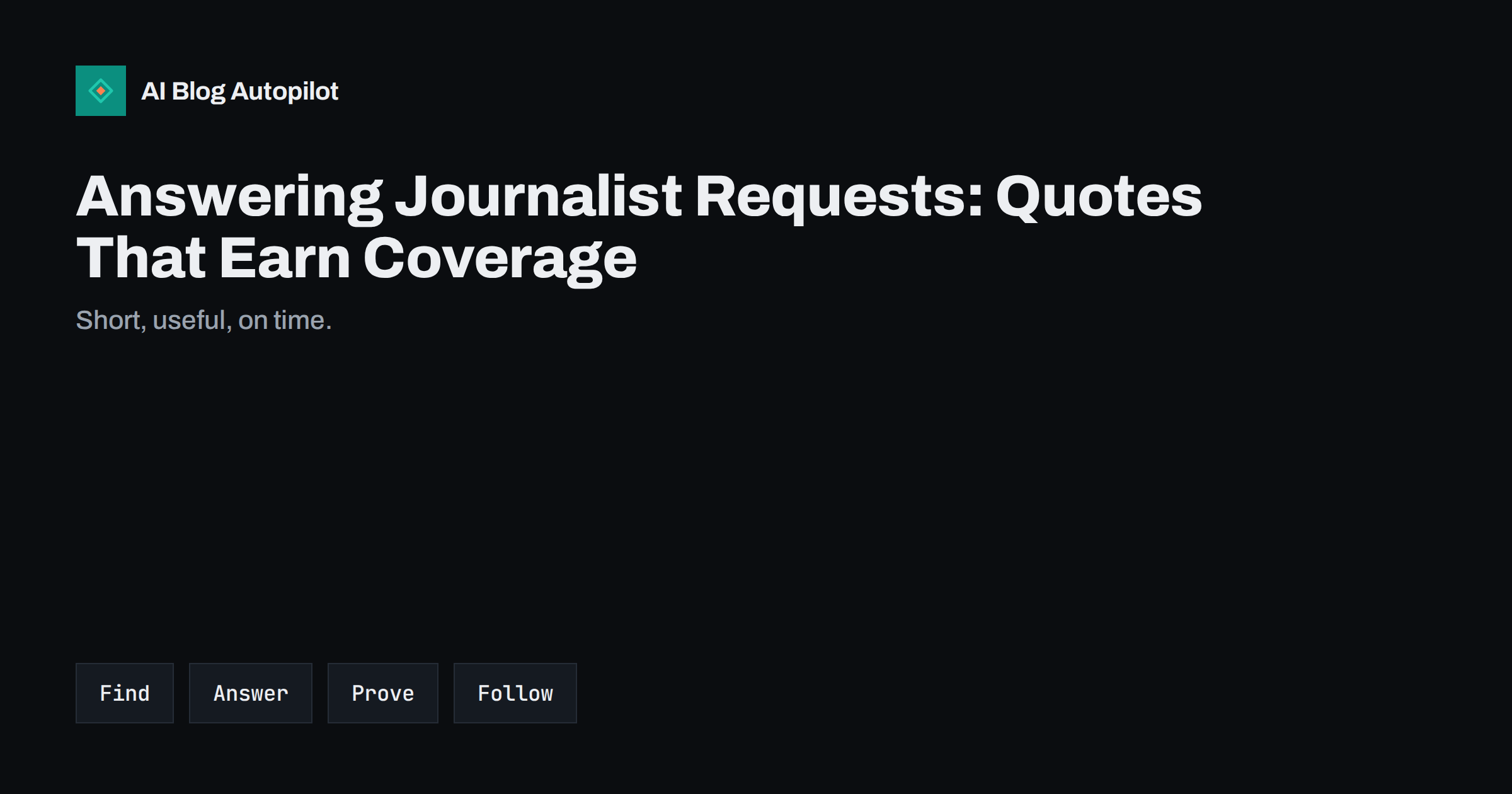
Short answer: to earn coverage by answering journalist requests, respond only to requests that match your real expertise, reply quickly with a short, specific, quotable answer, include a line on who you are and why you can speak on the subject, offer data or an example if you have one and never pressure a reporter to link. Keep a record of what you send and reuse good answers on your own blog.
Journalists, bloggers and editors regularly need an expert voice: a comment on a trend, a plain explanation of a technical point, a real example from a small business. They work to deadlines, often within hours, and many look for sources through public requests, social posts and email lists. Experts who answer well can earn mentions, links and recognition that advertising cannot buy.
This guide explains how to find requests that suit you, how to write answers that get used, how to prove your expertise without boasting and how to follow up politely. It is written for small business owners, consultants and bloggers who do not have a press office, and it avoids shortcuts that risk your reputation.
Decide what you can speak about
Start by listing the topics where you have real experience: what you do every day, what you have measured and what customers ask you. Journalists value first-hand knowledge, so a plumber on frozen pipes or an accountant on late filing penalties is more useful than a general commentator. Keep the list to a handful of subjects.
Write a short profile that you can paste into any reply: your name, your role, your business, years of experience, one or two credentials and a link to a page about you. Make it three lines at most. A reporter should understand within seconds why you are qualified and how to describe you in print.
Decide your limits. Think about which topics you will not comment on, such as legal, medical or financial advice outside your qualifications, and which facts you cannot share. Declining a request politely is better than a weak answer that misleads, and reporters remember sources who are honest about their limits.
Prepare a page on your own site that confirms who you are: an about page with photographs, a biography, links to your profiles and a list of previous mentions. Journalists check, and a clear, current page makes it easy to trust you. The guide on a press page for a small business explains what to include.
Find requests that fit
Requests appear in several places: services that connect reporters with experts, public posts by journalists on social networks, newsletters from industry bodies and direct messages from people who know your work. Choose one or two channels and check them at set times, instead of watching all day. A few well-chosen answers beat dozens of rushed ones.
Read each request fully. Note the deadline, the topic, the format that is wanted, the publication and any requirements, such as a location or a minimum experience. If the request asks for a case study from a company of a certain size, and you do not fit, move on. Reporters are quickly irritated by answers that ignore the brief.
Judge the value. A mention in a small niche site that your customers read may be worth more than a general publication with a vague audience. Check that the outlet is real, that the journalist has a record of published work and that the request does not look like an advertisement or an attempt to collect free content for a link scheme.
Be wary of anything that asks for payment to appear, requests personal data or looks like a scam. Genuine reporters do not charge sources. If something feels wrong, check the publication directly through its own website before replying.
Write an answer that gets used
Answer the question that was asked, in the first sentence. Journalists scan dozens of replies, and an answer that begins with the point has the best chance of being read. Then add a reason or an example in two or three sentences, and stop. Long essays are rarely used and often ignored.
Be specific. A general statement such as customers want better service is not quotable. A sentence such as in our shop, most returns come from the wrong size, so we added a measuring guide and cut returns by a third is clear and checkable, provided it is true. Use real numbers, with the period they cover, and do not exaggerate.
Write quotes in a natural voice. Imagine your sentence printed between quotation marks, and read it aloud. Avoid jargon, sales language and superlatives. A reporter will prefer a plain sentence they can use unchanged, and sometimes will quote your whole reply if it is clean.
Offer more without overloading. You can say that you have data, photographs or a case example if they are needed, and give a way to reach you quickly by phone. Do not attach large files without being asked. Put the key words in the body of the email, not in an attachment.
Prove expertise without boasting
Credentials help, but evidence helps more. Mention how long you have done the work, how many customers or cases you have handled, any qualification that is relevant and a link to something you have published on the subject. A reporter who can verify your claims in a minute is more likely to use you.
Give honest context. Say whether your numbers come from your own business or from a wider study, and say how large the sample is. Mixing small personal observations with general statements can mislead readers. If a figure comes from elsewhere, name the source and link to it. The guide on using evidence in marketing content shows how to keep every claim backed up.
Publish original material that reporters can find. A short report from your own data, a survey of customers or a clear explanation of a regulation on your blog gives journalists a reason to contact you before they ever send a request. The guide on original research posts explains how to start with a small sample.
Keep your public profiles consistent. The name, photograph, job title and business name should match across your site, your social profiles and your replies. Mismatches look careless, and search engines and assistants use the same signals to decide whether a person is a reliable source.
Think about timing. A reporter on a daily deadline may need your answer within an hour, while a feature writer may allow a week. Set aside a short slot each day for requests, and tell your team that a fast, accurate reply is worth more than a polished one that arrives too late. If you are away, say so in your profile or arrange for a colleague to cover.
Keep your replies tidy: a clear subject line that repeats the topic of the request, no attachments unless asked and a signature that gives your phone number and your site. Small courtesies like these make it easy for a busy person to include you, and they show that you respect their work.
Follow up with courtesy
If the journalist uses your answer, send a short thank you. Do not ask for a link; if the outlet links, it will do so, and if it does not, a request seldom helps. A friendly note keeps the door open for the next request, and journalists often keep a list of helpful sources.
If you do not hear back, let it go. Reporters receive many replies and use few. A single polite follow-up for a request with a long deadline is acceptable, but chasing someone repeatedly damages your standing. Move on and answer the next request that fits.
When a piece is published, read it and check the details. If there is a factual mistake about you or your business, send a calm, short note with the correction and the source. Most outlets will fix errors, and a courteous tone is more effective than a complaint.
Share the coverage honestly. Post it on your channels, add it to your press page and mention it in your newsletter, giving credit to the outlet and the journalist. Do not exaggerate by claiming that you were featured in a publication when you were one of several quoted sources.
Respect confidentiality and fairness. If you are asked to comment on a competitor, a customer or an incident, stay factual and avoid personal remarks. Never share private details about customers without consent, and be careful with anything that could be read as an attack. A good source is known for accuracy and calm, not for spicy comments.
Track results and reuse your answers
Keep a simple log: date, outlet, journalist, topic, what you sent, whether it was used and whether a link appeared. After a few months, you will see which topics and channels work for you. This record also prevents you from sending contradictory statements to different people.
Reuse your best answers. A good reply to a journalist is already a short article, and it can become a section of a blog post, a social post or a question and answer on your site. Check that you may reuse any material the journalist sent you, and do not republish their words without permission.
Consider the value of links, but keep perspective. A link from a respected outlet can help your visibility, but the larger benefits are credibility, referrals and recognition. The guide on digital PR for small blogs explains how mentions and links fit into a long-term plan, and unlinked brand mentions shows how to handle mentions without a link.
Be patient. Most of your answers will not be used, and that is normal. The habit of answering well and quickly, with honest evidence, builds a reputation over time, and one day a reporter will contact you directly because they remember that you were helpful.
How AI Blog Autopilot helps
When a reporter checks you out, your site is the first place they look. AI Blog Autopilot can write and publish articles on your chosen topics, with FAQ sections, tags and SEO meta, and share them to your social networks, so that your expertise is visible and current. See the pricing page for plans and monthly credits.
Related reading
The bottom line
Answer only the requests you can truly help with, reply fast with a short, specific quote and a clear line on who you are, and follow up with courtesy.
FAQ
How do I find journalist requests?
Use one or two channels, such as expert-matching services, journalists’ public posts and industry newsletters, and check them at set times.
How long should an answer be?
A direct answer in the first sentence, then two or three sentences of reason or example, and a short line about who you are.
Should I ask for a link?
No. If the outlet links, it will do so, and asking can harm the relationship. A friendly thank you is better.
What if the journalist makes a mistake?
Send a short, calm correction with the source. Most outlets fix factual errors when asked politely.
Do I need a press page?
It helps. A page with your biography, photographs and past mentions lets reporters verify you quickly.