ENEnglish
 LTLietuviškai
 DEDeutsch
 FRFrançais
 RUРусский
 ESEspañol
 PLPolski
 ITItaliano
 UKУкраїнська
 CSČeština
 PTPortuguês
 JA日本語
JA日本語 LVLatviešu valoda
 ETEesti
 HUMagyar
 IDBahasa Indonesia
 TRTürkçe
 HIहिन्दी
 ELΕλληνικά
 ARالعربية
 THไทย
THไทย VITiếng Việt
 RORomână
 MSBahasa Melayu
 BNবাংলা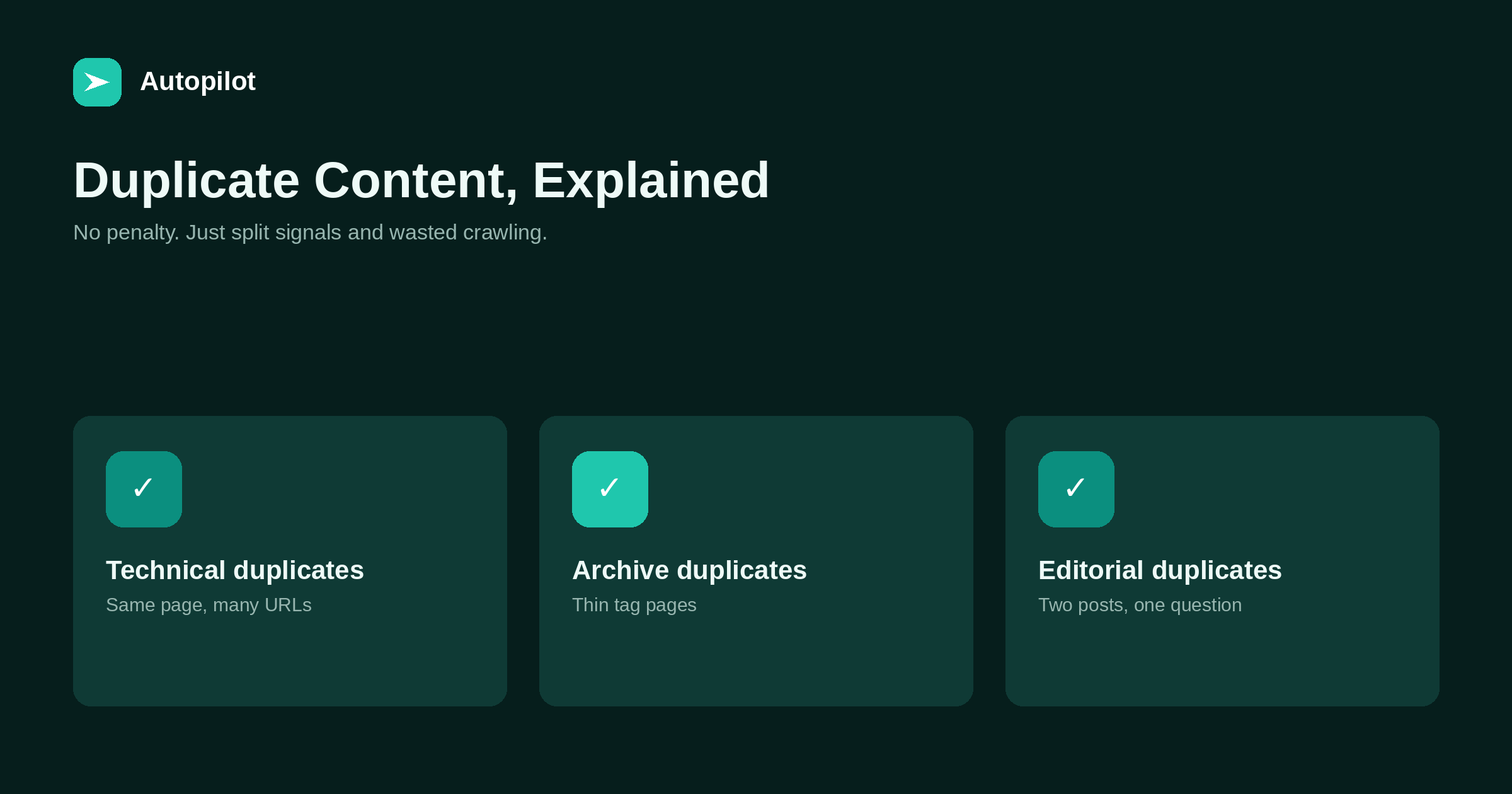
Short answer: for ordinary sites there is no penalty for duplicate content. What happens instead is that when several URLs carry the same or very similar content, search engines pick one to show and the others are filtered out, splitting links and signals between them and wasting crawling. On a typical blog the causes are URL variants of the same page, thin tag and date archives, syndicated or copied posts, printer and parameter versions, and two articles answering the same question. Technical duplicates are fixed with redirects and canonical tags; editorial ones by merging.
Duplicate content is one of the most feared and least understood subjects in SEO. The fear is of a penalty; the reality is more mundane and, in most cases, easier to fix.
Understanding what actually happens makes the fixes obvious, and it also makes clear which duplicates matter and which can be safely ignored.
What actually happens
When a search engine finds several URLs with the same or nearly the same content, it groups them and chooses one to show in results. The others are filtered out of results for that content.
That is not a penalty. The site is not demoted; the duplicate URLs are simply not shown separately. Manual action for duplication is reserved for deliberate, large-scale copying intended to manipulate results.
The real costs are two. Links and signals are split across versions rather than concentrated on one. And the version chosen may not be the one you wanted — a parameter URL instead of the clean one, or an archive page instead of the article.
The five causes on a typical blog
Most duplication on a blog comes from a short list.
| Cause | Example | Fix |
|---|---|---|
| URL variants | http and https, www and not, trailing slash | One redirect rule per variant |
| Parameters | ?utm_source=, ?replytocom= | Canonical tag to the clean URL |
| Archives | Tag with one post, date archives | Noindex or merge |
| Syndication | Your post republished elsewhere | Canonical on their copy, or a link back |
| Editorial overlap | Two posts answering one question | Merge and redirect |
The first four are technical and mostly handled once, at setup. The fifth is editorial and grows with every article published without a plan.
Technical duplicates: fix once
URL variants should be resolved with permanent redirects so that only one version of each address can be reached: https, one host, one trailing-slash convention. WordPress and most hosts handle much of this, but it is worth checking by typing the variants into a browser.
For parameter URLs, a canonical tag on each page pointing to its clean URL tells search engines which version is the original. SEO plugins add a self-referencing canonical by default. canonical tags covers how they work and where they go wrong.
This is set once in the setup described in setting up a new blog and then rarely needs attention.
Archive duplicates
Tag, category, date and author archives all list posts that exist elsewhere. Some of them are useful pages; many are not.
A tag archive with one post is effectively a duplicate of that post. A date archive duplicates the blog index. An author archive on a single-author blog duplicates the whole blog.
Set noindex on archives that add nothing, merge tiny tags into useful ones, and give the archives you keep a short written description so they are pages in their own right. categories and tags goes through it.
Editorial duplicates: the growing problem
The duplicate that matters most on an active blog is not technical. It is two articles, written months apart, answering the same question.
They are not identical, so no tool flags them as duplicates. But they compete for the same queries, split whatever links each attracts, and search engines may alternate between them. Search Console shows it: filter by the query and see several of your URLs.
The fix is merging: combine the best of both into the stronger URL, redirect the other permanently, and update internal links. deleting, merging or redirecting explains the process, and planning one question per article, as in how many keywords one article should target, prevents it.
Syndication and copying
If your articles are republished elsewhere with permission, ask the other site to add a canonical tag pointing to your original, or at minimum a clear link back. Otherwise their copy may be chosen as the one to show.
If your content is copied without permission, it is usually not worth pursuing unless the copy outranks you. Search engines are generally good at identifying the original. Where a copy does cause harm, a copyright removal request is the route.
The reverse also applies: publishing content copied from elsewhere, even with permission, gives readers and search engines no reason to choose your version.
What you can safely ignore
Several things look like duplication and are not worth worrying about.
Quoting. Short quotations with attribution are normal.
Boilerplate. A shared footer, sidebar or disclaimer on every page is expected.
Similar structure. Articles that follow the same template — a short answer, sections, an FAQ — are not duplicates if their content differs.
Product descriptions in several languages. Translations are separate content, handled with hreflang rather than canonicals.
Related reading
If this was useful, these cover the questions that usually come next.
- Canonical tags — the main tool for technical duplicates
- Deleting, merging or redirecting — the fix for editorial duplicates
- Categories and tags — the fix for archive duplicates
The bottom line
There is no duplicate content penalty for ordinary sites; there is split signal, wasted crawling and the wrong version being shown. Fix URL variants with redirects, parameters with canonical tags, and thin archives with noindex or merging, all once. Then watch for the duplicate that keeps growing: two articles answering one question, fixed by merging.
FAQ
Is there a Google penalty for duplicate content?
Not for ordinary duplication. Search engines choose one version to show and filter out the others. Manual action is reserved for deliberate large-scale copying intended to manipulate results.
What causes duplicate content on a blog?
Usually URL variants such as http and https, tracking parameters, thin tag and date archives, syndicated copies, and two articles that answer the same question.
How do I fix duplicate URLs?
Redirect variants permanently to one version, and use a canonical tag on each page pointing to its clean URL for parameter versions that cannot be redirected.
Are tag pages duplicate content?
Tags with one or two posts effectively duplicate those posts. Noindex or merge them. Tags with several posts and a written description can be useful pages in their own right.
How do I find articles that duplicate each other?
In Search Console, filter the performance report by a query and check the pages tab. Several of your URLs appearing for the same query usually means overlapping articles.
Is republishing my article on another site a problem?
It can be if their copy is chosen instead of yours. Ask them to add a canonical tag pointing to your original, or at least a clear link back to it.