ENEnglish
 LTLietuviškai
 DEDeutsch
 FRFrançais
 RUРусский
 ESEspañol
 PLPolski
 ITItaliano
 UKУкраїнська
 CSČeština
 PTPortuguês
 JA日本語
 LVLatviešu valoda
 ETEesti
 HUMagyar
 IDBahasa Indonesia
 TRTürkçe
 HIहिन्दी
 ELΕλληνικά
 ARالعربية
 THไทย
 VITiếng Việt
 RORomână
 MSBahasa Melayu
 BNবাংলা
Short answer: a giveaway or contest can bring new readers, subscribers and followers to a blog, but it works only when it has a clear goal, a prize that matches your audience, written rules, honest handling of entries and compliance with both the law and each platform’s terms. Rules about prize draws, contests and promotions differ widely between countries and networks, so check the requirements that apply to you, keep the mechanics simple and avoid asking people to do things that platforms forbid. This is general information and not legal advice.
Giveaways are popular because they are easy to explain and they generate quick attention. They are also easy to get wrong. A badly designed prize draw attracts people who only want free things, creates a pile of low-quality entries and can create legal or platform problems for the organiser. This guide walks through the planning, the rules, the platform issues and the follow-up, so that a contest helps the blog instead of becoming a distraction.
Decide what the giveaway is for
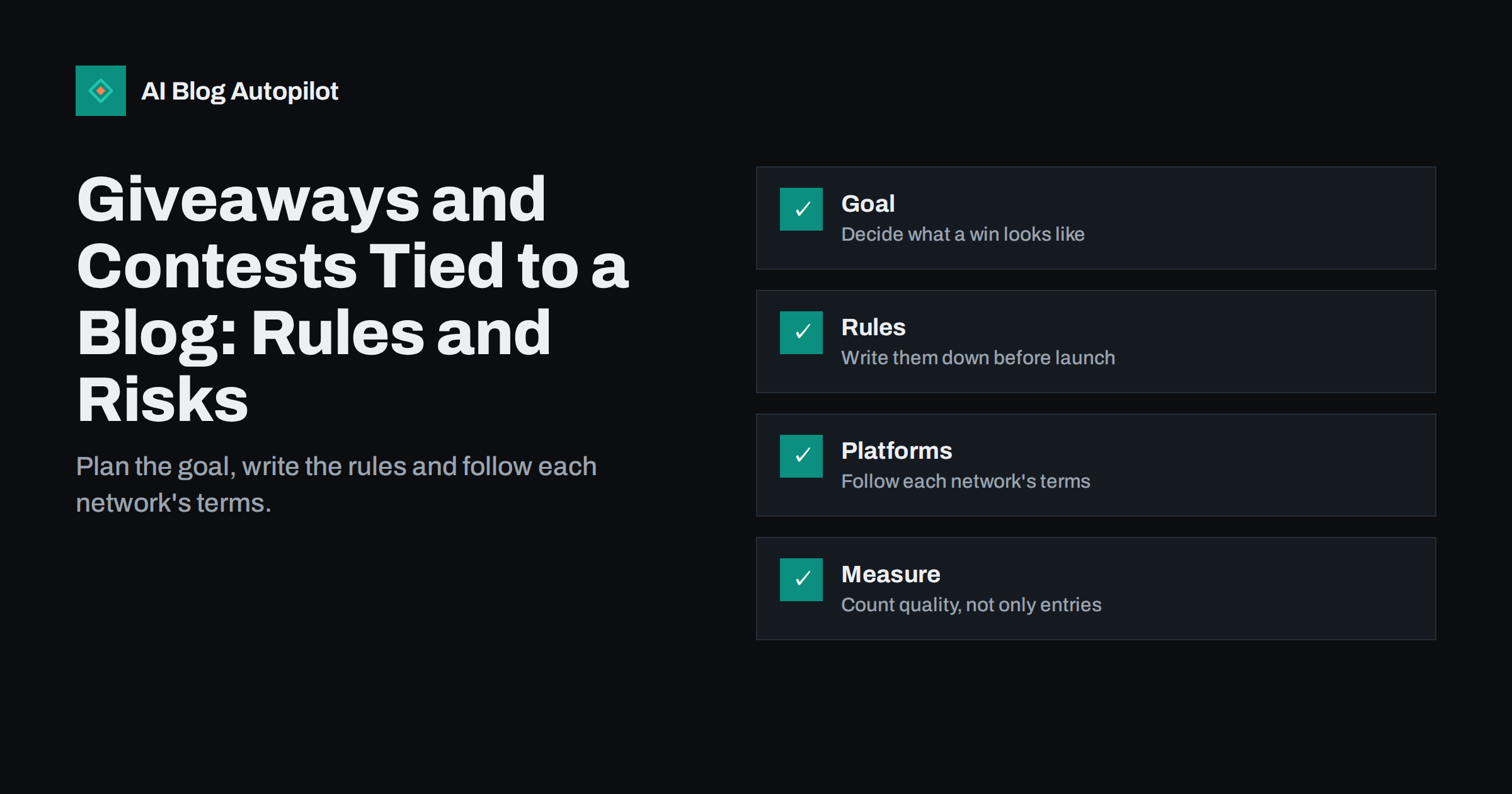
Start with one clear goal. A contest that tries to do everything usually does nothing well. Typical goals include growing an email list, getting readers to try a product, collecting reader-created content or increasing the number of people who follow your account on a particular network.
- Email list growth: ask for a valid email address and a clear opt-in to future messages.
- Content collection: ask readers to share a tip, a photo or a short story related to your topic.
- Product trial or awareness: offer your own product or service as the prize.
- Community and feedback: ask a question or run a vote related to your subject.
Pick the single action you want, and design everything around it. If the goal is subscribers, do not also ask for follows, shares, comments and tags, because every extra step reduces participation and muddles your results.
Choose a prize that attracts the right people
The prize determines who enters. A generic prize, such as cash or the latest phone, attracts everybody, including people who have no interest in your blog and who will unsubscribe or stop following the day after the draw. A prize related to your topic attracts people who may become real readers and customers.
- Offer something your audience would actually value, such as a product, a consultation, a course, a book or a service connected to your subject.
- Make sure you can deliver it, and budget for shipping, taxes and handling.
- Describe the prize accurately, with its value only if you can verify it.
- Do not promise anything you cannot guarantee, such as results.
- If you partner with another business, agree in writing who provides and ships the prize.
Keep the prize modest relative to your budget, and remember that tax or reporting rules may apply to prizes in some countries. Decide in advance what happens if the winner cannot be reached or lives where you cannot ship, and write that into the rules, so that you do not have to improvise later.
Write clear rules before you launch
Written rules protect both you and the participants. They should be easy to find, easy to read and published before the contest opens. Do not change them after entries begin, except to correct an error and with clear notice.
- Who may enter: age, country or region, and any exclusions such as employees and their families.
- How to enter: the single action, and the start and end dates and times with a time zone.
- The prize: what it is, how many there are and whether it can be exchanged.
- How the winner is chosen: random draw, judging by criteria or a vote, and who decides.
- How the winner is told: by what method and how long they have to respond before another winner is chosen.
- Data use: what you collect, why, how long you keep it and where your privacy notice is.
- Who runs it: your business name and contact details.
- Platform disclaimer: if the contest is on a social network, state that it is not run, sponsored or endorsed by that network.
Some countries regulate prize draws, lotteries and skill contests differently, and some require registration, a bond or a specific wording. A contest that requires a purchase to enter, or where winners are chosen by chance, can fall under stricter rules. If you are not sure, ask a lawyer who knows local promotion law before you launch.
Follow each platform’s terms
Every social network has its own rules for promotions, and the rules change. Some forbid certain mechanics, such as requiring people to tag friends who have not agreed, to share a post to a personal profile or to post unrelated content. Some require you to take responsibility for the contest and to release the platform from any liability. Others restrict the use of their features, for example likes, votes or stories, as entry methods.
- Read the current promotion guidelines of each network where you run the contest.
- Do not ask for actions that the platform bans, even if other accounts do.
- Avoid mechanics that encourage spam, such as mass tagging.
- Keep the official entry point on your own website if you can, and use social posts to point to it.
- Keep records of the posts and the rules, in case you need to answer a complaint.
A contest hosted on your blog, with a simple form, gives you more control than one that depends on a platform’s features, and it makes it easier to collect consent properly.
Handle entries, data and consent properly
A giveaway collects personal data, so privacy rules apply. Collect only what you need to run the contest and to contact the winner. If you want to add entrants to a newsletter, ask for separate, clear consent with an unticked box, and do not make it a condition of entering unless the law in your country allows it. Explain how you will use the data, and keep it only as long as necessary.
- Link to your privacy notice from the entry form.
- Store entries securely and limit who can see them.
- Delete the data when the contest and any legal retention period are over.
- Do not sell or pass the data to partners unless you told people clearly and they agreed.
- Respect unsubscribe and deletion requests quickly.
Our guide to GDPR and blog analytics covers the basics of consent and data handling in more detail.
Be honest in how you promote it
If a prize is provided by a partner, or you give products to creators to promote the contest, rules on advertising disclosure may apply, and they differ by country. Make it clear when a post is a promotion. Do not fake entries or winners, do not hide the closing date and do not imply that the chance of winning is greater than it is. Announce the winner publicly in a way that respects their privacy, for example by first name and initial, and with their consent where appropriate.
If something goes wrong, such as a prize being out of stock or an error in the rules, say so openly and fix it fairly. Honesty after a mistake does less damage than silence. Reply to questions in the comments politely and consistently, and have one person responsible for monitoring the contest until it closes and the prize has been delivered.
Measure quality, not only entries
A big number of entries is not the same as success. Compare what happened with the goal you set at the start.
- How many new subscribers or followers joined, and how many are still there a month later?
- How many opened your next emails or visited articles after the contest?
- Did any entrants become customers or leads?
- What did it cost in time, prize, shipping and promotion, per subscriber who stayed?
- Which source, network or message brought the best entrants?
Use tagged links so that you can see which posts and networks drove entries. Our article on UTM tags explains how. After the contest, send entrants something genuinely useful, such as your best article on the subject, so that the relationship starts well. Expect some people to leave, and treat that as normal.
Alternatives to a prize draw
If a giveaway feels like too much work or too much risk, consider alternatives that also attract engaged readers. A free checklist, template or mini-guide gives value to everyone, not just one winner, and it avoids the rules around prizes. A reader question series, a vote on the next topic or a feature of reader tips builds a community with no prize at all. These approaches tend to attract people who care about the subject, which usually matters more than a large number of entries. They are also cheaper, quicker to run and easier to repeat every month, so you can learn from each attempt and improve the next one without a large budget or a long list of legal checks.
How AI Blog Autopilot helps
AI Blog Autopilot shares each blog article to your connected social networks, with its own text and timing for each network, so the announcement and follow-up posts around a campaign can run alongside your regular publishing. You write the rules, choose the prize and check the legal requirements yourself. See the pricing page for the networks each plan includes.
Related reading
- Choosing Social Networks for a Blog
- Social Media Metrics for Bloggers
- Lead Magnets for Content Sites
- GDPR and Blog Analytics
The bottom line
A giveaway helps a blog only when it has one goal, a prize that attracts the right people, written rules and a clear process for entries and data. Check the law that applies to you and every network’s current terms, avoid mechanics that platforms ban, be honest in your promotion and measure the readers who stay, not just the number of entries. When a prize draw is too much risk, a useful free resource often does the job better.
FAQ
Do I need written rules for a small giveaway?
Yes. Even a small contest benefits from published rules covering eligibility, dates, the prize, winner selection and data use.
Can I run a giveaway on social media?
Often yes, but each network has its own promotion rules, and they change. Read the current guidelines and avoid banned entry mechanics.
Is a prize draw legal everywhere?
No. Rules for contests, prize draws and lotteries differ by country, and some need registration. Check local rules or ask a lawyer first.
Can I add entrants to my newsletter?
Only with clear, separate consent. Do not assume that entering a contest means agreeing to marketing emails.
What prize works best for a blog?
Something related to your topic that your real audience would value, such as a product, a course or a consultation, which attracts better-matched readers than cash.