ENEnglish
 LTLietuviškai
 DEDeutsch
 FRFrançais
 RUРусский
 ESEspañol
 PLPolski
 ITItaliano
 UKУкраїнська
 CSČeština
 PTPortuguês
 JA日本語
JA日本語 LVLatviešu valoda
 ETEesti
 HUMagyar
 IDBahasa Indonesia
 TRTürkçe
 HIहिन्दी
 ELΕλληνικά
 ARالعربية
 THไทย
THไทย VITiếng Việt
 RORomână
 MSBahasa Melayu
 BNবাংলা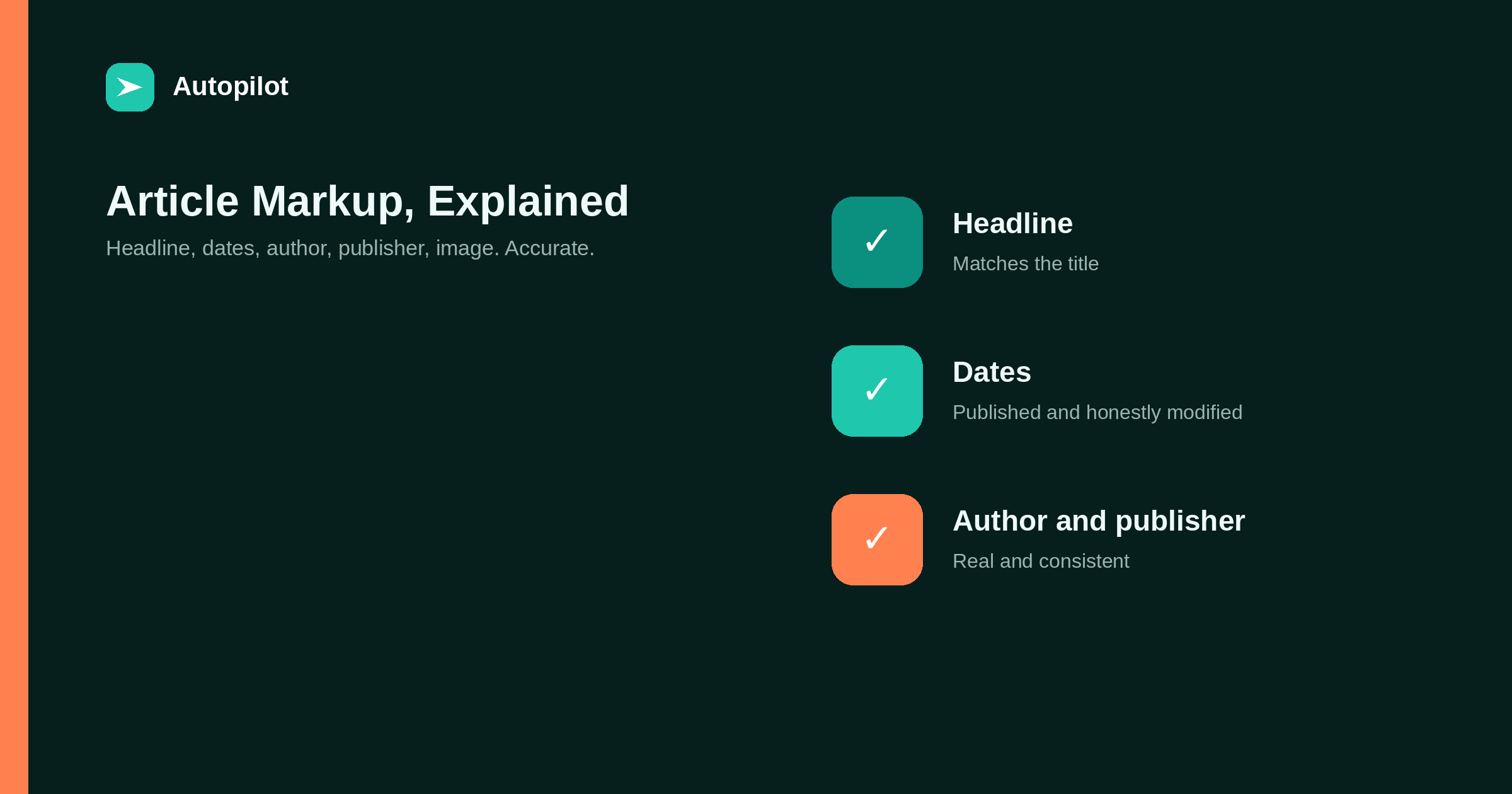
Short answer: Article (or BlogPosting) structured data describes each post: headline, description, date published, date modified, author, publisher and main image, plus the page it belongs to. Most SEO plugins generate it automatically; the job is making sure the values are right. The headline should match the visible title, the author should be a real person or the organisation, the publisher should be your business with its logo, and dateModified should change only when the article changes meaningfully. Check a few posts with a testing tool after any template change.
Every blog post can carry a small block of Article markup describing what it is: the headline, who wrote it, who published it, when, and with which image. It is one of the most basic types of structured data and one of the most often slightly wrong.
Getting it right is mostly a matter of checking that the values your plugin fills in are accurate and consistent with what readers see.
The fields that matter
A typical Article block includes a handful of properties.
| Property | Should contain |
|---|---|
| headline | The article’s title, as shown on the page |
| description | A short summary, usually the meta description |
| datePublished | When the article was first published |
| dateModified | When it last changed meaningfully |
| author | A real person or the organisation |
| publisher | Your organisation, with name and logo |
| image | The featured image, at a usable size |
| mainEntityOfPage | The article’s own URL |
Article, BlogPosting and NewsArticle are closely related types; BlogPosting or Article suits most business blogs.
Headline and description
The headline in the markup should match the visible title. If your SEO title differs from the on-page heading, the markup usually uses the on-page one; either way, it should not contain text that appears nowhere on the page.
The description is typically the meta description or excerpt. It should summarise the article accurately, the same standard as in titles and descriptions.
Dates, honestly
datePublished is when the article first appeared. dateModified is when it last changed in a way that matters to readers: new information, corrected facts, a rewritten section.
Updating dateModified for trivial edits, or setting it automatically every day, is misleading and teaches search engines to ignore it. Only meaningful updates should change it, which is also the principle in refreshing old posts. If the page shows an updated date, the markup should match it.
Author
The author should be whoever is genuinely accountable for the article: a named person with an author page, or the organisation. It should match the byline readers see.
Do not name an invented person. bylines and author pages covers choosing an honest byline; the markup simply records that choice. Where the author is a person, linking to their author page with a url property helps connect their articles.
Publisher and logo
The publisher is your organisation, with its legal or trading name, website address and logo. It should be identical across every post and match the Organization markup on the homepage.
A common error is a publisher block left with a theme’s default name or an old logo address. Check it once, carefully, since it repeats on every page.
Image
The image should be the article’s featured image, large enough to be useful in displays. Many guidelines suggest wide images of at least 1,200 pixels; the images on this blog are 2,400 pixels wide for that reason.
The image must be crawlable — not blocked by robots.txt — and should represent the article. featured images for automated posts covers producing one for every post.
Plugin-generated or hand-written
Most blogs should let their SEO plugin generate Article markup and focus on configuring it correctly: organisation name and logo, author handling, date behaviour.
Some setups add markup directly to each article, as this blog does alongside its FAQ markup. Either approach works, but avoid both at once, which produces two Article blocks per page with possibly conflicting values.
A sample block
For a typical post, a correct Article block contains the headline as shown, a one-sentence description, the published date, the last meaningful modification date, the author, the publisher with its name and logo, the featured image and the article’s own URL. Nothing more is required, and nothing in it should contradict what the reader sees.
Viewing the page source and finding the block takes seconds. Reading each value against the visible page is the most reliable check there is, and it catches errors that validators pass because they are syntactically correct but factually wrong.
Consistency across the site
Article markup on every post should agree with the Organization markup on the homepage and with the author pages. The same organisation name, the same logo, the same author names and URLs.
Inconsistencies usually creep in during a rebrand, a plugin change or a move to a new theme. A short checklist of values to confirm after any such change — organisation name, logo address, author handling, date behaviour — prevents most of them. Record the correct values somewhere your team can find them, so whoever makes the next change knows what the markup should say.
Speakable, reviews and other extras
Various other properties and types can be added to articles. Most are unnecessary for a business blog, and some — review ratings on your own services, for instance — are specifically restricted by search guidelines when self-serving. Keep to the core fields unless a specific, legitimate need appears.
More markup is not better markup. Accurate, consistent core fields are worth more than a long list of optional properties filled with guesses.
Checking it
Test a few posts with a rich results test or schema validator after setup and after any change to plugins, themes or templates. Search Console’s structured data reports show errors across the site.
Look specifically at the author, publisher, dates and image values, since those are the ones most often wrong while still passing validation. Article markup does not guarantee any particular display or ranking; it makes sure what search engines read about your posts is accurate.
Related reading
If this was useful, these cover the questions that usually come next.
- Structured data for a blog — the wider set of types
- Bylines and author pages — the author the markup names
- Refreshing old posts — when dateModified should change
The bottom line
Give every post Article or BlogPosting markup with the visible headline, an accurate description, honest publication and modification dates, the real author, your organisation as publisher with its logo, and a large featured image. Let one source generate it, not two, and check a few posts after any template or plugin change.
FAQ
What is Article structured data?
Markup describing a post’s headline, description, dates, author, publisher, image and URL in a standard vocabulary search engines understand.
Should I use Article or BlogPosting?
Either suits a business blog; BlogPosting is a more specific type of Article. Use one consistently.
When should dateModified change?
Only when the article changes meaningfully for readers. Updating it for trivial edits is misleading.
Who should be listed as the author?
Whoever is genuinely accountable: a named person with an author page, or the organisation. It should match the visible byline.
What size should the image be?
Wide and large enough to be useful; many guidelines suggest at least 1,200 pixels wide.
Can two plugins both add Article markup?
They can, and it causes duplicate, possibly conflicting blocks. Let one source generate it.