ENEnglish
 LTLietuviškai
 DEDeutsch
 FRFrançais
 RUРусский
 ESEspañol
 PLPolski
 ITItaliano
 UKУкраїнська
 CSČeština
 PTPortuguês
 JA日本語
JA日本語 LVLatviešu valoda
 ETEesti
 HUMagyar
 IDBahasa Indonesia
 TRTürkçe
 HIहिन्दी
 ELΕλληνικά
 ARالعربية
 THไทย
THไทย VITiếng Việt
 RORomână
 MSBahasa Melayu
 BNবাংলা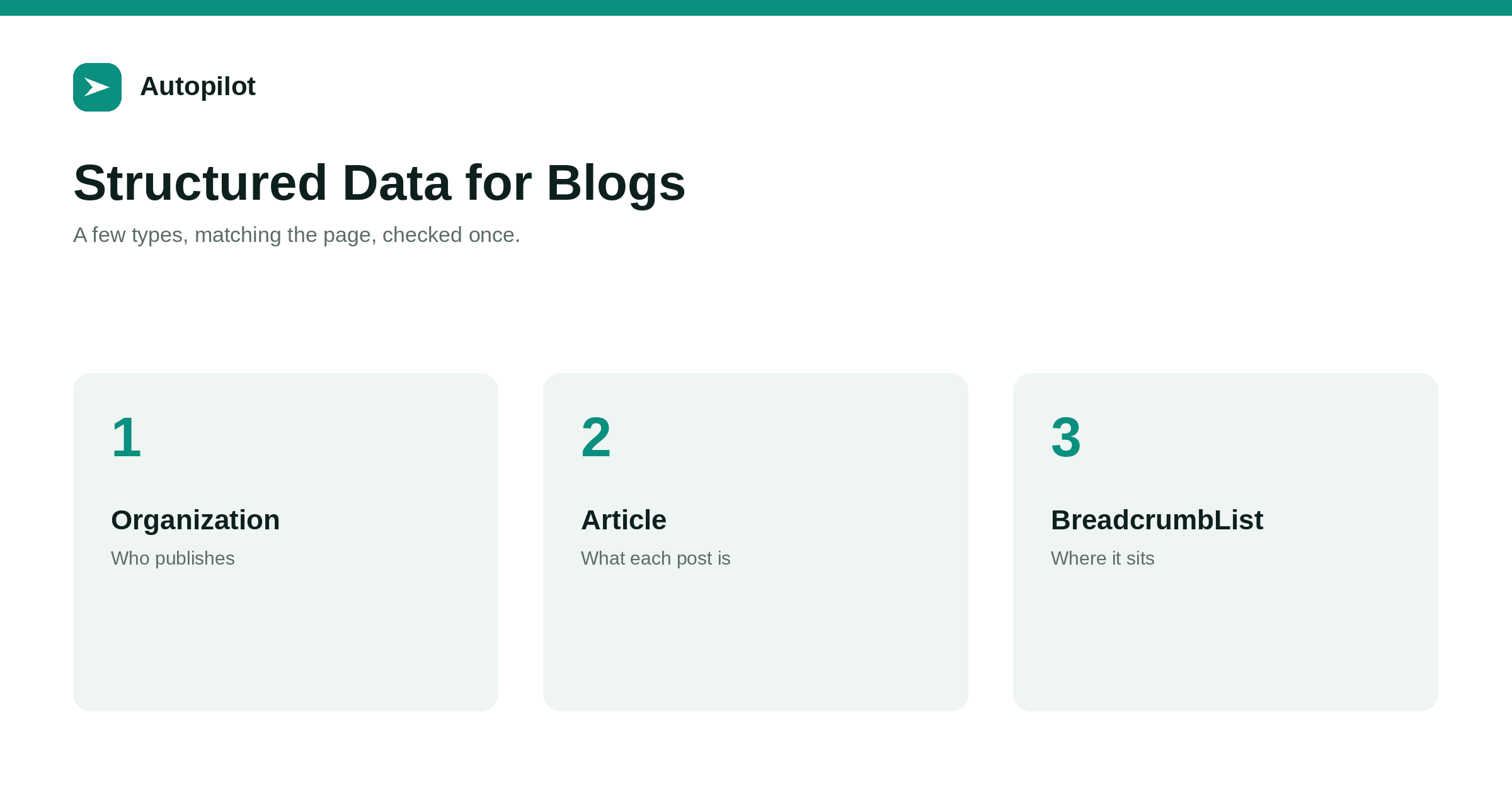
Short answer: structured data is code, usually JSON-LD, that describes what a page is in a vocabulary search engines understand. For a business blog, a few types cover almost everything: Organization for the publisher, Article or BlogPosting for each post, BreadcrumbList for site structure, and FAQPage where a real FAQ appears on the page. The markup must describe what is visible on the page, never more. Check it with free testing tools. It can make pages eligible for enhanced displays, but no markup guarantees one, and it is not a ranking shortcut.
Structured data is one of those subjects that sounds more complicated than it is. At its core it is a short block of code on each page saying, in a standard vocabulary, this is an article, published on this date, by this organisation, about this subject.
A blog needs only a few types, set up once and kept accurate. Most of the work is resisting the urge to add more than the page actually contains.
Cara ia berfungsi
Search engines read structured data alongside a page’s visible content. It helps them understand what the page is and can make it eligible for enhanced displays in results.
The common format is JSON-LD: a script block in the page containing a structured description. It does not change how the page looks to readers. The vocabulary comes from schema.org, a shared standard used by the major search engines.
The types a blog needs
A small set covers nearly every business blog.
| Jenis | What it describes | Where |
|---|---|---|
| Organization | The business: name, logo, contact, profiles | Site-wide |
| WebSite | The site itself, sometimes with search | Homepage |
| Article or BlogPosting | Each post: headline, dates, author, image | Every post |
| BreadcrumbList | The page’s position in the site | Posts and archives |
| FAQPage | Questions and answers visible on the page | Only where an FAQ exists |
Most SEO plugins generate the first four automatically. FAQPage is added per page where a genuine FAQ exists. Article structured data covers the Article type in detail.
The rule that matters most
Structured data must describe what is visible on the page. Marking up content that is not there — questions that do not appear, reviews that do not exist, an author who did not write it — is against search guidelines and can lead to the markup being ignored or to manual action.
The simplest way to stay compliant is to generate the markup from the same source as the visible content, so they cannot drift apart. On this blog, the FAQ that readers see and the FAQPage markup are built from the same text for exactly that reason.
FAQPage, carefully
FAQPage markup is appropriate when a page contains a genuine list of questions with answers, written by the site. It is not appropriate for forum threads, for questions invented to hold keywords, or for product pages where users submit questions.
Search engines have limited how often FAQ rich results are shown, so the markup’s display benefit varies. It still describes the page accurately, and clear question-and-answer passages remain useful for readers and for answer engines — writing FAQ sections covers writing them.
Rich results come and go
Some types can make a page eligible for enhanced displays: breadcrumbs in the result, article details, FAQ dropdowns. Search engines change which enhancements they show and when, sometimes significantly.
Treat enhanced displays as a possible benefit, not a promise. The durable reason to use structured data is that it describes your pages accurately in a standard way, which is useful however results are displayed.
Checking your markup
Two free tools do most of the work. A rich results test shows whether a page is eligible for enhanced results and reports errors. The schema markup validator checks the markup against the vocabulary more generally.
Search Console also reports on structured data it finds across the site, grouped by type, with errors and warnings. Check it after changing plugins or templates, since that is when markup most often breaks.
Common errors
A few problems recur.
- Duplicate markup from two plugins, producing two Article blocks per page.
- Missing required fields, such as an image or date.
- Stale data, such as an old logo URL or a dateModified that never changes.
- Markup describing hidden content, which should be removed.
- Wrong organisation details copied from a template.
What structured data is not
It is not a ranking shortcut. Adding markup does not make a page more relevant or more useful; it describes the page. A thin article with perfect markup is still a thin article.
It is also not a place for keywords or marketing claims. Keep descriptions factual and consistent with the page. Search guidelines on structured data are explicit that misleading markup is treated as spam.
Structured data on an automated blog
When articles are produced automatically, markup should be produced automatically too, from the same data as the visible page. That is the only reliable way to keep the two consistent at volume: the FAQ questions readers see and the FAQPage markup come from one list; the headline in the markup is the title on the page.
Spot-check a sample of articles each month with a testing tool rather than every article, and check immediately after any change to templates or plugins.
Setting it up once
For most blogs: configure the SEO plugin’s organisation details correctly, confirm Article markup appears on posts with the right author, dates and image, enable breadcrumbs, and add FAQPage only where real FAQs exist. Check a few pages with the testing tools.
Then revisit only when something changes: a new plugin, a new template, a rebrand. That is a few hours of work that stays useful for years.
Related reading
If this was useful, these cover the questions that usually come next.
- Article structured data — the type every post needs
- Writing FAQ sections — FAQ markup that matches the page
- Breadcrumbs and navigation — the visible side of BreadcrumbList
The bottom line
Use a few types — Organization, Article, BreadcrumbList, and FAQPage where a real FAQ exists — and make sure every piece of markup matches what readers can see. Generate it from the same source as the content, check it with free tools, and treat rich results as a possible bonus rather than a promise or a ranking shortcut.
FAQ
What is structured data?
Code, usually JSON-LD, that describes what a page is using a shared vocabulary from schema.org, so search engines can understand it more precisely.
Which structured data does a blog need?
Organization for the publisher, Article or BlogPosting for posts, BreadcrumbList for site structure, and FAQPage only where a genuine FAQ is visible on the page.
Does structured data improve rankings?
Not directly. It helps search engines understand pages and can make them eligible for enhanced displays, but it does not make a page more useful.
Can I add FAQ markup for questions not on the page?
No. Markup must describe visible content. Marking up hidden or non-existent content is against guidelines.
How do I test structured data?
With a free rich results test and the schema markup validator, and through the structured data reports in Search Console.
Will structured data guarantee rich results?
No. Search engines decide when to show enhancements and change their approach over time.