ENEnglish
 LTLietuviškai
 DEDeutsch
 FRFrançais
 RUРусский
 ESEspañol
 PLPolski
 ITItaliano
 UKУкраїнська
 CSČeština
 PTPortuguês
 JA日本語
JA日本語 LVLatviešu valoda
 ETEesti
 HUMagyar
 IDBahasa Indonesia
 TRTürkçe
 HIहिन्दी
 ELΕλληνικά
 ARالعربية
 THไทย
THไทย VITiếng Việt
 RORomână
 MSBahasa Melayu
 BNবাংলা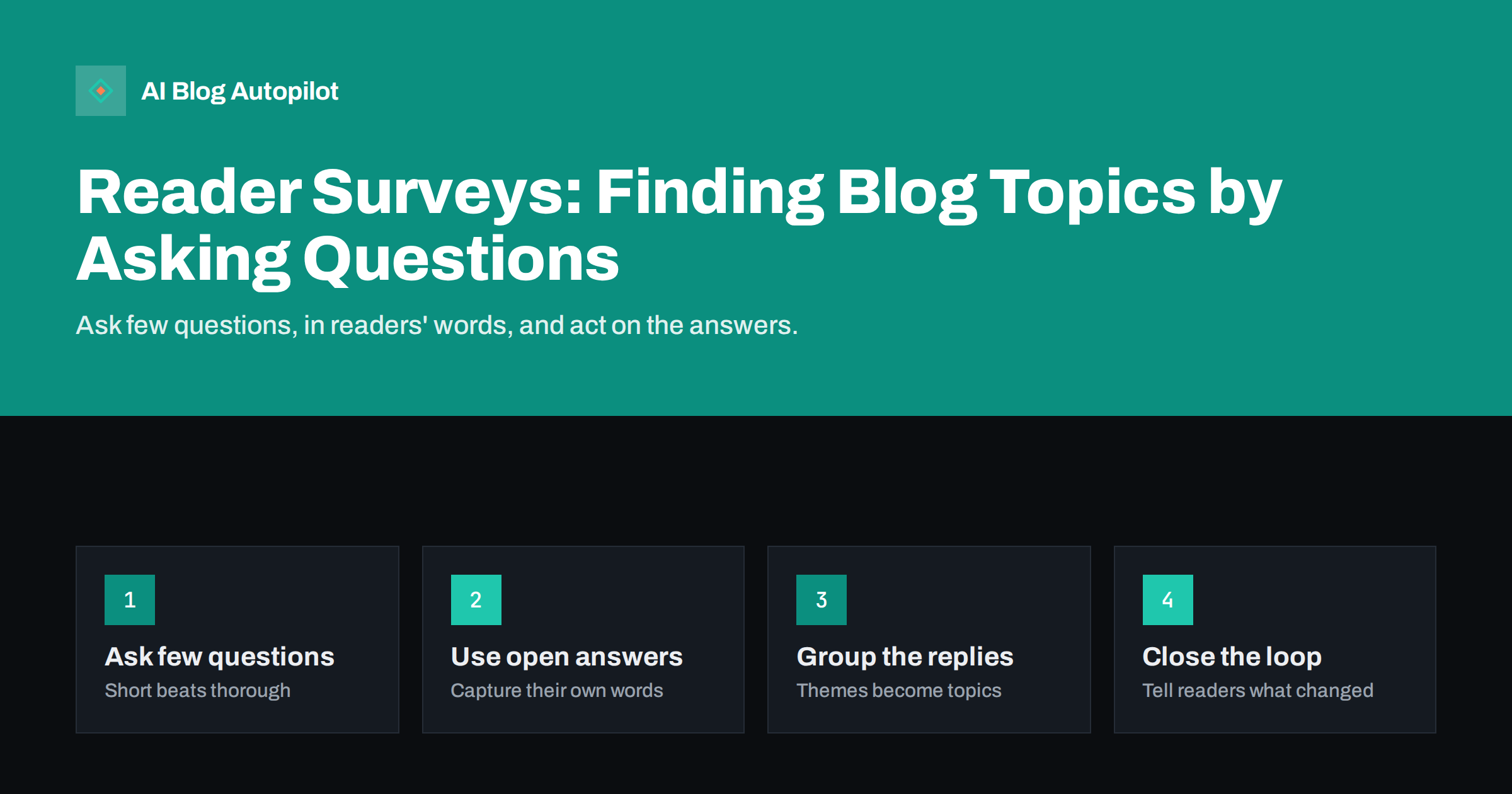
Short answer: a short reader survey is one of the cheapest ways to find blog topics, because it tells you what your own audience wants to know in their own words. Ask three to five questions, mix one or two choice questions with open text, send it to the people who already read or buy from you, group the answers into themes, and turn the most common themes into articles. Respect privacy, explain what you will do with the answers, and tell respondents afterwards what you published because of them.
Most blog topics come from keyword tools, competitors and the writer’s own guesses. These sources are useful, but they miss something important: the questions your readers have that nobody searches for in exactly that form. A survey fills that gap. It does not need special software, a large audience or statistical training. This article explains how to design a survey that people finish, how to reach the right respondents, how to read the answers and how to use them without overreading small numbers.
What a survey can and cannot tell you
Be clear about the limits before you start. A reader survey is a source of ideas and language, not a measurement of the whole market.
- It can show what problems your readers have, what words they use, what they have already tried and what stops them from acting.
- It can reveal gaps, such as a question that many people mention and that none of your articles answers.
- It cannot prove what the wider public wants, because respondents are a self-selected group, usually the more engaged readers.
- It cannot replace data about what people search for or do on your site. Use it together with Search Console, site search and sales questions.
With a small audience, treat the survey as a structured conversation. Twenty thoughtful replies can be worth more than two hundred careless ones, provided you read them carefully.
Design a short survey people finish
Every extra question loses respondents. For a topic survey, three to five questions are enough, and it should take under two minutes.
- “What is the biggest challenge you have with [your subject] right now?” An open text question. This is the most valuable one.
- “What have you tried so far, and what happened?” This shows the context and the unmet need.
- “What would you like us to write about next?” Simple and direct; some people answer this well.
- A choice question, such as “How would you describe your experience: beginner, some experience, or advanced?” This helps you group the answers.
- An optional question asking how they prefer to learn: short answers, step-by-step guides, templates or examples.
Write the questions neutrally. Avoid leading wording such as “How much do you love our guides?” and avoid asking two things in one question. Do not ask for personal information you do not need. If you want to follow up with someone, add an optional email field and say clearly that it is only for that purpose.
Reach the right people
The respondents decide the value of the results. Send the survey to the people whose questions you want to answer.
- Your email list or newsletter, which usually gives the best responses, since the readers already know you.
- A short note at the end of popular articles, inviting readers to tell you what is missing.
- Social posts or community messages, where the rules of the place allow it.
- Customers, perhaps after a purchase or a support conversation, with a single question first.
- Colleagues who talk to customers, who can tell you the questions they hear, as a sort of internal survey.
Keep the invitation honest and specific: “Help us decide what to write next. It takes two minutes, and we will publish the most requested topics.” A clear reason increases responses. Offering a small useful thing in return, such as an early look at the article or a checklist, can help, but avoid prizes that attract people who are not your readers.
Respect privacy and rules
A survey collects information, and the law may apply, depending on where your readers live. Keep it minimal and explain what you do.
- Say who is asking, why, and how long you keep the answers.
- Collect only what you need. A topic survey rarely needs names.
- If you collect email addresses, be clear about how they will be used, and do not add people to a mailing list without consent.
- Choose a survey tool whose data handling you understand and that suits your obligations.
- Do not publish individual answers without permission. If you quote a reader, anonymise the quote or ask first.
If in doubt about legal duties, take advice relevant to your country. Good practice also builds trust: readers are more willing to answer honestly when they know what happens to the data.
Read the answers and find the themes
Once replies come in, resist the urge to count only the checkbox answers. The open text holds the best material. A simple process works for a few dozen or a few hundred replies.
- Copy the open answers into a sheet, one per row, with the respondent’s level of experience beside each.
- Read them all once without judging, to get a sense of the range.
- Tag each answer with one or two themes, such as “pricing doubts”, “getting started” or “measuring results”.
- Count how often each theme appears, and note who raised it, beginners or experienced readers.
- Copy exact phrases into a separate column. These are the words to use in titles, headings and FAQ questions.
Be careful with small numbers. If six people out of twenty mention the same obstacle, that is worth acting on, but it does not mean that thirty percent of the market has it. Report counts, not percentages, when the sample is small.
Turn themes into articles
For each strong theme, decide what form of content answers it best, and check it against what you already have. Do not write a new article if an existing one answers the question but is hard to find; improve and link it instead.
- A question that is specific and common becomes a focused article, with the respondents’ wording in the title.
- A cluster of related questions becomes a guide, with each question as a heading.
- A repeated misunderstanding becomes a short “common mistakes” piece.
- A request for a tool or template becomes a downloadable resource with an article around it.
- Questions that are about your product go to the product pages or the help centre, not necessarily the blog.
Score the candidates against search demand and business value, using a simple method such as the one in the prioritisation guide linked below. Survey topics with little search demand can still be worth writing, because they serve people who are already your readers, but they should not displace everything else.
Close the loop with your readers
When you publish an article because of the survey, tell the people who took part. A short email or a note on the article saying “you asked, we answered” does three things: it shows that the survey was real, it brings readers back, and it encourages them to respond next time. Mention the broad results if they are interesting, for example the three most common challenges. Run the survey again every six or twelve months, with the same core question so you can see what has changed.
A sample question set and what it produced
Consider a small online shop that sells garden tools and has a newsletter of a few hundred people. It sends a survey with four questions: the biggest challenge in the garden this season, what the reader has tried, what they would like to read about, and whether they are a beginner or experienced. Forty-one people reply.
Reading the open answers, the owner finds that many beginners mention not knowing which tool to buy first, several experienced gardeners ask about sharpening and storing tools over winter, and a handful mention back pain from poor tools. None of these were on the content plan, and two were not obvious from keyword research. The owner plans three articles: a beginner’s guide to a first set of tools, a winter care checklist for tools, and a short piece on choosing tools to reduce strain. The headings use the readers’ own phrases, such as “which tool first” and “keeping blades sharp”.
When the articles are published, the shop sends a note to the newsletter saying that readers asked and it answered, with links. The survey costs an afternoon, but it produces a set of topics that fit the audience closely and a reason to write to the list. In six months the shop repeats the core question and compares the themes. Some have disappeared because the articles answered them, and new ones have appeared. That cycle of asking, writing and reporting back is the real benefit of the method.
If your audience is too small for a survey, use the same questions in conversation. Ask three customers or readers for a short call or message, and treat their words with the same care. The method scales down well.
How AI Blog Autopilot helps
AI Blog Autopilot plans topics from the subjects, keywords, audience and tone you give it, and writes full SEO articles with FAQ, tags and meta for your WordPress blog. Your survey results are exactly the kind of input that makes those topics specific to your readers. See the pricing page for plans.
Related reading
- Turning Customer Questions Into Useful Blog Topics
- What Readers Search For on Your Site, and What to Do With It
- Prioritising Blog Topics: A Simple Scoring Method
- Building a Newsletter From Your Blog Posts
The bottom line
A reader survey gives you topics and language that keyword tools cannot. Keep it short, ask mostly open questions, send it to people who really read you, protect their privacy and read the answers carefully for themes. Turn the strongest themes into articles, avoid reading too much into small numbers and tell respondents what you did. Repeat it now and then, and your blog will keep answering the questions your readers actually have.
FAQ
How many responses do I need?
There is no fixed number. For topic ideas, even twenty to thirty thoughtful answers can be useful. Do not treat small samples as statistics.
Which tool should I use?
Any simple form tool that you trust with the data. Choose one whose privacy terms you understand and that lets you export the answers.
Should I offer a reward?
A small useful reward, such as an early look at the article, is fine. Large prizes tend to attract people who are not your readers.
Can I quote respondents in articles?
Only with permission, or anonymised so that no one can be identified. Using their wording for headings is usually fine when it is generic.
How often should I run a survey?
Once or twice a year is enough for most blogs. Keep the core question the same so you can compare results.