ENEnglish
 LTLietuviškai
 DEDeutsch
 FRFrançais
 RUРусский
 ESEspañol
 PLPolski
 ITItaliano
 UKУкраїнська
 CSČeština
 PTPortuguês
 JA日本語
JA日本語 LVLatviešu valoda
 ETEesti
 HUMagyar
 IDBahasa Indonesia
 TRTürkçe
 HIहिन्दी
 ELΕλληνικά
 ARالعربية
 THไทย
THไทย VITiếng Việt
 RORomână
 MSBahasa Melayu
 BNবাংলা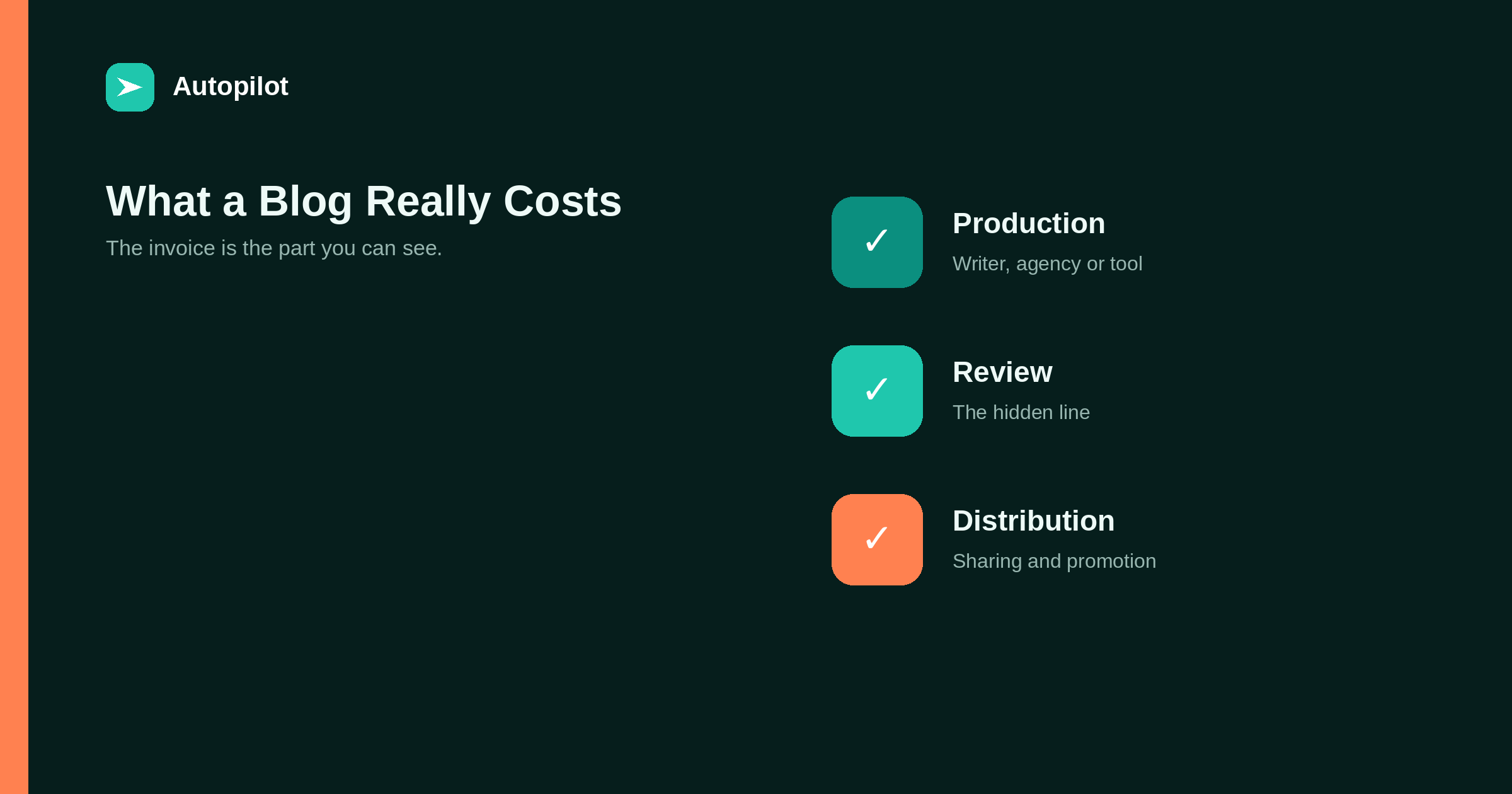
Short answer: a blog’s real monthly cost has five parts: production (a writer, an agency or a tool), review time from someone in the business, images and formatting, distribution and promotion, and the tools and hosting underneath. Production is usually the only line people count. Review is commonly the largest hidden cost, especially at volume, and time spent by a founder or senior specialist is expensive even when it is not invoiced. Count all five in hours and money before comparing options, because the cheapest-looking route is often not the cheapest.
Ask what a blog costs and the answer is usually a single number: what the writer charges, or the agency retainer, or the subscription. It is the visible number, and it is rarely the largest.
A full count takes ten minutes and changes most comparisons. It is also the only way to judge later whether the blog was worth it.
The five cost lines
Every blog, however produced, has the same five lines.
| Line | What it includes | Usually counted? |
|---|---|---|
| Production | Writer fees, agency retainer or tool subscription | Yes |
| Review | Time spent checking, correcting and approving | Rarely |
| Images and formatting | Finding or making images, laying out posts | Sometimes |
| Distribution | Sharing, newsletters, any paid promotion | Sometimes |
| Infrastructure | Hosting, plugins, analytics, SEO tools | Usually, separately |
The second line is the one that changes comparisons. A cheap writer whose articles need an hour of correcting each is not cheap.
Putting a price on review time
Review time is usually spent by someone senior — a founder, a subject specialist, a marketing lead — because only they can check the claims. That makes it expensive even though no invoice arrives.
Estimate it honestly: minutes per article multiplied by articles per month, valued at what that person’s time is worth to the business. For many small businesses this line alone rivals the production cost.
It is also the line most worth reducing, and the way to reduce it is better instructions rather than less checking — see writing a brief an AI can use. Clear instructions shorten review for every route, whether the draft comes from a person or a tool.
How the three routes compare
The routes differ less in total cost than in shape.
A freelance writer is a variable cost per article, with review time depending heavily on how well they know your subject.
An agency is a monthly retainer covering several lines — production, some editing, sometimes images and distribution — with a management overhead of briefings and approvals.
Automation is usually a fixed monthly cost for a set number of articles, with images, formatting and distribution included, and review as the main remaining time cost.
what the alternatives cost compares a writer and a tool in detail, and the three-way comparison is in freelancer, agency or automation.
Fixed against variable cost
The shape of the cost matters as much as the total.
With a per-article cost, every additional article costs the same as the last. With a fixed monthly cost covering a set number of articles, the marginal article up to that limit costs only its review time. That changes decisions: refreshing an old post, adding a supporting article to a cluster, or covering a small question becomes cheap enough to do.
For AI Blog Autopilot, plans are a fixed monthly price for a set number of articles, starting from the Starter plan, with current figures on the pricing page. Credits reset monthly and do not roll over, which is worth knowing if your publishing is irregular.
How the cost changes with volume
Volume changes the balance between the lines.
At four articles a month, production dominates and review is a manageable hour or two. At thirty, review becomes the largest line on any route, because it scales with every article while a fixed subscription does not. That is why teams that increase volume without improving their instructions often find the blog costs more in senior time than it did before automation.
The answer is not less review but faster review: better instructions, a checklist, and lighter treatment for categories that consistently need no changes — the options in draft, approve or full auto.
The costs that never appear on an invoice
Three more are worth naming, because they decide whether a blog pays off.
The month nothing was published. Irregular publishing means the fixed parts of the cost — tools, planning, the time spent getting started again — are spread over fewer articles.
The article nobody saw. Skipping distribution to save time means paying full production cost for a fraction of the audience.
The rewrite. An article redone because the brief was vague costs twice.
Doing the calculation
A one-page sheet covers it. For the last three months, or an honest estimate of the next three, write down:
- Production spend.
- Review minutes per article multiplied by articles, valued at the reviewer’s hourly cost.
- Time on images, formatting and publishing.
- Distribution time and spend.
- The share of tools and hosting used by the blog.
Divide by articles published. That per-article figure, set against what the blog produces as measured in measuring whether a blog is working, is the honest basis for any decision. No route guarantees a return; this at least tells you what you are paying for the chance.
Related reading
If this was useful, these cover the questions that usually come next.
- What the alternatives cost — the head-to-head comparison
- Measuring whether a blog is working — the other side of the calculation
- Freelancer, agency or automation — the three routes compared
The bottom line
Count all five lines: production, review, images and formatting, distribution, and infrastructure. Value review time honestly, because it is usually the largest hidden cost. Compare routes by shape as well as total, and divide everything by articles actually published. That number, against measured outcomes, is what a decision should rest on.
FAQ
How much does it cost to run a blog each month?
It depends on volume and route, but the real figure includes production, review time, images, distribution and tools. Most estimates count only production and understate the total considerably.
What is the biggest hidden cost of blogging?
Review time, usually spent by someone senior who can check the claims. At volume it can rival or exceed the production cost.
Is automation cheaper than a freelance writer?
Usually on production, images and distribution. Review time remains in both cases, so the real difference depends on how much checking each route’s articles need.
Why does fixed monthly pricing matter?
Because the marginal article up to the plan limit costs only its review time, which makes refreshes, supporting articles and small questions affordable to cover.
How do I calculate cost per article?
Add production spend, valued review time, image and publishing time, distribution and the blog’s share of tools over a period, then divide by the number of articles actually published.
Does spending more guarantee better results?
No. Spending buys production capacity and quality control. Results depend on the pages, your market and competition, which no budget controls.