ENEnglish
 LTLietuviškai
 DEDeutsch
 FRFrançais
 RUРусский
 ESEspañol
 PLPolski
 ITItaliano
 UKУкраїнська
 CSČeština
 PTPortuguês
 JA日本語
JA日本語 LVLatviešu valoda
 ETEesti
 HUMagyar
 IDBahasa Indonesia
 TRTürkçe
 HIहिन्दी
 ELΕλληνικά
 ARالعربية
 THไทย
THไทย VITiếng Việt
 RORomână
 MSBahasa Melayu
 BNবাংলা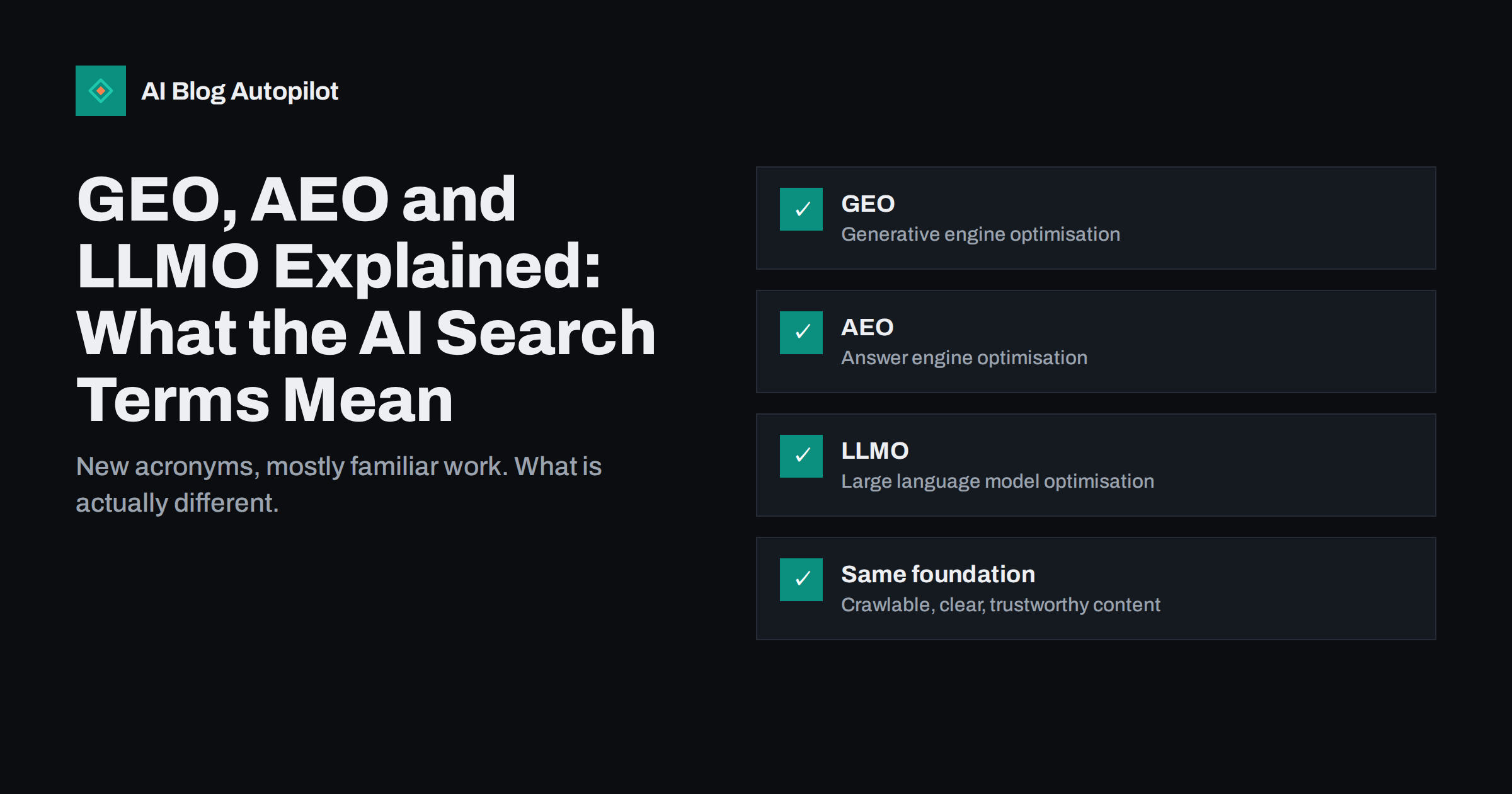
Short answer: GEO (generative engine optimisation), AEO (answer engine optimisation) and LLMO (large language model optimisation) are overlapping names for the same goal: getting your content found, used and cited in AI-generated answers. They are not separate disciplines with secret techniques. They rest on ordinary SEO foundations, such as crawlable pages, clear answers, trustworthy sources and a recognisable brand, plus a few habits that make content easier for AI systems to quote. Google says there are no additional requirements to appear in its AI features beyond SEO best practices.
If you read marketing news, you have probably seen these acronyms multiply: GEO, AEO, LLMO, AIO, AI SEO, even “SGE optimisation” from when Google’s AI answers were still an experiment. Agencies rename services around them, and business owners reasonably wonder whether they need a new strategy. This guide explains what each term means, where they came from, what is genuinely different about AI answers, and what a blog should actually do.
The terms, one by one
The names overlap heavily, and people use them loosely. Roughly:
| Term | Stands for | Usual meaning |
|---|---|---|
| SEO | Search engine optimisation | Making pages discoverable and competitive in search results |
| AEO | Answer engine optimisation | Structuring content so systems can extract a direct answer, originally for featured snippets and voice assistants |
| GEO | Generative engine optimisation | Getting content used and cited in AI-generated answers |
| LLMO | Large language model optimisation | Influencing how AI assistants describe a brand or topic |
| AIO / AI SEO | AI optimisation | A general label for any of the above |
AEO is the oldest. It was used in the era of featured snippets and voice assistants, when the aim was to be the single answer read aloud or shown at the top of the results. Its core advice, answering questions directly and clearly, carries straight over to AI answers.
GEO became widely known after a 2023 academic paper that used the term “generative engine optimisation” and tested how changes to content affected its visibility in AI-generated answers. The term was then adopted broadly by the marketing industry.
LLMO is usually used when the focus is on what AI assistants say about a brand, for example whether an assistant recommends your business, and whether it describes it correctly.
What is genuinely different about AI answers
AI answers do change some things, and it is worth being precise about which:
- Answers are assembled, not listed. Instead of ten links, the reader gets a synthesised answer with a few cited sources. Being one of the cited sources matters more than a position in a list.
- Passages matter more than pages. Systems retrieve and quote specific sections. A clearly written section can be used even if the page as a whole would not rank first.
- Questions are longer and more conversational. People ask AI tools full questions with context, and AI search may split them into several related searches behind the scenes.
- Mentions matter, not only links. When an assistant recommends businesses, it draws on how often and how consistently a brand is described across the web, not just on your own site.
- Fewer clicks for simple facts. When the answer is fully given, some readers do not click. Pages that offer depth, tools, examples or a next step beyond the summary still earn visits.
What stays exactly the same
Much more stays the same than the new acronyms suggest. Google’s page on AI features and your website states that SEO best practices remain relevant for AI Overviews and AI Mode, and that there are no additional requirements or special optimisations needed to appear in them. In practice, the foundations are unchanged:
- Your page must be crawlable and indexed. AI search features in Google draw on its search index. A page blocked by robots.txt, marked noindex or broken by rendering problems cannot be used.
- Content has to be helpful and trustworthy. The same quality signals, such as expertise, accuracy and clear sourcing, influence which pages are chosen.
- Relevance still depends on matching what people ask. Topic choice and search intent matter as much as ever.
- Authority is earned slowly. Links, mentions and a reputation in your field cannot be shortcut with a new label.
Other assistants that search the web use their own crawlers and indexes, and some rely on partner search engines. The practical implication is the same: be accessible to the crawlers you want, and publish content worth citing.
The practical habits that help
If you strip away the terminology, the advice that different GEO and AEO guides agree on is short and sensible:
- Answer first. Open with a direct answer of two to four sentences, then explain. The guide on answer-first writing covers the details.
- Make sections self-contained. Each H2 section should start with a sentence that makes sense on its own if quoted.
- Be specific. Concrete steps, conditions, ranges and named standards are more useful to quote than general statements.
- Cite sources. Link to primary sources for facts and figures, and date anything that changes.
- Use clear structure. Descriptive headings, lists for steps, tables for comparisons, and an FAQ for follow-up questions.
- Keep content current. Outdated pages are less likely to be used and more likely to spread wrong information.
- Describe your business consistently on your site and on other profiles, so AI systems can understand what you do.
Every item on that list also improves the page for human readers and for traditional search. That is a good test for any AI-search tactic: if it makes the page worse for people, it is unlikely to be a durable strategy.
Applying it to one article
To see how little of this is new, take a typical blog post such as “how to choose a standing desk” and apply the combined advice:
- SEO: the post targets a real search, loads quickly, is indexed, and is linked from related articles on the site.
- AEO: it opens with a short answer, such as the three measurements that matter most, and each section starts with a direct statement.
- GEO: it includes specifics a summary can use, such as height ranges, weight capacity considerations and what to check in a warranty, with links to any standards it mentions.
- LLMO: if the business sells desks, its own site and profiles describe it consistently, so an assistant asked for recommendations has clear information about what it offers.
One well-made article covers all four labels. The acronyms describe different angles on the same piece of work rather than four separate projects, which is why it rarely makes sense to buy them as separate services.
Claims to be sceptical of
A new field attracts confident claims. Treat these with caution:
- Guaranteed citations or placements in AI answers. Nobody outside the AI providers controls which sources are used.
- Secret markup or files that unlock AI visibility. Structured data helps systems understand pages, and llms.txt is a proposed convention, but neither forces inclusion. See AI crawlers, robots.txt and llms.txt.
- Writing for machines instead of people, such as stuffing pages with question variations or repeating the brand name unnaturally.
- Precise “share of AI voice” figures presented as exact. AI answers vary by wording, user, location and time, so monitoring tools give estimates from samples.
- Mass-produced pages aimed at AI, which are likely to fall under search engines’ policies on scaled low-value content.
Should you hire a GEO or AEO specialist?
For most small businesses and blogs, a separate AI-search specialist is not necessary. If your SEO work already covers technical health, useful content, answer-first structure and a consistent brand presence, you are already doing most of what these services offer. A specialist can be useful when:
- Your brand is frequently misrepresented in AI answers and you need a systematic way to monitor and correct sources.
- You compete in a category where AI assistants are a major way customers choose between providers.
- You need regular, structured monitoring across several assistants and markets.
When evaluating any offer, ask what exactly will be done to your site and content, how results will be measured, and which claims are estimates. If the answers are vague, or the proposal promises guaranteed placements, look elsewhere.
How to measure progress
Measuring visibility in AI answers is still imperfect. Sensible signals include:
- Search Console performance, which in Google’s case includes traffic from AI Overviews and AI Mode within the overall web data.
- Referral visits from AI assistants in your analytics, where they pass a referrer.
- A fixed set of questions you test manually in AI tools at regular intervals, recording whether and how your site is mentioned.
- Enquiries where customers say they found you through an AI assistant, which is worth asking about in contact forms or calls.
The guide on checking whether AI assistants mention your blog sets out a simple routine.
How AI Blog Autopilot fits in
AI Blog Autopilot writes and publishes SEO articles with the structure these guides recommend: a direct answer at the start, descriptive headings, an FAQ, and titles and descriptions written for each post. It works on the same foundations as good SEO rather than promising special AI placements, and it cannot guarantee that any assistant will cite your content. See how Autopilot works.
Related reading
- How to Get Your Blog Cited by ChatGPT, Perplexity and Google AI Overviews
- AI Answers in Search Results: What They Mean for Traffic
- Zero-Click Searches: What They Mean for a Business Blog
The bottom line
GEO, AEO and LLMO are useful names for a real shift: more answers are now written by AI systems that quote a few sources. But the work behind them is mostly familiar. Keep your site crawlable, write clear answer-first content that is specific and sourced, keep it current and describe your business consistently. Be wary of anyone who sells the acronyms as secret techniques or guaranteed placements.
FAQ
What is the difference between GEO and SEO?
SEO aims to make pages discoverable and competitive in search results, while GEO focuses on getting content used and cited in AI-generated answers. In practice GEO builds on SEO foundations, because AI search features draw on indexed, trustworthy pages.
What does AEO mean?
AEO stands for answer engine optimisation. It means structuring content so that systems can extract a direct answer, a practice that began with featured snippets and voice assistants and now applies to AI answers too.
Do I need special optimisation to appear in Google AI Overviews?
Google says there are no additional requirements or special optimisations needed to appear in AI Overviews or AI Mode. The same SEO best practices apply, and the page must be indexed and eligible to show a snippet.
Is LLMO different from GEO?
The terms overlap heavily. LLMO is often used when the focus is on how AI assistants describe or recommend a brand, while GEO is more often used for getting specific content cited, but many people use them interchangeably.
Can anyone guarantee that AI assistants will cite my site?
No. The AI providers decide which sources their systems use, and answers vary by question wording, user and time. Treat any guarantee of AI citations or placements as a warning sign.