ENEnglish
 LTLietuviškai
 DEDeutsch
 FRFrançais
 RUРусский
 ESEspañol
 PLPolski
 ITItaliano
 UKУкраїнська
 CSČeština
 PTPortuguês
 JA日本語
 LVLatviešu valoda
 ETEesti
 HUMagyar
 IDBahasa Indonesia
 TRTürkçe
 HIहिन्दी
 ELΕλληνικά
 ARالعربية
 THไทย
 VITiếng Việt
 RORomână
 MSBahasa Melayu
 BNবাংলা
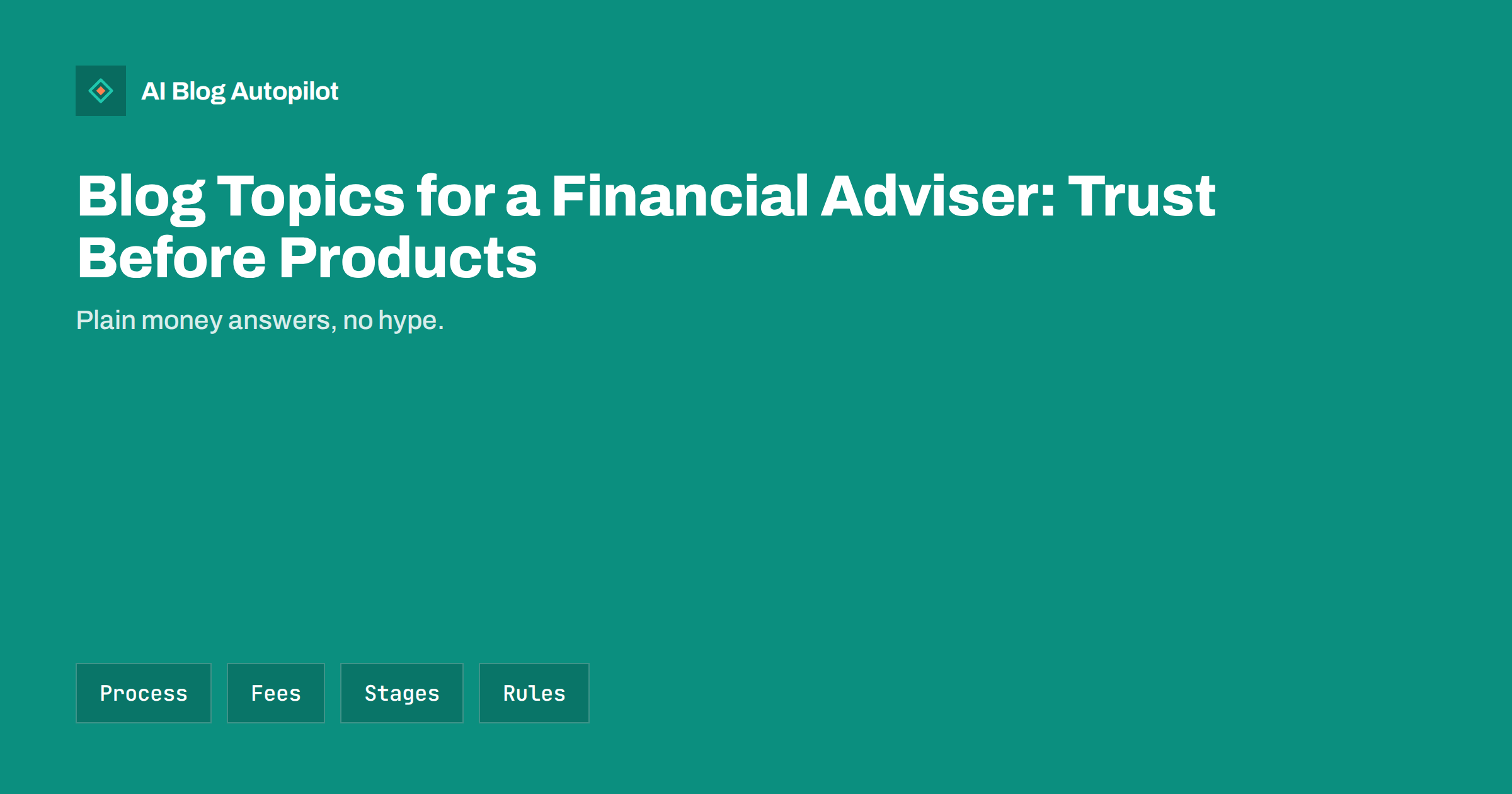
Short answer: a financial adviser should blog about how advice works rather than which product to buy: what happens in a first meeting, how fees are charged, what planning looks like at each stage of life, which mistakes are common and how to prepare for a conversation. Write for one country, date every page, avoid predictions and promises, and make clear that a guide is general information, not a personal recommendation.
People look for a financial adviser at turning points: a new job, a house purchase, a child, an inheritance, a divorce or the approach of retirement. They are often anxious, they may feel embarrassed about what they do not know, and they have heard stories about high fees and pushy sales. A blog that answers their first questions calmly is one of the few ways to show how you work before they call.
This guide lists topic groups for a small advice firm or an independent adviser, explains how to turn real client questions into pages, and describes how to keep content accurate and within the rules that apply to your business. Always read your regulator’s guidance on promotions first, since the rules differ by country and by type of service.
Explain how advice works
The most valued page is often the simplest: what happens when you hire an adviser. Describe the first meeting, what you ask about, which documents to bring, what you deliver and how often you review the plan. Readers who understand the process lose their fear of the first call, and many will decide that they are ready to book.
Say who you work with and who you do not. A firm that serves families with moderate savings has different pages from a firm that advises business owners. A clear description of your clients saves time for both sides and helps the right readers recognise themselves in your writing.
Explain the difference between types of help in plain words. Some readers do not know whether they need an adviser, an accountant, a mortgage broker or a bank manager. A short page that explains what each does, and where your work starts and ends, is useful, honest and easy for search engines and AI assistants to quote.
Think about the order in which a reader meets your pages. Someone who finds a guide about retirement may not be ready to book, but may return after reading about fees and process. Link each page to the next logical one, so that a visitor can move from a general question to a first conversation without searching again. This is also how a small site builds authority on a narrow subject.
Add a short glossary for terms such as fund, allowance, annuity or drawdown. Many readers hide that they do not know a word, and a plain explanation in a box lets them keep reading. Write for the person who has never spoken to an adviser, and the page will also suit journalists, referral partners and anyone using an AI assistant to learn the basics.
Write honestly about fees
Fees are the first worry and the most avoided subject. Explain how you are paid: a fixed fee, an hourly rate, a percentage of assets, commission or a mix. Give examples with invented numbers, clearly labelled as examples, and say what is included in each stage. The article on writing honest articles about what things cost offers a structure that suits advice fees as well.
Describe what the reader gets for the fee, not only the amount. A plan, a review, access to the adviser between meetings and help with paperwork are all part of the value. List what is not included and what could cost extra, such as product charges or tax work done by someone else.
Date the page and review it whenever your fees change. An old fee table that no longer matches your terms causes distrust and may break the rules on promotions. If you cannot publish exact amounts, explain what affects the price and how a reader can get a written estimate before any commitment.
Choose topics by listening rather than guessing. Ask the people who answer the phone which questions come first, and note which words callers use. Readers search with their own words, such as how much do I need to retire, and not with industry terms. A title that matches their words is easier to find and sounds friendlier than one that uses a technical label.
Do not forget the quiet stages between meetings. A page about what happens after the first plan is agreed, how reviews work and what to do when life changes keeps existing clients engaged and shows prospects that the relationship continues. It is also a topic that competitors rarely cover well.
Cover life events and planning stages
Most searches come from events. Write guides such as what to think about when you start a new job, how to plan for a first home, what to check when you receive an inheritance, how to prepare for retirement five years ahead and what to do after a partner dies. Each guide can be a checklist of questions rather than a set of recommendations.
Keep each page tied to one country, since tax rules, allowances and pensions differ. Name the year, link to the official source for any figure and show the date of the last review. If a rule changes often, explain the principle and point to the current official figure instead of repeating a number that may soon be wrong.
Use short worked examples with invented people, and say so. A page that follows a fictional couple through a planning conversation shows how the process feels without revealing a real client. Mention that circumstances differ and that the example is not a forecast or a promise of results.
Be careful with comparisons. Naming other firms or products can be misleading unless you can prove each statement, and many regulators require that comparisons are fair and balanced. Describe your own approach and let readers draw conclusions. If you mention a product type, explain how it works and what it costs, and leave out any suggestion that it is suitable for everyone.
Check images and examples as well. A photograph of a happy retired couple on a beach implies an outcome, while a photograph of a desk with a notebook does not. Choose pictures and numbers that describe a process, not a result, and keep a record of the sources for every figure you use in a table or chart.
Be careful with advice, predictions and promises
Money is a subject where search engines and regulators expect extra care. The guide on writing about money and health topics responsibly explains why accuracy, sources and visible expertise matter more here than in most areas. Show who wrote and reviewed each page, with their qualifications, and keep the evidence on file.
Avoid headlines that promise returns, name a best product or predict a market. Replace them with titles that describe a decision, such as how to compare two ways to save for a deposit. Explain risks as clearly as benefits, and never suggest that past results guarantee future ones.
Add a short notice that the page is general information and not a personal recommendation, and that readers should seek advice for their own situation. The guide to disclaimers and notices on a blog helps with wording that is clear without being a wall of small print.
Answer the common mistakes and myths
Readers appreciate specific warnings. Write about mistakes such as saving without a goal, ignoring an employer pension, holding no emergency cash, borrowing without comparing costs or leaving a will unwritten. Explain each in a few sentences, say why it matters and describe a sensible first step.
Myth pages work well when they are fair. Take a belief you hear often, such as the idea that advice is only for the wealthy, and explain what is true, what is not and what depends on the person. A calm tone builds more trust than a tone that mocks the belief or the reader.
Collect the questions that come up in meetings and calls. Ask colleagues to log them for a month, group them by stage and turn the most frequent ones into short pages. The guide on turning customer questions into topics shows a simple way to sort them without losing the reader’s own words.
Think about different kinds of reader. A young professional wants simple steps and low cost, a family wants security and clarity about education and housing, and a business owner wants to separate personal and company finances. Writing a version of a main guide for each group, with its own examples, doubles the number of useful pages without repeating text.
Measure what matters. Count enquiries by page rather than visits alone, and ask new clients how they found you. A guide that attracts few readers but many first calls is worth more than one with thousands of views and no action. Review the figures each quarter and expand the pages that lead to good conversations.
Show the people and make the next step easy
Clients hire a person, so show who they will meet. Write short profiles with qualifications, areas of work, languages and a sentence about how the adviser works with clients. Use real photographs, state the regulatory details required in your country and keep them identical to your contact page and business profile.
End every guide with one clear next step: a phone number, a booking link or a short form. Say what happens next, how long the first conversation takes and whether it carries a charge. Nobody should be surprised by what follows a click.
Keep a simple register of pages: topic, author, reviewer, date published, date reviewed and the sources used. It takes little time and is invaluable if a client, a colleague or a regulator asks where a statement came from. Review each page at least once a year and whenever a rule or figure changes.
How AI Blog Autopilot helps
AI Blog Autopilot can write and publish articles on your chosen topics, with FAQ sections, tags and SEO meta, and share them to your social networks. Give it your country and your service areas, and have a qualified person check every rule, fee and example before each article goes live. See the pricing page for plans and monthly credits.
Related reading
- Blog Strategy for Professional Services Firms
- Writing About Money and Health Topics Responsibly
- Writing Honest Articles About What Things Cost
The bottom line
Explain how advice works, be open about fees, tie every page to one country and date, and end each guide with one clear next step.
FAQ
What should a financial adviser blog about first?
Start with how advice works, what a first meeting involves and how fees are charged, then add life-event guides.
Can a blog post count as a personal recommendation?
Write it as general information, add a short notice and avoid statements that depend on a reader’s own circumstances.
Should I publish my fees?
You can, with a date and conditions. If not, explain what affects the price and how to get a written estimate.
How often should money pages be reviewed?
At least once a year and whenever a rule, allowance or fee changes, with the review date shown on the page.
Can I mention returns or past performance?
Be very careful and follow your regulator’s rules. Most advisers avoid return claims in general guides.