ENEnglish
 LTLietuviškai
 DEDeutsch
 FRFrançais
 RUРусский
 ESEspañol
 PLPolski
 ITItaliano
 UKУкраїнська
 CSČeština
 PTPortuguês
 JA日本語
 LVLatviešu valoda
 ETEesti
 HUMagyar
 IDBahasa Indonesia
 TRTürkçe
 HIहिन्दी
 ELΕλληνικά
 ARالعربية
 THไทย
 VITiếng Việt
 RORomână
 MSBahasa Melayu
 BNবাংলা
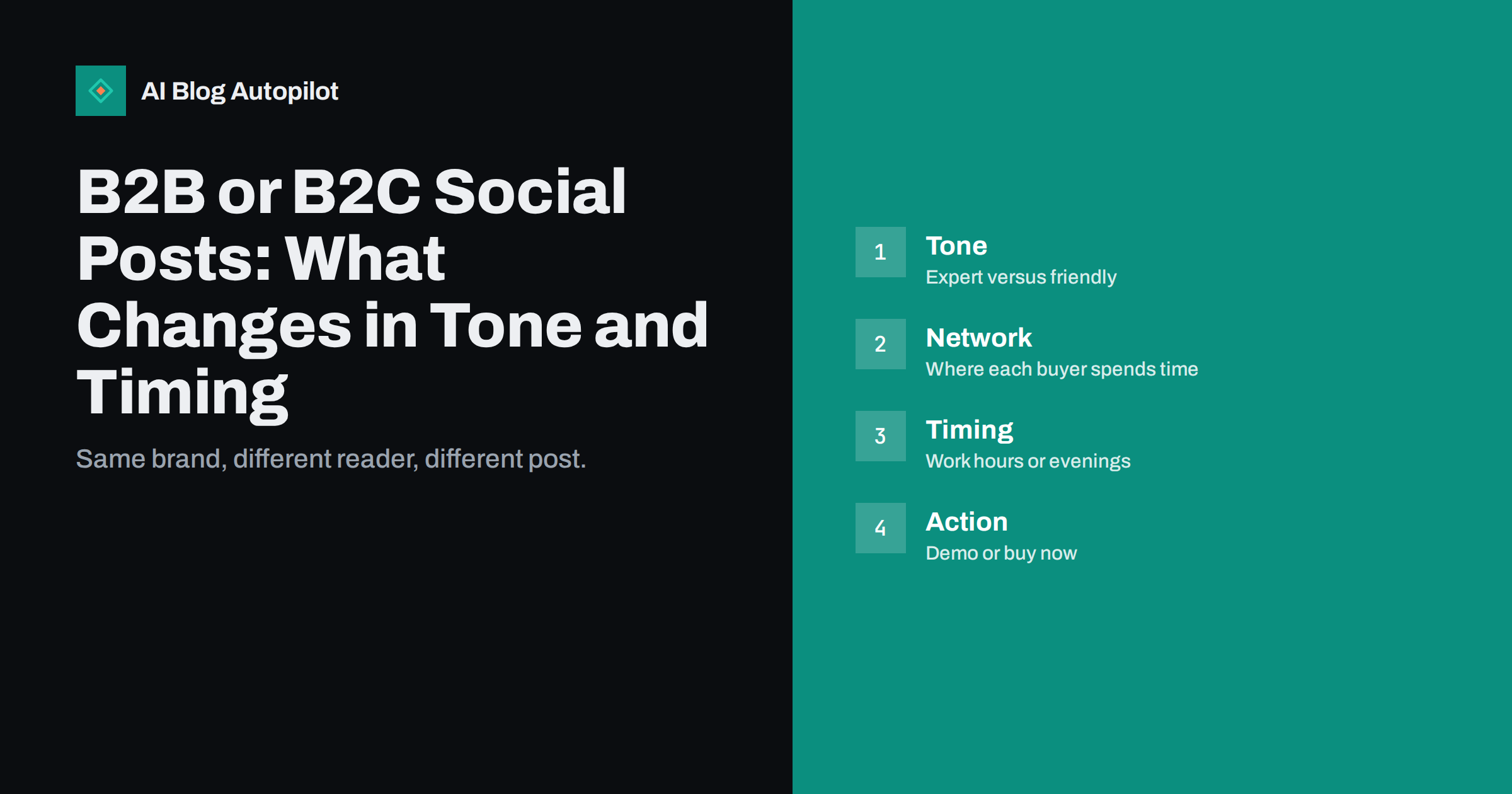
Short answer: business buyers use social networks to research, compare and check credibility, usually during working hours, and they expect clear information, proof and a calm tone. Consumers use them for inspiration, entertainment and quick decisions, often in the evening and at weekends, and respond to visuals, stories and simple offers. Adapt the network, tone, timing, proof and call to action to the buyer, and test with your own data, since averages hide a lot.
Many small companies sell to both kinds of buyer, or sit between them. A web designer may serve a local shop and a family. A fitness studio may sell memberships to individuals and packages to employers. Even so, the posts that work for one group often fall flat for the other.
This guide compares the two audiences along the points that matter most for a posting plan: who reads, what they want, how long they take to decide, where they are active and how to ask for action. It gives you a method to adjust each post, and it explains how to mix the two when you serve both.
Who reads and how they decide
A business purchase usually involves several people, a budget and a longer process. The person who reads your post may be a researcher, a user or an influencer, and not the one who signs. They look for evidence that you understand their problem, can deliver and are safe to choose. A post that shows a clear result for a similar company works better than one that shouts about features.
A consumer decision is often faster and more personal. The reader may decide in seconds, based on a picture, a price or a recommendation from a friend. Emotion, convenience and trust in the brand play a larger role than detailed comparison, although big purchases still involve research.
The guide to content for a buying committee explains how several readers in one company need different information, and it applies directly to business posts.
Tone and language
Business audiences value clarity, competence and respect for time. Use plain statements, concrete numbers and the vocabulary of their field, without jargon for its own sake. Avoid hype, exclamation marks and slang unless your brand has always used them. A calm, specific post earns more trust than an excited one.
Consumer audiences respond to warmth, humour and directness. Short sentences, questions, stories about real customers and a friendly voice help a post feel human. The tone can be lighter, but it should still match your brand and avoid anything that could offend.
In both cases, the post should sound like a person and not like a press release. Write the way a helpful member of your team would speak. The guide on adjusting tone for different readers shows how to keep one voice while changing its register.
Think about the role of each network in the buyer’s path. A professional network may bring awareness and credibility, a video network may demonstrate the product and a messaging channel may handle questions. Map each network to a stage, such as discover, evaluate or ask, and decide what each should do for you. This keeps your effort focused and helps you judge results fairly.
Networks and formats
Business buyers are often found on professional networks, in industry groups, on video platforms and in newsletters. Posts that work include short explanations of a method, a chart with a clear takeaway, a customer result, a lesson from a project and an announcement of a useful guide. Document posts and carousels do well when each slide has one point.
Consumers are spread across visual and community networks. Short video, photos, polls, behind-the-scenes content, offers and user stories do well. The best format depends on your product: a restaurant lives on photos, a clothing shop on video and styling ideas, and a repair service on before-and-after pictures.
Do not post the same content everywhere. Each network has its own rules, character limits and habits, as the article on social media character limits shows. Choose two or three networks where your buyers are and do them well, instead of spreading thin across ten.
Think about time zones and seasons. If your buyers are in several countries, a single posting time will suit only some of them, so schedule important posts for more than one window. Seasons matter, too: business buyers slow down around holidays and budget deadlines, while consumers speed up before gift seasons and events. Plan your calendar with these cycles in mind and give each audience content that fits the moment.
Timing and frequency
Business audiences are most active during working hours, especially at the start of the day, around lunch and in mid-afternoon on weekdays. Weekends are usually quiet for professional content. Consumers are more active in the evening, at weekends and during commutes, although this depends on the product and the country.
Use averages as a starting point, not a rule. Your own audience may behave differently, and the best time may vary with the network. Check your analytics for the hours when your posts get the most reach and replies, and test a different time every few weeks. The guide to the best time to share a blog post on social media explains how to test.
Frequency also differs. A business account can do well with a few quality posts a week, while a consumer brand may post daily on a visual network. Do not post more than you can keep up with. Regular, useful posts beat bursts followed by silence.
Show the people behind the posts. Business buyers like to know who will work with them, so introduce the team, share short profiles and let experts post under their own names where the network allows it. Consumers like to see the owner, the staff and the place, so share glimpses of daily work. Real faces and names make an account feel trustworthy in both cases.
Handle criticism calmly. A public complaint on a business post is a chance to show how you solve problems, and a consumer complaint is often seen by many potential buyers. Reply quickly and politely, move the details to a private channel and follow up when it is solved.
Proof and credibility
Business buyers want proof: case descriptions, numbers, named clients where permitted, certifications, awards and clear explanations of methods. Share results with context, such as the starting situation, what was done and what changed, and avoid claims you cannot support. If you cannot name a client, describe the type of company and the result.
Consumers want social proof too, but in a lighter form: reviews, photos from customers, ratings, recommendations and user content. A short quote from a satisfied customer with a photo, shared with their permission, is persuasive. Real people and real situations work better than polished adverts.
Both groups notice inconsistency. If your social profiles, website and reviews tell different stories, trust falls. Keep names, descriptions and facts the same across places. The article on how to write a case study that persuades without exaggerating is useful for the business side.
Keep the follow-up in mind. A business reader who clicks a guide may not be ready to buy for months, so give them a way to stay in touch, such as a newsletter, a follow-up on the same network or a reminder when you publish something new. A consumer who clicks an offer may decide within the hour, so make sure the page loads fast on a phone and the purchase takes few steps.
Test one change at a time. Try two different calls to action on similar posts and compare clicks and results after a few weeks. Small differences in wording, such as “get the guide” and “read the guide”, can change the result, but only your own data will tell you which works for your readers.
Calls to action
Business calls to action ask for a smaller step than a purchase: read a guide, watch a short demo, join a webinar, request a call or download a checklist. The decision is long, and an early request for a contract will fail. Offer something useful that helps the reader move forward and gives you a reason to follow up.
Consumer calls to action can be more direct: shop now, book a table, try a sample, use a code, visit the shop. Make the step easy, with a link that goes straight to the right page, and mention the benefit, the price or the deadline when it is real. Do not invent urgency, since readers recognise it and trust you less.
Whatever the audience, send readers to a page that continues the story. A post about a guide should link to the guide, and a post about an offer should link to the offer. Use tracking tags so that you can see which posts bring visits, as explained in the guide to UTM tags for social shares.
When you serve both audiences
Some businesses sell to both groups. Consider separate accounts or at least separate content streams when the audiences are very different. If you keep one account, label posts clearly, for example by using different series or formats, so that each reader can find what is for them.
Look for content that works for both: educational posts, behind-the-scenes stories, values and community. A tip that helps a household may also help a small company. Keep the tone friendly and clear, and add details for each group in the follow-up pages.
Review your results by audience. Compare reach, engagement, clicks and enquiries for each type of post and adjust the mix. The article on the social media content mix offers a simple structure for balancing different kinds of posts.
How AI Blog Autopilot helps
AI Blog Autopilot shares each article to your connected social networks, with text written for each network and timing set per network in AUTO mode. Tell it who your readers are in the topic and tone settings, so that the posts speak to them in the right way. See the pricing page for plans and the number of networks on each.
Related reading
- Social Media Content Mix: What to Post Between Articles
- Using LinkedIn to Distribute a Business Blog
- Best Time to Share a Blog Post on Social Media
The bottom line
Match the network, tone, timing, proof and call to action to the buyer. Test with your own data and keep one honest voice across everything.
FAQ
Is LinkedIn only for B2B?
It is strongest for business audiences, but some consumer services find clients there too. Test with your own results.
Should B2B posts be formal?
Clear and calm, not stiff. Plain language and specific facts work better than formal phrases.
When should I post for consumers?
Evenings and weekends are common peaks, but check your own analytics and test different times.
Can one account serve both audiences?
Yes, with clearly labelled series or formats. Separate accounts help when the audiences differ a lot.
What is the best call to action for B2B?
A small, useful step such as a guide, a short demo or a call request, rather than an immediate purchase.