ENEnglish
 LTLietuviškai
 DEDeutsch
 FRFrançais
 RUРусский
 ESEspañol
 PLPolski
 ITItaliano
 UKУкраїнська
 CSČeština
 PTPortuguês
 JA日本語
 LVLatviešu valoda
 ETEesti
 HUMagyar
 IDBahasa Indonesia
 TRTürkçe
 HIहिन्दी
 ELΕλληνικά
 ARالعربية
 THไทย
 VITiếng Việt
 RORomână
 MSBahasa Melayu
 BNবাংলা
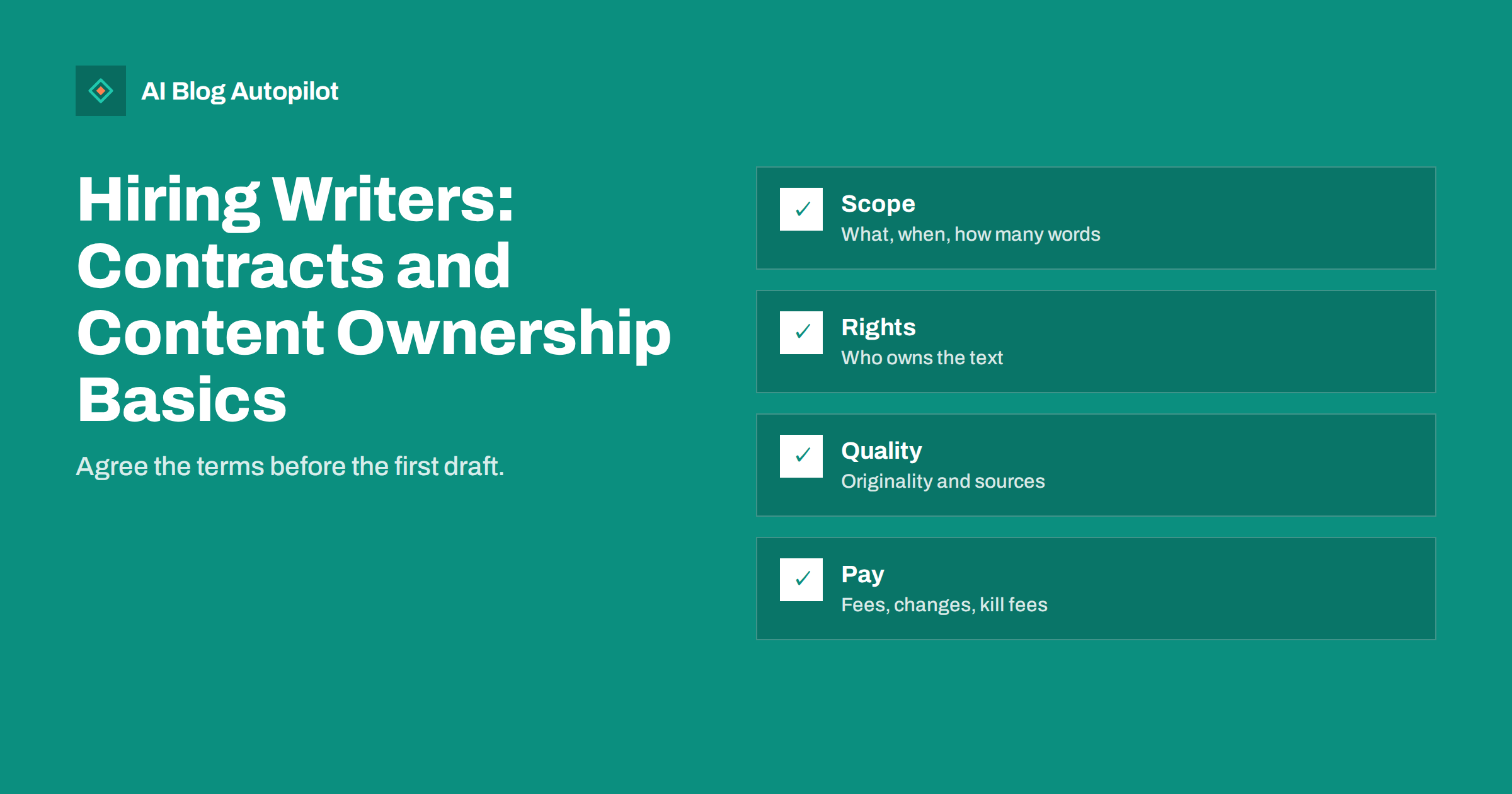
Short answer: a good writer agreement states what will be written, by when and at what price, who owns the finished text and what rights each side keeps, how revisions and credit work, what standards of originality and sourcing apply and how either side can end the arrangement. Put it in writing before work begins, keep it plain and have a qualified lawyer review your template, since the rules differ between countries.
Many blogs begin with a friendly email and a verbal understanding. For one article, that may be enough. As soon as you publish regularly, pay several people or reuse the text across products, unclear terms start to cause trouble: who may republish the piece, who is responsible if it copies another source, what happens if the writer disappears halfway or if you want a rewrite.
This guide explains the main points to agree with a freelance writer or an agency, in everyday words. It is general information, not legal advice. Laws about copyright, employment and contracts vary, so treat the checklist as a way to prepare for a conversation with a professional and with your writer.
Define the work clearly
Begin with scope. State the type of piece, the topic or brief, the target reader, the length, the sources expected and the format of delivery. If you use a content brief, attach it. Vague requests such as write something about our product lead to disappointment on both sides and to arguments about what was agreed.
Set the timeline. Include the due date for a first draft, the time you will take to give feedback, the deadline for revisions and the publication date if it matters. A clear schedule protects the writer from endless rounds of delays as much as it protects you from missed dates.
Agree how many revisions are included. A common approach is one or two rounds of reasonable changes within the brief, with extra work paid separately if the direction changes. Define the difference between fixing errors and changing the whole idea, so that a request for a different angle is treated as a new job.
Describe the review process: who reviews, how comments are given and who has the final say. If an expert must check facts, say who that is and how long they have. A short process, written down, removes many sources of friction before they begin.
Decide who owns the text and the rights
In many places, the creator of a text holds the copyright unless an agreement says otherwise, and some systems treat work done for an employer differently. Do not assume. State in writing whether the writer transfers the rights to you, gives you a licence to use the text or keeps certain rights, and in which territories, formats and periods you may use it.
For a business blog, most companies prefer full ownership of the finished article, including the right to edit, translate, republish and adapt it. If the writer keeps the right to show the piece in a portfolio, say so, and agree on a delay if needed. Be explicit about whether the writer may reuse parts of the text for other clients.
Think about timing. Many agreements say that rights pass to you when you have paid in full. This protects the writer, and it is usually reasonable. If you publish before payment, you may create a dispute that is hard to settle, so keep payment and publication in step.
Consider moral rights and credit. In some countries, an author may insist on being named or may object to changes that harm their reputation, and these rights may be limited by agreement. Decide whether articles carry the writer’s name, a company byline or no credit, and write it down. The guide on author bios and bylines explains how to present them.
Set standards for originality and sources
State that the work must be original, must not copy or closely paraphrase other texts and must not infringe anyone’s rights. Ask the writer to name the sources used, to quote and link them properly and to avoid unreliable material. These are normal expectations, and good writers are happy to confirm them.
Agree on the use of automated tools. Some businesses allow writers to use drafting or editing tools, and others forbid it, and both positions are fair. What matters is that the rule is clear, that the writer remains responsible for facts and originality and that you know how the work was produced. The guide on disclosure of AI use explains how to think about it.
Cover images and other material. If the writer supplies pictures, charts or quotations, ask who made them, under what licence they may be used and whether you may reuse them. Never accept images without a clear source. The guide on copyright and AI images describes the questions to ask.
Ask for a short statement of responsibility. The writer confirms that the work is their own, that they have the right to grant the rights you need and that they will tell you if a claim arises. This simple clause prevents many misunderstandings, and it is easier to agree before the work than after a complaint.
Agree fees, payment and changes
State the fee, the currency, the payment date and the method. Say whether the fee is per article, per word or per hour, and what it includes, such as research, images and revisions. Mention taxes, since the writer may be responsible for their own, and ask for an invoice with the details your accountant needs.
Decide what happens if you cancel. A kill fee, a percentage of the price paid if you drop a piece after work has begun, is common and fair. Specify at what stage it applies, and say what happens to the draft: whether you may use it, or whether the rights stay with the writer.
Think about late delivery and late payment. A short clause that says what happens if either side misses a date, and how to raise the issue, is better than silence. Many writers offer a discount for fast payment and some charge for late payment, and both are easier to accept if written in advance.
Agree on future price changes. If you plan to work together for months, state how rates are reviewed and how much notice is required. Surprises are the quickest way to lose a good writer, and a short note on this point protects the relationship as well as the budget.
Think about work for hire and international writers. If you hire someone in another country, the rules about copyright, tax and employment may differ from your own, and a clause that works at home may not work abroad. Ask a professional how to handle cross-border work, and note which country’s law applies to the agreement and where disputes would be settled.
Be careful with the line between a contractor and an employee. If you control hours, tools and methods closely, authorities may treat the writer as an employee, with consequences for tax and benefits. Describe the working relationship honestly, and review it when the volume of work grows.
Cover confidentiality, conflicts and exclusivity
If the writer will see non-public information, such as product plans, customer details or internal data, include a confidentiality clause. State what is confidential, how long it remains so and what the writer must do with the material when the work ends. Share only what is needed, and use secure channels.
Consider conflicts of interest. If the writer works for a competitor, say whether that is acceptable and what safeguards apply. Be careful with exclusivity: demanding that a writer works only for you is a serious restriction that usually needs a higher fee. Most small blogs do better with a simple agreement that each side acts honestly.
Be clear about sponsored or paid content. If the writer will be paid by a third party to mention a product, or if you ask for reviews, the arrangement must follow the advertising rules of your country, and the reader must be told. Ask the writer to disclose any relationship that could affect a recommendation.
Protect personal data. If the writer will handle names or contact details, agree how they are used and deleted. Many content jobs need none, in which case it is simplest to say that no personal data will be shared. This keeps both sides on the safe side of privacy rules.
Review the agreement at least once a year. Rates, tools, laws and the nature of your blog change, and an agreement that suited a single monthly article may not suit a weekly schedule. A short annual review, with the writer, keeps the terms fair and avoids slow drift into unwritten habits.
Plan the ending and keep records
Say how either side can end the arrangement: notice period, what happens to work in progress and how final payment is calculated. An ending that is planned in advance is calmer, and many writers prefer a short, honest clause to a relationship that stops suddenly with a late invoice.
Keep records in an organised way: the signed agreement, briefs, drafts, feedback, invoices and proof of payment. Name files clearly and store them where more than one person can find them. If you ever need to show who wrote a piece, when and under what terms, a tidy folder is worth far more than memory.
Use a template, but adapt it. A standard agreement, reviewed by a lawyer, saves time on every new writer, but each job may need small changes for length, rights or fees. Keep a list of changes, so that you can improve the template after each project.
Finally, build trust alongside the paperwork. A contract does not replace respect, clear briefs and prompt payment. The best working relationships combine a fair written agreement with open conversation, and they produce better articles. The guides on freelance writers, agencies and automation and hiring an in-house writer help you choose the right model.
How AI Blog Autopilot helps
Whoever writes your articles, clear ownership and a steady schedule matter. AI Blog Autopilot can write and publish articles on your chosen topics, with FAQ sections, tags and SEO meta, and share them to your social networks. Check your own agreements and local law for any question about rights. See the pricing page for plans and monthly credits.
Related reading
- Freelance Writer, Agency or Automation: How to Choose
- Hiring an In-House Content Writer
- Copyright and AI Images on a Blog
The bottom line
Put scope, rights, originality, fees and ending terms in writing before work starts, keep the language plain and have a professional review your template.
BUJ
Who owns an article written by a freelancer?
It depends on the country and the agreement. State in writing whether rights transfer to you or you receive a licence.
How many revisions should a contract include?
One or two rounds within the brief is common, with extra work paid separately if the direction changes.
What is a kill fee?
A percentage of the price paid if you cancel a piece after work has started, which compensates the writer for time spent.
Can writers use automated drafting tools?
That is for you to decide. Write the rule down and keep the writer responsible for facts and originality.
Do I need a lawyer for a writer agreement?
A lawyer should review your template, since rights, employment and tax rules differ between countries.