ENEnglish
 LTLietuviškai
 DEDeutsch
 FRFrançais
 RUРусский
 ESEspañol
 PLPolski
 ITItaliano
 UKУкраїнська
 CSČeština
 PTPortuguês
 JA日本語
 LVLatviešu valoda
 ETEesti
 HUMagyar
 IDBahasa Indonesia
 TRTürkçe
 HIहिन्दी
 ELΕλληνικά
 ARالعربية
 THไทย
 VITiếng Việt
 RORomână
 MSBahasa Melayu
 BNবাংলা
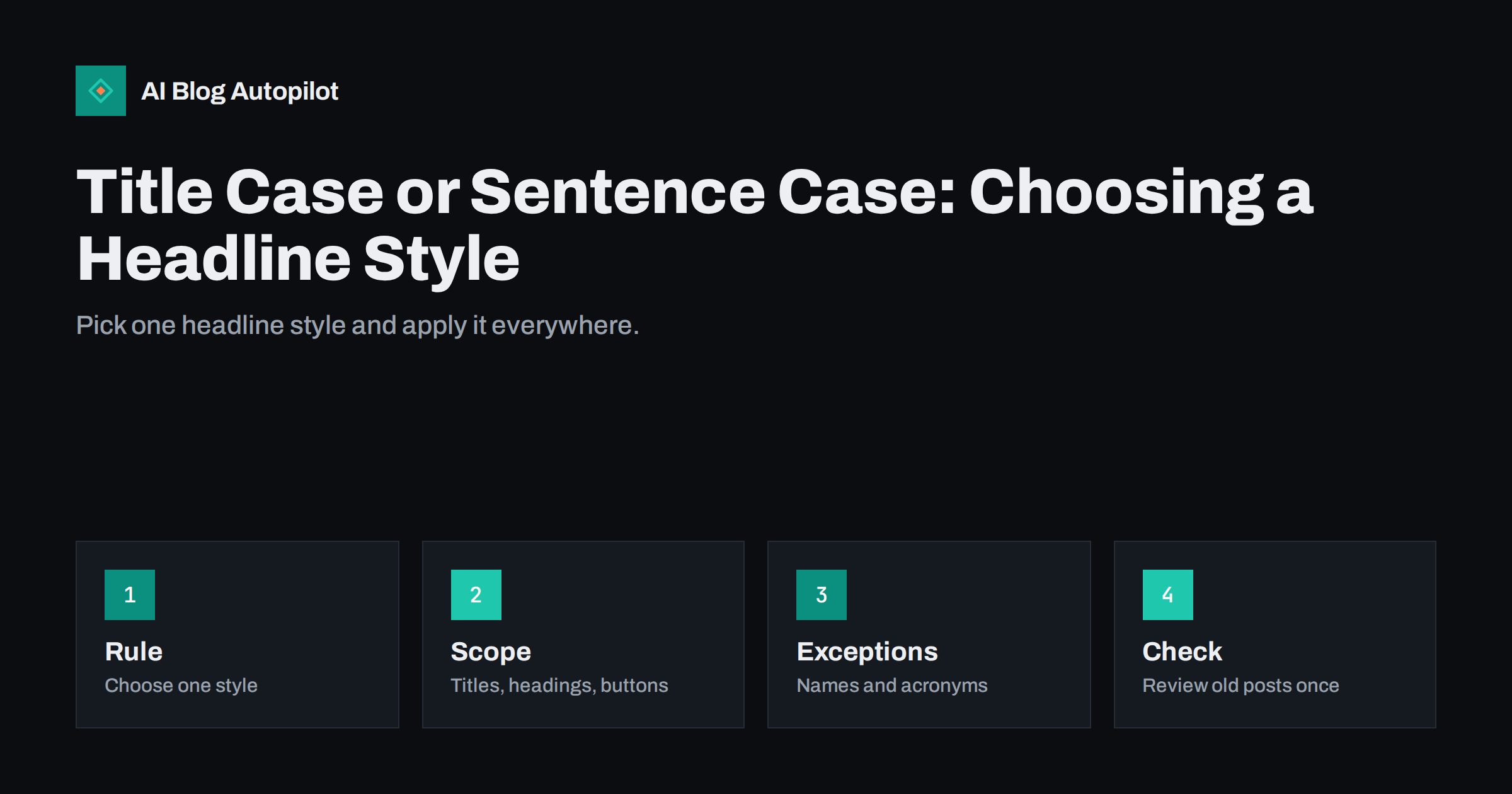
Short answer: title case and sentence case have no direct effect on search rankings. Search engines read the words, not the capital letters. The real choice is about readability, brand tone and consistency. Sentence case, where only the first word and proper names are capitalised, is easier to read in long headlines and is common on modern sites. Title case looks more formal and works well for short titles. Pick one, write the rule down, apply it to every title and heading, and fix the exceptions in your style guide.
Headline style is one of those small decisions that nobody notices when it is consistent and everybody notices when it is not. A blog with a mixture of styles looks unmanaged, and a headline with odd capitals in the middle can look like an error in a search result. This guide explains the two styles, the practical differences and a simple way to settle the question once.
What the two styles mean
In title case, the main words of a headline start with a capital letter. Small words such as articles, short prepositions and conjunctions usually stay in lower case, unless they come first or last. In sentence case, a headline is written like a normal sentence: the first word is capitalised, and so are proper names, but nothing else.
- Title case: How to Plan a Content Calendar for a Small Business
- Sentence case: How to plan a content calendar for a small business
The two lines say exactly the same thing. The difference is visual rhythm. Title case creates a capital letter every few characters, which gives a formal, newspaper-like look. Sentence case is quieter and closer to how people speak and write messages.
Does either style affect rankings?
No. Search engines normalise capital letters when they match a query to a page, so a search for a phrase finds the same pages whatever the capitalisation. Neither style is a ranking factor, and no guideline from a search engine recommends one over the other. Claims that one style earns more clicks are usually based on small tests that are hard to repeat across different audiences.
What can matter indirectly is how the title looks in the results page. Capital letters take more horizontal space than lower-case letters, so a title in title case may be cut off slightly earlier by the width limit. This is a small effect, but if your titles are long, sentence case can fit a few more words before truncation. The more important factor is still the length and clarity of the words themselves.
How each style reads
Readers process lower-case words faster because the shapes of words are more distinctive. Long headlines in title case can feel heavy, and the eye has to work harder to find the meaning. For short titles of three to five words, the difference is almost invisible, and title case can look neat and confident.
Tone matters too. Title case tends to suggest authority, tradition and formality, which suits legal, financial and academic topics. Sentence case suggests a conversational, helpful voice, which suits how-to guides, advice and most small-business blogs. Neither is better in itself; the question is which fits the voice of your brand. If your brand voice guidelines describe your writing as plain and friendly, sentence case supports that. If they describe it as precise and formal, title case may be the better fit.
The practical problems of title case
Title case sounds simple, but it has many small rules, and different style guides disagree on them. Which prepositions stay lower case? Is a four-letter word capitalised? What about words after a colon or a hyphen? Each guide has its own answers, and writers who do not know the rule will guess, producing inconsistent results.
- Short words: some guides lower-case words with up to three letters, others up to four or five.
- Hyphenated words: should the second part of a compound be capitalised?
- After a colon: many guides capitalise the first word of the second part, but not all do.
- Words like “is”, “are” and “be”: these are verbs and are capitalised in most guides, though writers often forget.
- Automatic tools: online converters apply their own rules and may disagree with your guide.
Sentence case has fewer rules, which is its main practical advantage. The only judgement calls are what counts as a proper name or an acronym, and these are much easier to list.
Exceptions you need to list
Whichever style you choose, a short list of exceptions prevents mistakes. In sentence case, the exceptions are the words that must keep their capitals: names of people, places, products, companies and acronyms. In title case, the exceptions are the small words that stay in lower case. Put the list into your editorial style guide so that every writer, human or automated, can follow it.
- Brand names: write them as the owner does, even when this includes unusual capitals.
- Acronyms: keep them in capitals, such as SEO or FAQ, and avoid mixing styles within a single heading.
- Product and feature names: decide whether they are capitalised and be consistent in every article.
- Job titles and days: days and months are capitalised in English; job titles usually are only before a name.
- Quoted titles: when you refer to the title of another work, keep the capitalisation it uses.
Where the rule applies
A headline style should be defined for more than the main title. A complete rule covers every place where a reader sees a heading or label, so that the site feels like one product.
- The article title and the title tag, which should normally match in style.
- Subheadings inside the article, from the second level down.
- Social preview titles and the text of buttons or calls to action.
- Menu items, category names and tag names.
- Email subject lines and newsletter headings, if they are drawn from the blog.
Many sites use title case for the main headline and sentence case for subheadings. This is acceptable if it is written down as a rule and applied everywhere. Problems arise only when the choice is left to each writer and varies from one post to the next.
Headlines in other languages
A headline style also travels badly if nobody checks it. A rule that works in one language can look strange in another, so plan for this early.
If you publish in several languages, remember that English title case is mostly an English habit. Many languages, including most European ones, use sentence case for headlines as the normal standard, and applying English-style capitals to them looks wrong to native readers. Germans, for example, capitalise nouns by rule, which has nothing to do with title case. When you publish in other languages, follow the convention of each language, and make a note of this in your style guide so that translated headlines do not copy English capitals by mistake.
The same applies to the reading experience on a multilingual site. A reader who switches languages expects the headline to look natural in the new one. Treat headline style as part of each language’s local conventions, not as a brand rule that overrides them.
How to decide and clean up
You do not need a test or a debate. Take five of your recent headlines and write them in both styles. Read them aloud, view them in a search-result preview on a phone, and ask which looks more like your brand. If the answer is not obvious, choose sentence case, because it has fewer rules and fewer mistakes to correct later.
Then record the decision in one paragraph: the chosen style, the places it applies and the list of exceptions. Share it with everybody who writes or edits, and with any tool that drafts content, so that new articles arrive in the right style without manual correction. A rule that takes a minute to read is much more likely to be followed than a long guide. Review it once a year, because new formats such as social cards or app notifications may need a line of their own.
Once the rule exists, apply it to new posts first. If your archive already has a mixture of styles, you do not have to fix everything at once, and nobody expects a perfect archive overnight. Prioritise by visibility: the posts that bring most traffic and the ones linked from your menu or home page. Changing capital letters in a title is a small edit that does not alter the meaning, and the address of the page should stay the same, so the risk is low.
- Export a list of titles and mark those that do not follow the rule.
- Edit the title and the matching title tag together, so that they stay in step.
- Leave the web address alone unless it contains an obvious error.
- Check the social preview of a few edited posts to confirm that the new title appears.
Do this in small batches over a few weeks. Avoid combining it with other large changes, so that if something looks different in your reports you know what caused it. Keep a short note of the date and the batch, because a change log makes later questions about traffic much easier to answer.
How AI Blog Autopilot helps
AI Blog Autopilot works from the topics, keywords, audience and tone you give it, and writes full articles with FAQ, tags and SEO meta. A clear headline rule is part of the tone you describe, so it is worth writing yours down before you start. See the pricing page for plans.
Related reading
- How to Write a Headline People Actually Click
- How to Write Brand Voice Guidelines an AI Can Follow
- Editorial Style Guide Basics
The bottom line
Capital letters do not change how your pages rank. Choose title case for a formal voice or sentence case for a plain, friendly one, and lean towards sentence case when you are unsure because it is simpler to apply. Write the rule and the exceptions down, apply them to titles, headings and buttons, respect local habits in other languages, and tidy old posts in small batches, starting with the ones that matter most.
BUJ
Does title case help SEO?
No. Search engines ignore capitalisation when matching queries, so neither style is a ranking factor.
Which style gets more clicks?
There is no reliable answer for every audience. Clear, specific wording matters far more than capital letters, so test only if you have enough traffic.
Should the title tag match the article headline style?
Usually yes. Using the same style in both avoids a visible mismatch between the search result and the page.
Can I use different styles for headlines and subheadings?
Yes, if it is a written rule applied everywhere, such as title case for the main title and sentence case for subheadings.
Do I need to change old posts?
Not all at once. Start with the pages that get the most traffic or appear in your menu, and leave web addresses unchanged.