ENEnglish
 LTLietuviškai
 DEDeutsch
 FRFrançais
 RUРусский
 ESEspañol
 PLPolski
 ITItaliano
 UKУкраїнська
 CSČeština
 PTPortuguês
 JA日本語
JA日本語 LVLatviešu valoda
 ETEesti
 HUMagyar
 IDBahasa Indonesia
 TRTürkçe
 HIहिन्दी
 ELΕλληνικά
 ARالعربية
 THไทย
THไทย VITiếng Việt
 RORomână
 MSBahasa Melayu
 BNবাংলা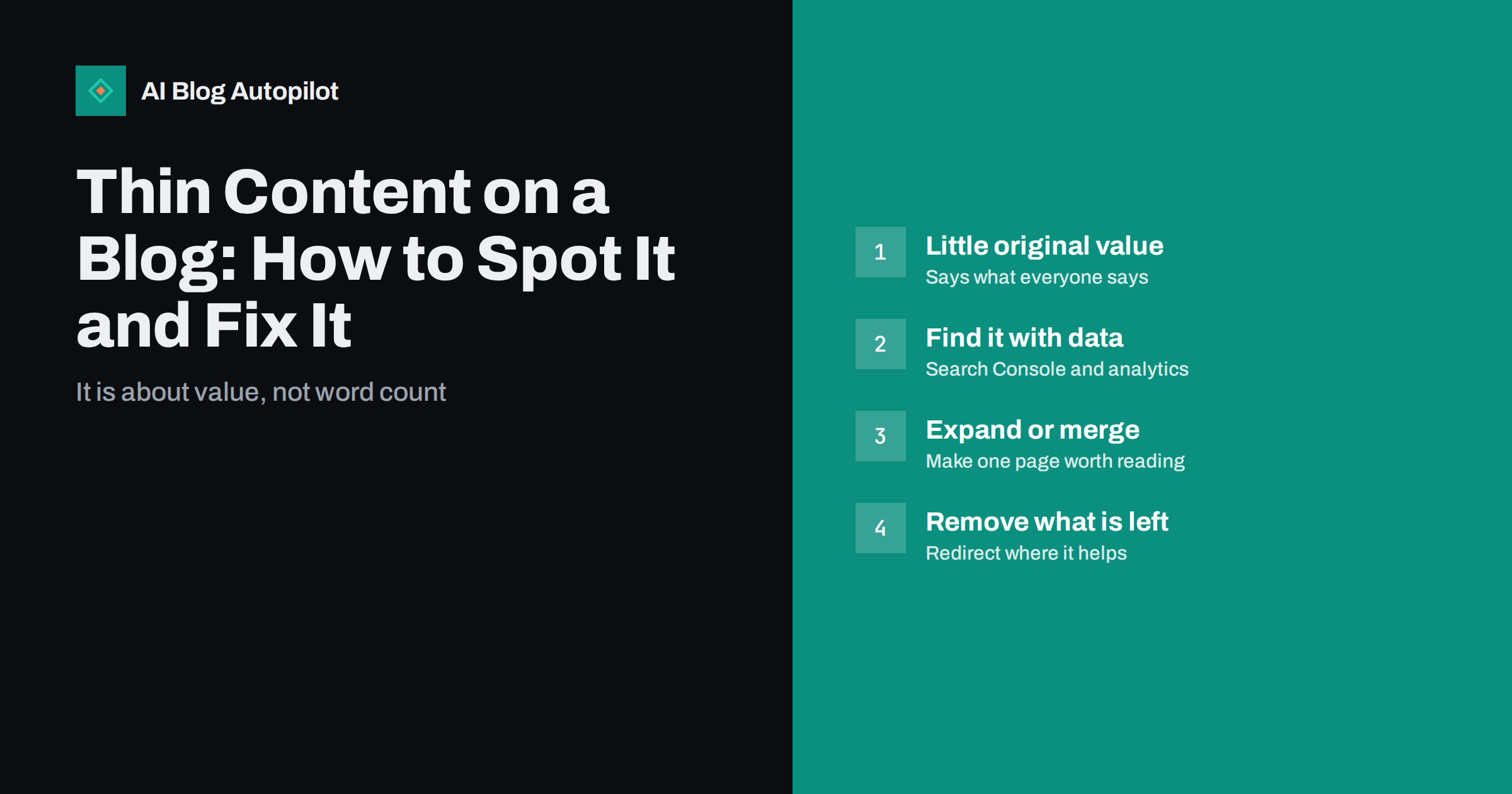
Short answer: thin content is content that gives readers little or no value of its own: posts that repeat what is already everywhere, answer nothing specific, exist mainly to target a keyword, or are near-copies of other pages on the same site. It is not defined by word count; a short, precise answer can be excellent and a long, padded article can be thin. Find candidates with Search Console and analytics, then improve the posts worth keeping, merge overlapping ones, and remove or redirect the rest. A blog with fewer, stronger posts usually performs better than one full of weak ones.
“Thin content” is one of the most repeated phrases in SEO and one of the most misunderstood. Many people hear it and conclude that every post needs to be longer. So they add paragraphs, and the posts get longer but no better.
Search engines are not counting words. They are trying to judge whether a page is genuinely useful to the person who searched. This guide explains what thin content actually looks like on a blog, how to find it and what to do about it.
What thin content means
Google’s guidance on creating helpful, reliable, people-first content asks questions such as whether the content provides original information, analysis or insight, whether it adds substantial value compared with other pages in search results, and whether a reader would leave feeling they learned enough to achieve their goal.
Thin content fails those questions. On blogs, it typically takes these forms:
- Generic rewrites. Posts that restate what the top ten results already say, with no example, experience or angle of their own.
- Keyword pages. Short articles created mainly to target a search phrase, with the answer buried or missing.
- Near-duplicates. Several posts on the same question in slightly different words, often written years apart.
- Announcement stubs. Brief posts about events, offers or updates that have long since passed.
- Padded articles. Long posts where a useful paragraph is surrounded by filler: vague introductions, repeated points, generic tips.
- Auto-generated or scraped pages with little human review and nothing to distinguish them from their sources.
Why word count is the wrong test
Length correlates loosely with depth, which is why long articles often rank well for complex topics. But length is a side effect, not the goal.
- A 300-word post that precisely answers a narrow question, with a clear example, can serve its reader perfectly.
- A 3,000-word post that circles a topic without committing to anything useful is thin, however long it is.
- Adding words to a weak post rarely fixes it. Adding substance does: a worked example, a checklist, a comparison, real experience, an answer to the follow-up questions readers actually have.
The right question is not “is it long enough?” but “would someone who searched for this be glad they found this page rather than another one?”
Why thin content matters
Individual thin posts are rarely a disaster, but they add up:
- They do not rank or convert. A post that gives readers nothing new has little chance of being chosen over better pages.
- They may not be indexed. Search engines often crawl such pages and decide not to index them, which shows up in Search Console as “Crawled, currently not indexed”.
- They can affect how the site is seen. Search engines assess quality at the site level as well as page by page. A large share of unhelpful pages can weigh on how the whole site performs.
- They dilute internal linking and make it harder for readers to find your best work.
- They cost trust. A reader who lands on a thin post is less likely to return or to believe your other articles.
How to find thin content on your blog
You can find most thin posts with free data. Build a simple list of all posts and add a few columns:
- Search Console clicks and impressions over the last twelve months. Posts with almost no impressions are either off-target or not trusted.
- Index status. Posts reported as crawled or discovered but not indexed deserve a close look.
- Analytics engagement. Very short engagement time or high exit rates on posts that do get visits can signal disappointment.
- Word count, not as a verdict but as a filter. Very short posts are worth reviewing first.
- Topic overlap. Sort by main topic or keyword to spot several posts answering the same question.
- Age and accuracy. Old posts with outdated facts often become thin in effect even if they were good once.
Then read the flagged posts. Data finds candidates; only reading tells you whether a post is actually weak or just new, niche or seasonal.
Four ways to fix it
Every thin post gets one of four treatments:
| Situation | Treatment |
|---|---|
| Topic is valuable, post is weak | Improve: rewrite with real substance, examples and a clear answer |
| Several posts cover the same question | Merge into the strongest one and redirect the others |
| Post is useful to some readers but not for search | Keep it, and consider noindex |
| Outdated, irrelevant or valueless | Remove, with a redirect if a relevant page exists |
Check external links before removing anything. A weak post that other sites link to should usually be merged or redirected rather than deleted, so those links still lead somewhere useful.
How to improve a thin post properly
When a topic deserves a good article, improving the existing post is usually better than starting again, because the URL keeps any history it has.
- Clarify the question. Decide exactly what the reader searched for and put a direct answer at the top.
- Check the competition. Read the pages that rank and note what they cover and what they miss.
- Add what only you can add. Your experience, a real example from your work, a screenshot, a process you use, a mistake you have seen. Never invent it.
- Cover the follow-up questions readers usually have next, in sections or a short FAQ.
- Cut the filler. Remove generic introductions, repeated points and vague advice.
- Update facts and links, and change the visible date only if the content has genuinely changed.
- Link it into the site from related posts, so the improved page is easy to find.
A simple before-and-after
Imagine an accounting firm’s blog post titled “Invoice Tips for Freelancers”. It has 400 words: an introduction about how important invoicing is, five one-line tips such as “be professional” and “send invoices on time”, and a closing line inviting readers to get in touch. It gets a trickle of impressions and almost no clicks.
Nothing in it is wrong. It is simply thin: every tip is generic, none is explained, and a freelancer learns nothing they did not already know.
The improved version answers a specific question, “What must a freelancer’s invoice include?”, in its first paragraph. It then lists the required details in a checklist, explains payment terms and what to write about late payment, shows a sample layout, covers what to do when a client does not pay, and ends with a short FAQ on the questions the firm’s own clients ask most. The firm adds a note from its experience about the invoicing errors it sees most often.
The article is longer, but that is a side effect. What changed is that a reader can now finish it and send a correct invoice.
Preventing thin content in future
It is easier to avoid thin posts than to clean them up later:
- Check before writing. Make sure no existing post already answers the question; update that one instead.
- Start from a real question readers ask, not from a keyword alone.
- Decide what the article adds before drafting it. If you cannot say, reconsider the topic.
- Review before publishing, whether the draft was written by a person, an agency or an automated tool.
- Audit once or twice a year using the method above, and deal with new weak posts while the list is short.
How AI Blog Autopilot approaches quality
AI Blog Autopilot writes long-form articles of 2,000 to 3,000 words, each planned around a real search query, with FAQ, tags and SEO meta. An automatic quality gate checks length, structure, keyword and meta, and articles that fall short wait for you instead of going live; the writer is instructed never to make up statistics, quotes or sources. Choosing distinct topics that match what your business knows remains the best protection against thin content. You can read more on the AI Blog Autopilot home page.
Related reading
- Content Pruning: When to Delete, Merge or Redirect a Blog Post
- How to Refresh Old Blog Posts (and When It Beats Writing New Ones)
- Crawled but Not Indexed: Why Some Blog Posts Stay Out
- Keyword Cannibalisation: When Your Own Posts Compete
The bottom line
Thin content is content without value of its own, not content without enough words. Find weak posts with Search Console and analytics, read them, and decide for each: improve it with real substance, merge it into a stronger post, keep it out of search, or remove it with a redirect. Then prevent new thin posts by starting every article from a real question and a clear idea of what it adds.
BUJ
What is thin content in SEO?
Thin content is content that offers little or no original value to readers, such as generic rewrites of other pages, short keyword-targeted posts without a real answer, near-duplicate articles and padded posts full of filler. It is judged by usefulness, not by word count.
Is a short blog post thin content?
Not necessarily. A short post that precisely answers a narrow question can be very useful. A post is thin when it fails to give the reader what they came for, whatever its length.
Does thin content cause a penalty?
Thin content is not usually a manual penalty, although pure spam can be. More often, thin pages simply do not rank or are not indexed, and a large share of unhelpful pages can affect how search engines assess the whole site.
Should I delete thin blog posts?
Only after checking. Improve posts on valuable topics, merge overlapping posts into a stronger one and redirect them, and remove only outdated or valueless posts. If a post has external links, redirect it to the most relevant page rather than simply deleting it.
How can I find thin content on my site?
List your posts with Search Console clicks, impressions and index status, plus engagement data from analytics. Flag posts with almost no impressions, not-indexed statuses, very short engagement or overlapping topics, then read them to decide what each needs.
Will adding more words fix thin content?
Rarely on its own. Padding a weak post makes it longer, not better. What helps is substance: a clear answer, examples, experience, comparisons and answers to the follow-up questions readers actually have.