ENEnglish
 LTLietuviškai
 DEDeutsch
 FRFrançais
 RUРусский
 ESEspañol
 PLPolski
 ITItaliano
 UKУкраїнська
 CSČeština
 PTPortuguês
 JA日本語
JA日本語 LVLatviešu valoda
 ETEesti
 HUMagyar
 IDBahasa Indonesia
 TRTürkçe
 HIहिन्दी
 ELΕλληνικά
 ARالعربية
 THไทย
THไทย VITiếng Việt
 RORomână
 MSBahasa Melayu
 BNবাংলা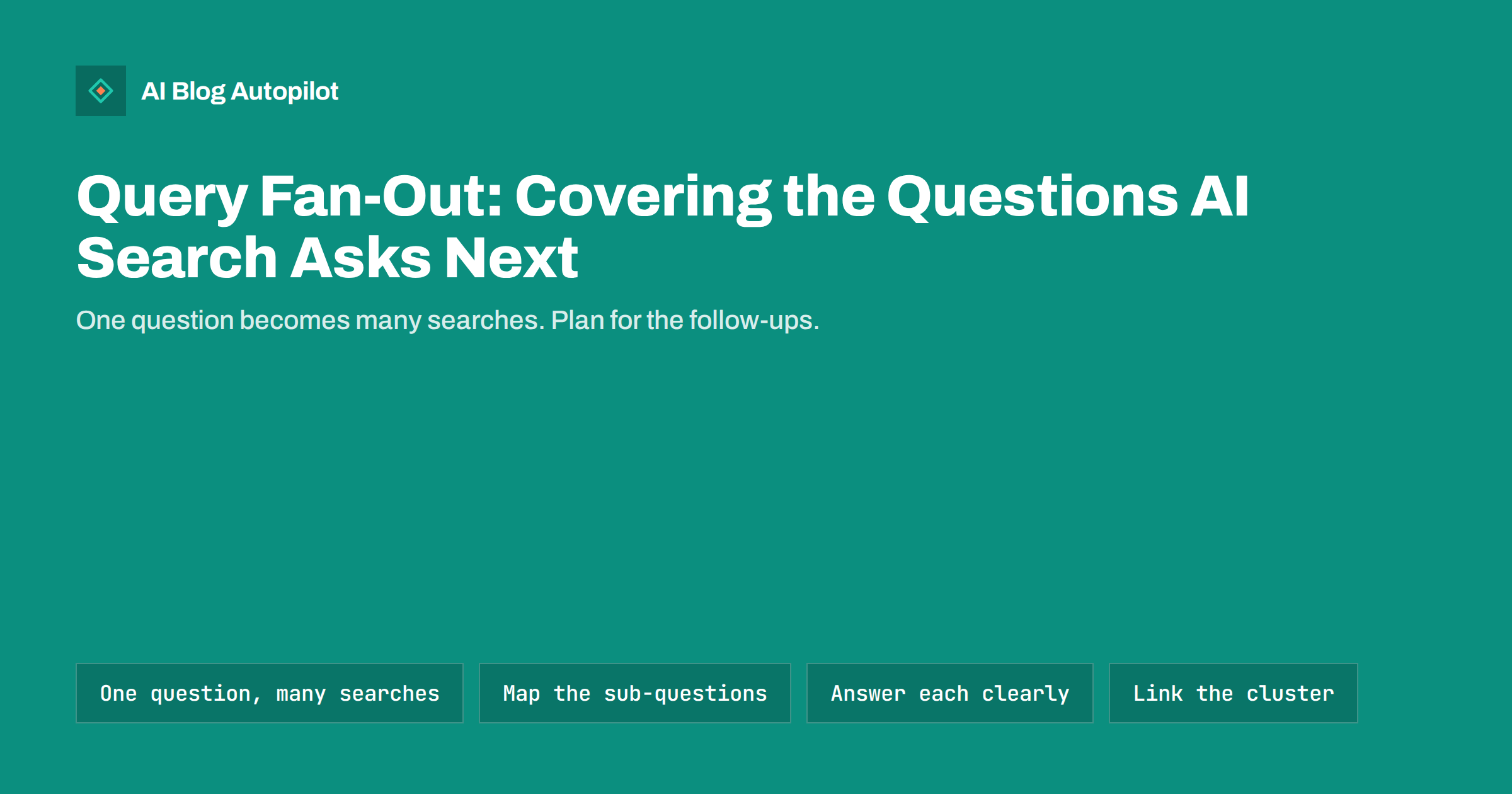
Short answer: query fan-out is a technique AI search features use to answer a complex question: instead of running one search, the system breaks the question into related sub-questions and searches for each of them, then combines the results into one answer. Google says both AI Overviews and AI Mode may use it. For a blog, this means a page can be cited for a sub-question it answers well, so articles should cover the natural follow-up questions in clear, self-contained sections, and larger branches deserve their own linked articles.
Traditional search matched one query to a list of pages. AI search features behave more like a researcher: they take a question such as “is an e-bike worth it for commuting in a hilly city”, work out what someone would need to know to answer it properly, and look for each piece separately. Understanding that process changes how you plan and structure blog content, and it rewards the kind of thorough, well-organised writing that already works for readers.
What query fan-out means
Google’s page on AI features and your website explains that AI Overviews and AI Mode may use a “query fan-out” technique, issuing multiple related searches across subtopics and data sources to develop a response. Other AI assistants that search the web work in a broadly similar way: they rewrite, split or expand the user’s question before retrieving pages.
Take the commuting question above. A fan-out might produce searches along these lines:
- How far can a typical e-bike go on one charge?
- How do e-bikes handle steep hills, and which motor types are better for climbing?
- What does it cost to run an e-bike compared with public transport or a car?
- What do commuters need for rain, security and parking?
- What are the rules for e-bikes on roads and cycle paths in a given country?
The final answer draws on sources for each part. A page that only says “e-bikes are great for commuting” has little to contribute. A page with a clear section on hill climbing, or a precise cost breakdown, can be used for that part of the answer even if it would never rank first for the original question.
Why it matters for a blog
Fan-out changes the competition in a few useful ways for smaller sites:
- Specific sections can be cited on their own. AI answers retrieve passages, not just whole pages. A well-labelled section that directly answers one sub-question has a chance to be used, even on a site that is not the biggest in its field.
- Coverage of follow-ups matters. The systems anticipate what the user will need next. Articles that already answer the obvious follow-up questions match more of those hidden searches.
- Long-tail topics get searched on the user’s behalf. Sub-questions that few people type directly, such as a specific maintenance step, can still be searched as part of a bigger question.
- Vague content has nothing to offer. Pages that circle a topic without concrete answers do not match any particular sub-question.
It is worth being clear about what we do not know. Google does not publish how many sub-queries are generated, how they are chosen, or how sources are weighted. Nobody outside the company can see the fan-out for a specific search. The practical advice below does not depend on those details; it follows from the documented idea that answers are assembled from several related searches.
How to find the sub-questions for a topic
You cannot see the exact fan-out, but you can reliably predict most sub-questions, because they are the same ones a knowledgeable person would ask. Useful sources:
- Customer conversations. The questions people ask your sales or support team after the first one are exactly the follow-ups an AI system anticipates.
- People Also Ask and related searches. These show the questions Google already associates with a topic.
- AI assistants themselves. Ask one to list the questions a buyer or beginner should consider for a topic. Treat the output as a brainstorming list to check, not as research.
- Standard dimensions. Most practical topics branch into the same kinds of sub-question: what it is, how it works, cost, comparison with alternatives, steps, requirements, risks, and who it suits.
- Search Console queries. Longer, question-style queries that already bring impressions show which sub-questions people associate with your pages.
Write the list down per topic before drafting. It becomes both the outline of the main article and a list of candidates for separate articles.
Structuring an article for fan-out
Once you have the sub-questions, structure the article so each important one has an obvious home:
- Open with a direct answer to the main question in two to four sentences.
- Give each major sub-question its own H2 or H3, with a heading that names the sub-topic plainly, such as “How much does it cost to run” rather than “The money side”.
- Answer at the start of each section. The first sentence or two should make sense on their own if lifted out of the page.
- Include the specifics that make an answer usable: ranges, conditions, steps, names of standards, and dates where things change.
- Use tables for comparisons where several options are compared on the same criteria.
- Add an FAQ for the smaller follow-ups that do not justify a full section.
This is not a special format for machines. It is the same structure a good reference article has always had, applied consistently. The guide on answer-first writing covers the paragraph-level habits in more detail.
One article or several?
Fan-out does not mean every article should try to answer everything. Some sub-questions are large enough to need their own page. A simple rule of thumb:
- If a sub-question can be answered well in one or two paragraphs, keep it as a section in the main article.
- If answering it properly takes a full guide, and people also search for it on its own, give it a separate article and link to it from the relevant section.
- If two sub-questions would produce near-identical articles, keep them together, to avoid pages competing with each other.
The result is a small cluster: a main article that answers the core question and summarises each branch, and deeper articles for the branches that deserve them, all linked together with descriptive anchor text. This helps readers and makes the site a consistent source for the whole topic. See content clusters and pillar pages for how to organise it.
A worked example
Imagine an accounting firm planning an article on “should a freelancer register for VAT voluntarily”. Listing the sub-questions first might give:
- What voluntary registration means and how it differs from compulsory registration.
- The main advantages, such as reclaiming VAT on purchases.
- The main disadvantages, such as higher prices for private customers and more administration.
- Which kinds of freelancer usually benefit, and which usually do not.
- How to register and what changes afterwards.
- How to deregister later if it turns out to be the wrong decision.
Items one to four fit comfortably as sections of the main article, each opening with a direct answer and stating the country it applies to. The registration process, with its forms and deadlines, may justify its own step-by-step article, linked from a short summary section. Deregistration might be a single FAQ answer. The finished article answers the core question clearly, and each section is a usable source for one part of a larger AI answer. Because it is a tax topic, a qualified person should check the figures and rules before it is published.
Common mistakes
- Stuffing every possible question into one page. Coverage should be useful, not exhaustive. A section that exists only to mention a keyword adds length without helping anyone.
- Generating dozens of thin articles for tiny variations of a sub-question. They compete with each other and look like scaled, low-value content.
- Vague headings that do not say which question the section answers.
- Burying the answer after long context, so no single passage stands on its own.
- Assuming a tool can show the real fan-out. Tools that claim to reveal it are estimating. Use them for ideas, not as fact.
Measuring the effect
Traffic from AI features is hard to isolate. Google includes AI Overviews and AI Mode data in the overall Search Console performance report rather than in a separate report, so you cannot filter for it there. Reasonable signals to watch:
- Growth in impressions for long, question-style queries on the article.
- Whether the article appears as a source when you manually test typical questions in AI search features, done consistently over time.
- Referral visits from AI assistants in your analytics, where they pass referrer information.
- Enquiries or conversions from the article, which matter more than any visibility measure.
How AI Blog Autopilot fits in
AI Blog Autopilot plans articles from the topics, keywords and audience you give it and writes long SEO articles with an answer-first structure, descriptive headings and an FAQ for follow-up questions. You can steer the plan so that big sub-topics become their own articles rather than being squeezed into one. It cannot guarantee that any AI feature will cite a page. See how Autopilot works.
Related reading
- Conversational Queries: Writing for How People Ask AI
- Using People Also Ask as a Content Source
- Topical Authority: What It Means in Practice
The bottom line
AI search increasingly answers one question by running many related searches. You cannot see those searches, but you can predict most of them: they are the follow-up questions your customers already ask. Cover them in clearly labelled, answer-first sections, give the big branches their own linked articles, and avoid padding. That makes your content useful for each piece of the answer, and for the people reading it.
BUJ
What is query fan-out?
Query fan-out is a technique where an AI search feature breaks a question into several related sub-questions and searches for each of them. The results are then combined into one answer. Google says AI Overviews and AI Mode may use it.
Can I see which sub-queries were used for a search?
No. Google does not show the fan-out for individual searches, and tools that claim to reveal it are estimating. You can predict likely sub-questions from customer questions, People Also Ask and related searches.
Should one article answer every related question?
No. Answer the main question and the common follow-ups in clear sections. Sub-questions that need a full guide of their own are better as separate articles linked from the main one.
Does query fan-out help small sites?
It can, because answers draw on passages that address specific sub-questions. A small site with a clear, specific section on one part of a topic can be cited for that part, though no citation is ever guaranteed.
How do I track traffic from AI Overviews and AI Mode?
Search Console includes this traffic in the overall performance report without a separate filter. Watch impressions for longer question queries, test typical questions manually over time, and check analytics for referrals from AI assistants.