ENEnglish
 LTLietuviškai
 DEDeutsch
 FRFrançais
 RUРусский
 ESEspañol
 PLPolski
 ITItaliano
 UKУкраїнська
 CSČeština
 PTPortuguês
 JA日本語
JA日本語 LVLatviešu valoda
 ETEesti
 HUMagyar
 IDBahasa Indonesia
 TRTürkçe
 HIहिन्दी
 ELΕλληνικά
 ARالعربية
 THไทย
THไทย VITiếng Việt
 RORomână
 MSBahasa Melayu
 BNবাংলা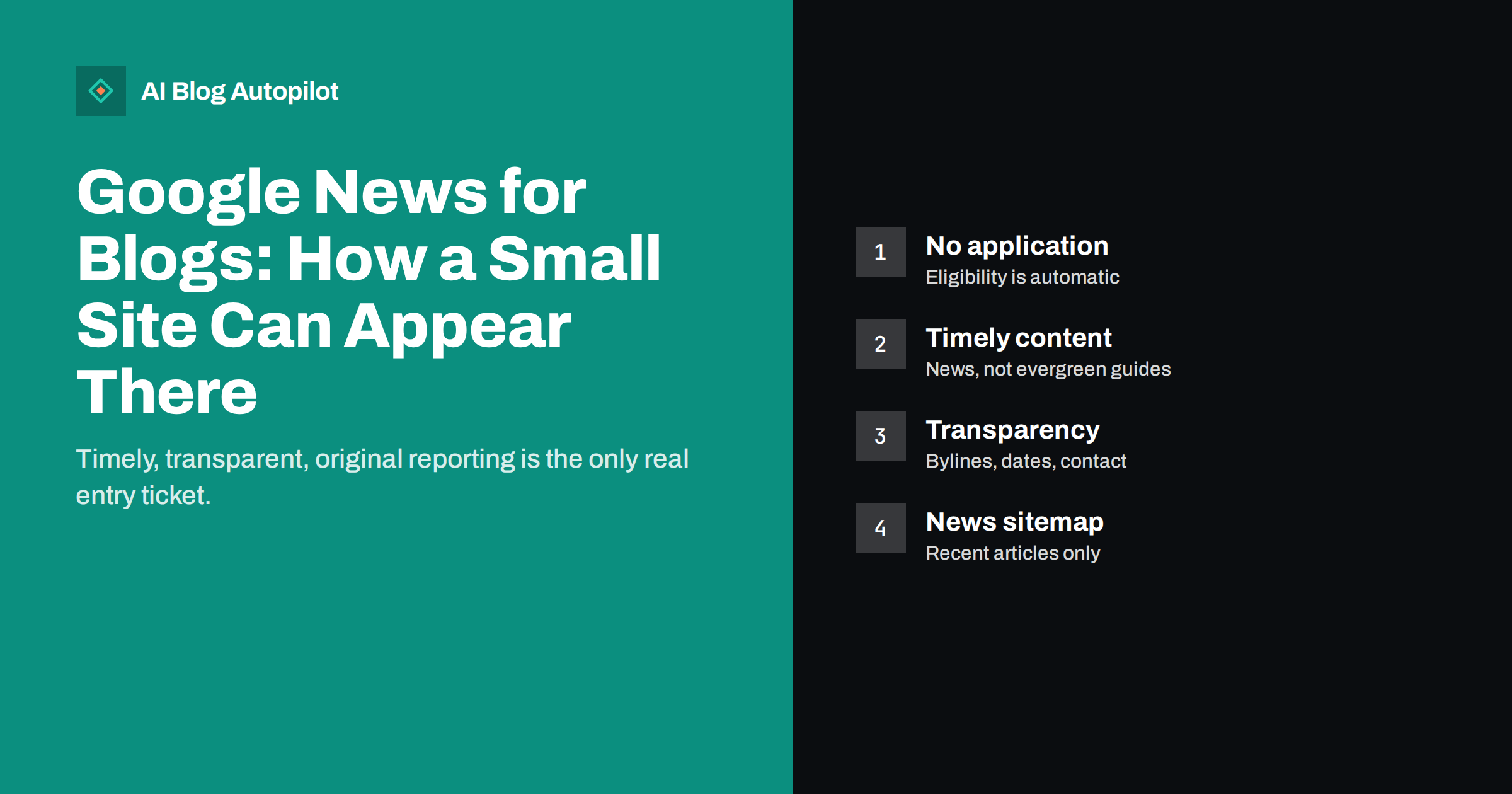
Short answer: any site, including a small blog, can appear in Google News and in the Top stories results, and there is no application form that guarantees it. Google automatically considers sites that publish timely, original news content and follow its news content policies. A blog full of evergreen how-to guides will rarely show up there, because those surfaces are built for current events. If you do publish news, clear bylines, dates, contact details and a news sitemap make you a more credible candidate.
Google News is a separate product with its own app and site, but news results also appear inside regular search: in the Top stories carousel, in the News tab and in the feed on mobile devices. For a publisher with timely content, these surfaces can bring sudden bursts of visitors. Many blog owners therefore ask how to “get into Google News”. The honest answer starts with a question about the content itself.
How eligibility works today
In earlier years, publishers submitted their sites for review and waited for approval. That process is gone. Google now considers sites for its news surfaces automatically. Publisher Center still exists as a tool for publishers to manage how their content appears in the Google News app, but adding a site there is not a requirement for showing up and does not guarantee inclusion.
In practice, a site becomes eligible when it publishes content that Google’s systems recognise as news, and when it meets the news content policies. Those policies focus on things like transparency about who is behind the content, avoiding deceptive practices, and not publishing harmful or misleading material. Google describes the rules in its Google News policies.
Being eligible is not the same as being shown. For any given story, many outlets compete, and ranking signals such as relevance, freshness, originality and the publisher’s authority on the topic decide which articles appear.
What counts as news content
This is where most blogs fall outside the picture. News surfaces are built for content about recent events and developments. Typical examples:
- Reports on something that happened today or this week in your industry or local area.
- Announcements of new regulations, products, studies or decisions, with analysis of what they mean.
- Original reporting, such as interviews, data you collected, or coverage of an event you attended.
- Timely commentary from someone with recognised expertise on the subject.
By contrast, a guide to choosing a lawn mower, a recipe or a list of productivity tips is evergreen content. It can rank very well in normal search for years, but it is not what Top stories or the News tab are designed to show. If your blog is mostly evergreen, Google News is simply not the right channel, and that is fine.
A useful test is to ask whether the article would still make sense, unchanged, a year from now. If it would, it is evergreen. If its value depends on the fact that something just happened, it is news. Many good articles mix the two: a short news section explaining what changed, followed by practical advice that stays useful. Such articles can work in both places, but only if the news part is genuinely new and published while it still matters.
Some niche blogs do sit in between. A blog that follows search engine updates, a local site covering city council decisions or a trade blog reporting on industry events can publish genuinely newsworthy articles alongside guides.
Signals that make a site look like a credible news source
Because news can shape opinions and decisions, transparency matters more here than almost anywhere else. Before expecting visibility, check that your site shows:
- Clear bylines. Every news article names its author, with a link to an author page that explains their background.
- Accurate dates. Publication and update dates are visible on the page and in structured data, and they reflect real changes.
- Information about the publisher. An about page describing who runs the site, its purpose and, where relevant, its ownership.
- Contact details. A way for readers to reach the editors, ideally including a way to report errors.
- A corrections practice. When you get something wrong, you fix it openly and note the change.
- Separation of advertising. Sponsored content is clearly labelled and does not look like reporting.
These are good habits for any blog, but for news content they are close to essential. Anonymous articles without dates or contact information are a poor fit for surfaces that aim to show trustworthy reporting.
Technical basics for news articles
News visibility depends on speed: a story is valuable for hours or days, not months. That makes a few technical details more important than usual.
- Fast discovery. New articles should be linked from your homepage or a section page right away, so crawlers find them quickly.
- A news sitemap. A separate sitemap following the news sitemap format lists only articles published in the last two days, with their titles and publication dates. It helps search engines find fresh articles quickly. Older articles stay in your normal XML sitemap.
- Article structured data. Article or NewsArticle markup with headline, author, image and dates helps search engines understand the page.
- Large, relevant images. Top stories and feeds display images prominently, so each article needs a good featured image that is not a logo or stock filler.
- Stable URLs. Each story should have its own permanent URL. Do not reuse one URL for a series of different news items.
- Readable pages. Heavy pop-ups and intrusive ads hurt both readers and your chances in fast-moving results.
Search Console also shows a separate performance report for Google News once your site receives traffic from the News app or news.google.com, which helps you see whether your articles actually appear there.
What does not help
Some tactics circulate in forums but do not work, or can backfire:
- Rewriting other outlets’ stories. Thin rewrites of news published elsewhere add nothing. Google’s systems favour original reporting and are good at spotting the source.
- Labelling evergreen posts as news. Adding a “news” category or NewsArticle markup to a how-to guide does not turn it into news.
- Changing dates to look fresh. Updating the date without real changes is misleading and can make freshness signals less trusted.
- Publishing volume for its own sake. Dozens of short, shallow posts per day do not make a site more authoritative.
- Keyword-heavy headlines. News headlines should state what happened clearly. Clickbait reduces trust and often reduces clicks too.
Is Google News worth it for your blog?
Before investing in news content, weigh what it requires against what you get.
| Question | If yes | If no |
|---|---|---|
| Does your niche have regular, real news? | News articles can work alongside guides | Focus on evergreen search content |
| Can you publish within hours of an event? | You can compete for timely queries | Late coverage rarely appears |
| Can you add original facts or expertise? | Your coverage has a reason to be shown | Rewrites will struggle against larger outlets |
| Do you want lasting traffic? | Mix news with evergreen articles | News traffic spikes and fades quickly |
News traffic is short-lived by nature. A story can bring thousands of visits in a day and almost none a week later. Evergreen articles, by contrast, often grow slowly and keep bringing visitors for years. For most business blogs, evergreen content is the foundation, and news is an occasional addition when something truly matters to your readers.
A practical approach for niche blogs
If your subject does produce news, a sustainable approach is to combine the two types of content:
- Publish a short, accurate news article when something important happens, with your own explanation of what it means for your readers.
- Link that news article to your evergreen guide on the same subject, so readers who arrive for the news find deeper help.
- Update the evergreen guide with the new information, and note the update date honestly.
- Share the news article on your social channels quickly, since social sharing in the first hours often matters as much as search.
This way, news brings attention while evergreen content keeps the value long after the story has faded.
Keep expectations realistic in the first months. Even a well-run niche site may appear in Top stories only for narrow, specialised queries where large outlets have little coverage. That is where small publishers have the best chance: topics that matter a lot to a specific audience but are too small for national media. Track which of your news articles bring visits, and do more of the kind that works.
How AI Blog Autopilot helps
AI Blog Autopilot is built for the evergreen side of a blog: it plans topics from your keywords and audience, writes full SEO articles with FAQ, tags and meta descriptions, publishes them to your WordPress site and shares every article to your social networks with its own text and timing. That gives your blog a steady base of search content, while you add timely news articles yourself when your industry has something worth reporting. See the pricing page for plans.
Related reading
- Evergreen or News Content: What a Business Blog Should Publish
- Google Discover for Blogs
- Publish Dates, Updated Dates and Freshness in Search
- Author Bios and Bylines
The bottom line
There is no form to fill in and no trick that puts a blog into Google News. Sites are considered automatically when they publish timely, original news and follow the news content policies. If your niche has real news and you can cover it quickly and transparently, news articles can bring valuable bursts of traffic. If your blog is mostly guides and advice, put your energy into evergreen content, which keeps working long after any news cycle.
BUJ
Do I need to apply to get my blog into Google News?
No. Google considers sites for its news surfaces automatically. Publisher Center can help you manage how your content appears in the Google News app, but it is not required and does not guarantee inclusion.
Can a personal or small blog appear in Top stories?
Yes, if it publishes timely, relevant news content and follows Google’s news content policies. Size is not a requirement, but original information and clear transparency about the author and publisher matter.
Do I need a news sitemap?
It is not mandatory, but it helps if you publish news regularly. A news sitemap lists only articles from the last two days, which helps search engines find fresh stories quickly.
Will evergreen guides appear in Google News?
Rarely. Google News and Top stories focus on recent events. Evergreen guides perform best in regular search results, where they can bring visitors for years.
How do I know if my site gets Google News traffic?
Search Console shows a separate Google News performance report once your site receives traffic from the Google News app or news.google.com. Regular search clicks from Top stories appear in the standard search performance report.