ENEnglish
 LTLietuviškai
 DEDeutsch
 FRFrançais
 RUРусский
 ESEspañol
 PLPolski
 ITItaliano
 UKУкраїнська
 CSČeština
 PTPortuguês
 JA日本語
JA日本語 LVLatviešu valoda
 ETEesti
 HUMagyar
 IDBahasa Indonesia
 TRTürkçe
 HIहिन्दी
 ELΕλληνικά
 ARالعربية
 THไทย
THไทย VITiếng Việt
 RORomână
 MSBahasa Melayu
 BNবাংলা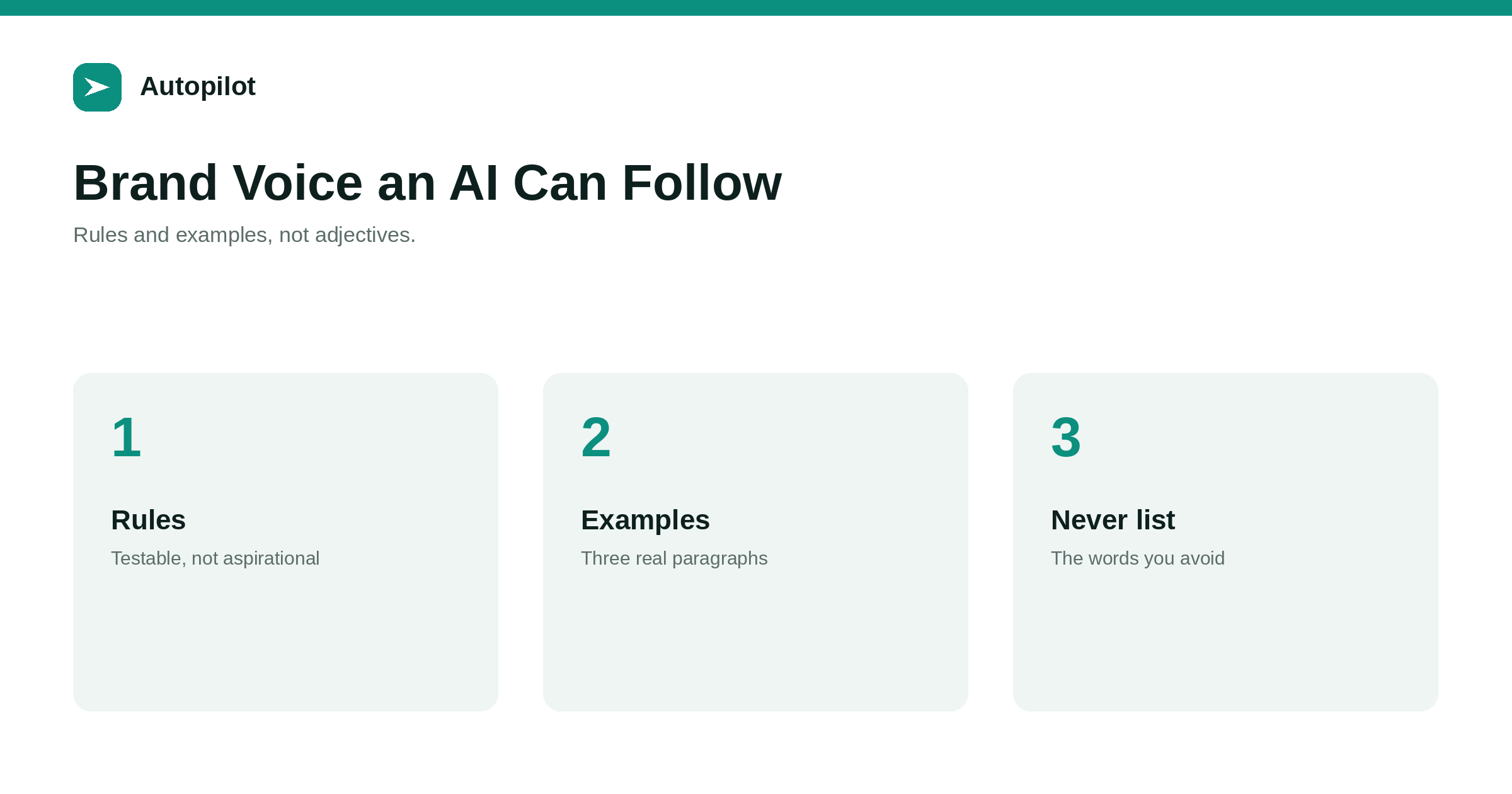
Short answer: replace adjectives with rules and examples. A usable voice guide fits on one page and contains four things: testable rules about sentences and vocabulary, a list of words and constructions you never use, three real paragraphs from your own site marked as the target, and a short note on who you are writing for. Warm, authoritative and approachable are not instructions, because two writers will read them differently and a tool cannot act on them at all. Rewriting a two-page voice document into one page of rules usually removes more editing work than any other single change.
Almost every company has a brand voice document, and almost none of them change what gets written. They are lists of adjectives — confident but never arrogant, expert but accessible — that everyone agrees with and nobody can act on.
The test of a voice guide is simple: could two people who have never met produce similar writing from it, and could you tell which of two drafts followed it? If not, it is a mood board, not a guide.
Why adjectives fail
Ask five writers to be authoritative and you get five different registers, because the word describes an impression rather than a behaviour. Approachable produces exclamation marks from one person and second-person address from another.
The problem is worse when the writing is generated, because a tool cannot infer your intent from your industry or from what your competitors sound like. It follows what is written down, literally. That is a limitation and also the opportunity: literal instructions produce consistent output, which is more than most human style guides achieve.
So write the behaviour rather than the impression. Instead of authoritative: make claims directly, without hedging phrases such as it could be argued. Instead of approachable: address the reader as you, and explain any term a newcomer would not know on first use.
The four parts of a usable guide
One page, four sections.
- Rules. Testable statements about sentences, structure and person. Someone should be able to check a draft against each one and say yes or no.
- The never list. Words, phrases and constructions you do not use. This is the single most effective section.
- Examples. Three real paragraphs from your own site that you are happy with, plus one you are not, labelled as such.
- Reader. Two sentences on who this is for and what they already know.
If it runs past one page, the extra is almost always aspiration rather than instruction.
Writing rules that can be checked
A rule is useful when a draft either follows it or does not.
| Instead of | Write |
|---|---|
| Keep it concise | Most sentences under 25 words; no paragraph over four sentences |
| Be conversational | Address the reader as you; use contractions |
| Sound expert | State the recommendation before the caveats, and only once |
| Be friendly | No exclamation marks; no rhetorical questions as openers |
| Avoid jargon | Explain any acronym on first use, then use it freely |
| Be honest | Never promise a ranking or a result; say when something is uncertain |
Six to ten rules is plenty. Twenty rules is a document nobody reads, and the last ten contradict the first ten.
The never list does the most work
Positive instructions are open-ended; prohibitions are exact. A short never list changes output immediately.
Ours, as an illustration of the shape rather than a template to copy, forbids: unlock, leverage as a verb, game-changer, revolutionise, seamless, effortless, in today’s fast-paced world, any sentence beginning In conclusion, and every construction of the form it is not just X, it is Y.
Build your own by reading four of your existing articles and writing down what made you wince. That list is more specific to your brand than anything you would invent in a workshop, and it is immediately enforceable — you can search a draft for each term.
Examples beat description
Three real paragraphs will do more than a page of rules, because they carry the things rules cannot: rhythm, how much context you give before a point, whether you use humour, how you handle uncertainty.
Pick them deliberately. One explaining something technical to a non-technical reader. One making a recommendation. One acknowledging a limitation or a trade-off. Those are the three situations where voice actually varies.
Include one counter-example too, from your own archive, with a line saying what is wrong with it. The contrast teaches faster than either example alone. If your archive is thin, write the three paragraphs yourself once — it is an hour, and it is the highest-value hour in this exercise.
Where the guide lives and how it is applied
A voice guide is only useful where writing happens, which means it belongs in the instructions attached to every article rather than in a shared drive. In practice it becomes a standing part of the brief, as described in writing a brief an AI can use, so no individual request has to restate it.
Then check it against reality. Read four recent articles and mark every rule violation. If the same one appears repeatedly, either the rule is badly worded or it is fighting something structural, and you should rewrite the rule rather than keep correcting the output. Consistent violations of a clear rule almost always mean the rule was ambiguous.
What voice cannot fix
Two things get blamed on voice and are not voice.
An article with nothing in it. No register saves a page that has no specifics, no position and no experience behind it. That is a brief problem and, past a certain point, a problem only you can solve by adding something you know — see editing a draft.
Inconsistency across a large archive. If you have published for five years with no guide, new articles matching the guide will not match the old ones. That is normal and not worth solving by editing history; apply it forward, and fix older pages only when you are revisiting them anyway.
Related reading
If this was useful, these cover the questions that usually come next.
- Writing a brief an AI can use — where the voice guide gets applied
- Editing a draft — the pass a good voice guide shortens
- Writing a headline people click — voice matters most in the first line
The bottom line
Write rules a draft can be checked against, a never list drawn from your own wincing, three real example paragraphs and two sentences about the reader. Keep the whole thing to a page, attach it to every article rather than filing it, and rewrite any rule that keeps being broken instead of correcting the same thing forever.
BUJ
How long should a brand voice guide be?
One page. Rules, a never list, three examples and a note on the reader. Anything longer tends to be aspiration rather than instruction, and it stops being read.
Why are adjectives like authoritative not enough?
Because they describe an impression rather than a behaviour, and two people will act on them differently. Replace each one with something checkable, such as state the recommendation before the caveats.
What is the fastest improvement I can make?
A never list. Read four of your own articles, write down every phrase that made you wince, and forbid those. It is enforceable by searching a draft and it changes output immediately.
Should the examples be written specially or taken from my site?
From your site if you have paragraphs you genuinely like, because those carry your real rhythm. If not, write three yourself once: one explaining something technical, one making a recommendation, one admitting a limitation.
Will a voice guide make the writing sound less generic?
It fixes register, which is a real part of the problem. It cannot add specifics, a point of view or your own experience, and those are what actually separate a useful article from a competent one.
Do I need to rewrite old posts to match a new guide?
No. Apply it to new articles and fix older ones only when you are editing them for another reason. Rewriting an archive for consistency is a large job with very little return.