ENEnglish
 LTLietuviškai
 DEDeutsch
 FRFrançais
 RUРусский
 ESEspañol
 PLPolski
 ITItaliano
 UKУкраїнська
 CSČeština
 PTPortuguês
 JA日本語
 LVLatviešu valoda
 ETEesti
 HUMagyar
 IDBahasa Indonesia
 TRTürkçe
 HIहिन्दी
 ELΕλληνικά
 ARالعربية
 THไทย
 VITiếng Việt
 RORomână
 MSBahasa Melayu
 BNবাংলা
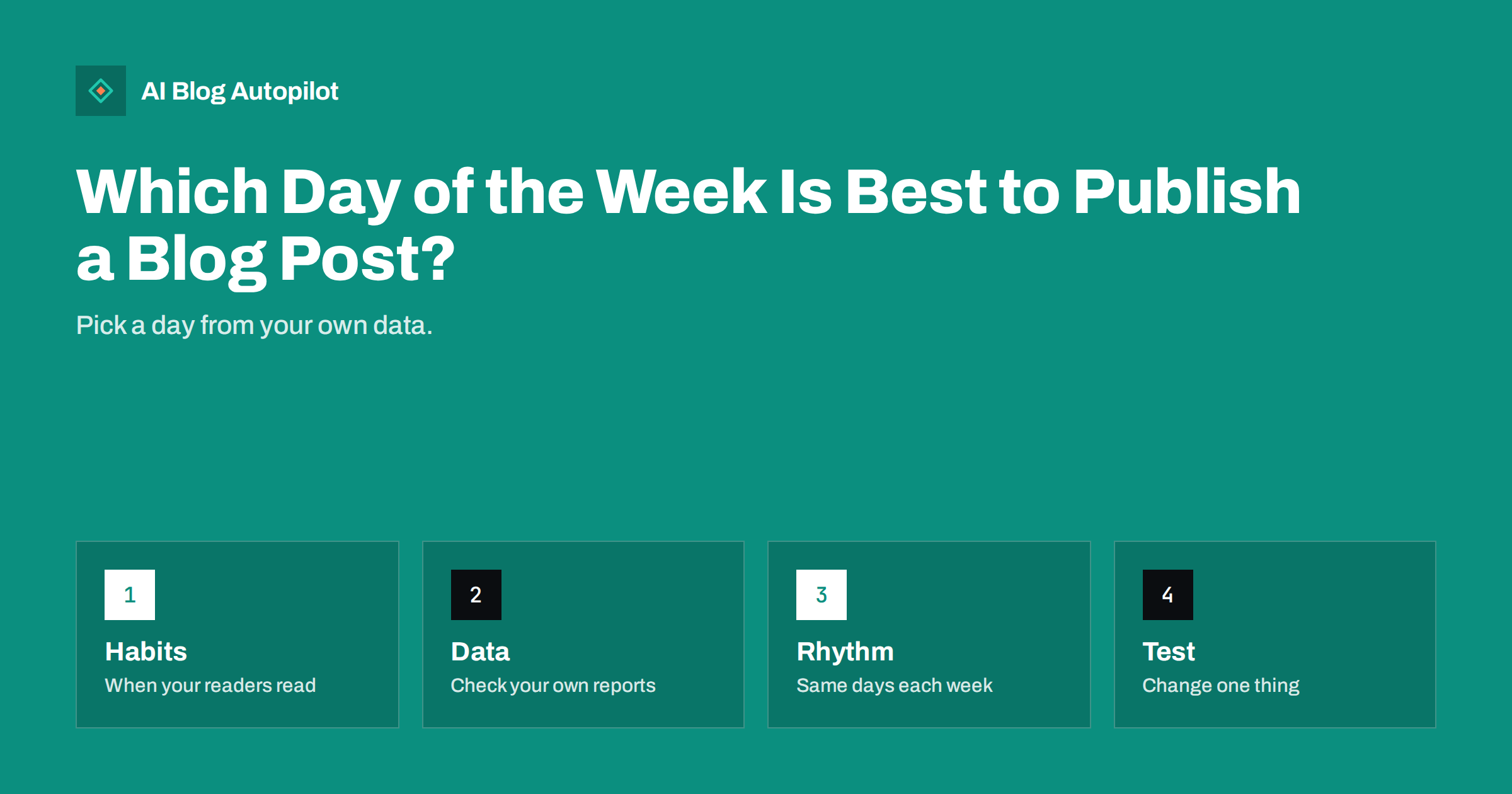
Short answer: there is no single best day to publish a blog post. The right day is the one when your readers have time to read, which you can learn from your own analytics. For most business blogs a steady rhythm on the same days each week matters far more than the weekday, so choose a pattern you can keep and review it every quarter.
Articles about the best day to publish often quote a single weekday as if it applied to everyone. In practice a blog for accountants, a blog for gardeners and a blog for parents of young children have readers with very different weeks. A day that works for one will be quiet for another.
This guide explains what the day of publication can and cannot change, how to find your own answer with data you already have, and how to build a calendar that stays stable even when you are busy. The advice suits company blogs, shops, service businesses and software products.
What the publishing day really affects
The day affects three things: the first burst of visits from people who follow your blog, the timing of your social and email announcements, and the pace at which you can respond to comments and questions. It affects search rankings very little. A search engine finds a new page within hours or days either way, and a page that is useful will keep earning visits for months.
That is why the weekday is a small lever. If a post is weak, no day will save it. If a post is strong, it will find readers whether it appears on a Tuesday or a Saturday. The day only decides how quickly the first readers arrive and whether you are available to help them.
Think about the first forty-eight hours. During that time your newsletter subscribers, social followers and colleagues are most likely to read and share the page. Those early visits can bring links, replies and useful feedback. So choose a day when you or your team can answer a question quickly, not a day that looks good on a chart.
Think about your readers’ week
Start with who reads. Professionals who read at work tend to open articles early in the week, during a commute or at a quiet moment at their desk. Consumers who read for pleasure or for a purchase may read in the evening or at the weekend. Readers who plan an event, a trip or a project may read ahead of a weekend.
Ask a few customers when they usually look for information. A short question in an email or a conversation at the till is enough. Also look at your own habits: when would you read an article like yours? The answers will not be scientific, but they give you a first guess that is better than a rule you read somewhere.
Consider the purpose of the article too. A guide that helps people decide on a purchase suits the days before they usually buy. A seasonal article should appear early enough for readers to act, as the guide to seasonal content planning explains. A news-style post must appear on the day the news happens, whatever the weekday.
Find your answer in your own data
Open your analytics and look at visits to blog pages by day of the week over the last six to twelve months. Note which days bring the most visits overall and which days bring the most visits to articles published in the last week. These are different questions: the first tells you when people read, the second tells you when fresh articles get attention.
Then look at your email and social reports. Note the days when opens, clicks and replies are highest. Compare the pattern with your blog visits. If the two agree, you have a clear signal. If they disagree, trust the channel that brings you the most useful readers, such as enquiries or sign-ups, not just the most clicks.
Be careful with small numbers. A blog with a few hundred visits a month will show random differences between days. Use at least two or three months of data and look for a pattern that repeats, not a single spike. Note also the effect of holidays, school breaks and your own campaigns, which can distort a few weeks of results.
Do not forget the quiet readers who never subscribe. Many people arrive from a search engine weeks after publication, and for them the weekday of the original post is invisible. This is another reason to put effort into the content itself, since evergreen articles earn most of their visits long after the first week.
A useful habit is to note, in your calendar, which posts are time-sensitive and which are evergreen. Time-sensitive posts get the best day you can offer. Evergreen posts can fill the gaps in your rhythm, which takes pressure off the schedule and lets you publish on days that suit your team.
Rhythm beats the perfect weekday
Readers who subscribe to a blog like to know when to expect something. A post every Tuesday and Thursday builds a habit, and a habit brings returning visitors, who are the most valuable ones. A random pattern of five posts one week and none the next makes it harder to build that habit, even if some of the days were theoretically ideal.
Search engines also notice a steady rhythm in the sense that they revisit a site that changes regularly. You do not need to publish every day; you need to publish consistently at a pace you can sustain. The article on how often to publish blog posts helps you pick a frequency before you pick the days.
Pick days that fit your own working week. If you write on Monday and review on Tuesday, publishing on Wednesday gives you a calm margin. If the only time you can promote a post is on Friday, then Friday is your day. A plan that fits your week will survive busy periods, and an ideal plan that you keep missing will not.
Match announcements to the day
The blog post and its announcement are separate events. You can publish on one day and send the newsletter on another, or share the post on social networks at different times for different audiences. Publishing early in the day gives search engines and early readers time to see the page, while the announcements can follow at the times each audience is active.
Each network has its own habits. Professional networks tend to be busier during working hours, and image-led networks tend to be busier in the evening and at the weekend. Treat these as starting points and check your own reports. The article on the best time to share a blog post goes deeper into this.
Avoid clashes. If you send a newsletter, run a promotion and publish a major article on the same morning, each one takes attention from the others. Spread them over the week so each gets a clear moment, and so that a problem with one does not affect the rest.
Test one change at a time
If you want evidence, run a simple test. Keep your usual rhythm for a month, then move one article each week to a different day for a month and compare the results for the first seven days after publishing. Change only the day; keep the topic type, length and promotion similar. Otherwise you will not know what caused the difference.
Record each article, its day, the first-week visits and the first-week actions, such as sign-ups or enquiries. A small spreadsheet is enough. After two or three months you will see whether the day matters for your blog. In many cases the differences are small, which is itself a useful answer: you can then choose the day that suits your team.
Review the pattern each quarter. Reader habits change with seasons, school terms and your own growth. A day that worked last year may be less useful this year. A short review, with a note of what you decided, keeps the calendar honest.
Plan for holidays and quiet periods
Public holidays, school breaks and big events change reading habits. Some readers are away; others have more time. Check the calendar for the countries your readers live in, and decide in advance whether to publish, move a post or leave a gap. A prepared plan is calmer than a last-minute scramble.
If you schedule posts ahead, check them before a holiday. A scheduled post that goes live while nobody is available to answer comments or fix a broken link is a small risk, but one that is easy to avoid. Move important posts to a day when someone is at work.
Finally, do not let the search for the best day delay the work. A good article published on an average day is worth more than a perfect plan that never leaves the notebook. Choose a sensible pattern, publish, and let the data guide small adjustments over time.
Time zones add another layer. If your readers live in several countries, an early morning post in one place arrives in the middle of the night in another. Choose the time of day that suits your largest group, and check your reports for the next largest, instead of trying to please everyone at once.
Finally, write down your decision and the reason for it, for example Tuesday and Thursday mornings because our readers open the newsletter at the start of the week. Colleagues who join later will understand the choice, and you will remember what to test when you next review the calendar.
How AI Blog Autopilot helps
AI Blog Autopilot plans a month of articles from your topics and publishes them to your WordPress blog at the hour you choose, then shares each one to your social networks. That makes a steady rhythm easy to keep. See the pricing page for plans and monthly credits.
Related reading
- Content Calendar on Autopilot: Planning 30 Articles a Month
- How Often Should You Publish Blog Posts?
- Best Time to Share a Blog Post on Social Media
The bottom line
There is no universal best day: learn when your readers read, keep a steady rhythm on days that suit your week, and review the pattern each quarter.
BUJ
Does the day of the week affect search rankings?
Very little. Search engines find a new page within hours or days, and a useful page keeps earning visits whichever day it appeared.
Is Tuesday really the best day?
Not for everyone. Readers differ by audience, so use your own analytics instead of a general rule.
Should I publish on weekends?
If your readers read at weekends and you can answer comments then, yes. Otherwise a weekday is simpler.
How many months of data do I need?
At least two or three, looking for a pattern that repeats rather than a single spike.
Can I publish on one day and announce on another?
Yes. The post and its announcements are separate events and each can use the best time for its audience.