ENEnglish
 LTLietuviškai
 DEDeutsch
 FRFrançais
 RUРусский
 ESEspañol
 PLPolski
 ITItaliano
 UKУкраїнська
 CSČeština
 PTPortuguês
 JA日本語
 LVLatviešu valoda
 ETEesti
 HUMagyar
 IDBahasa Indonesia
 TRTürkçe
 HIहिन्दी
 ELΕλληνικά
 ARالعربية
 THไทย
 VITiếng Việt
 RORomână
 MSBahasa Melayu
 BNবাংলা
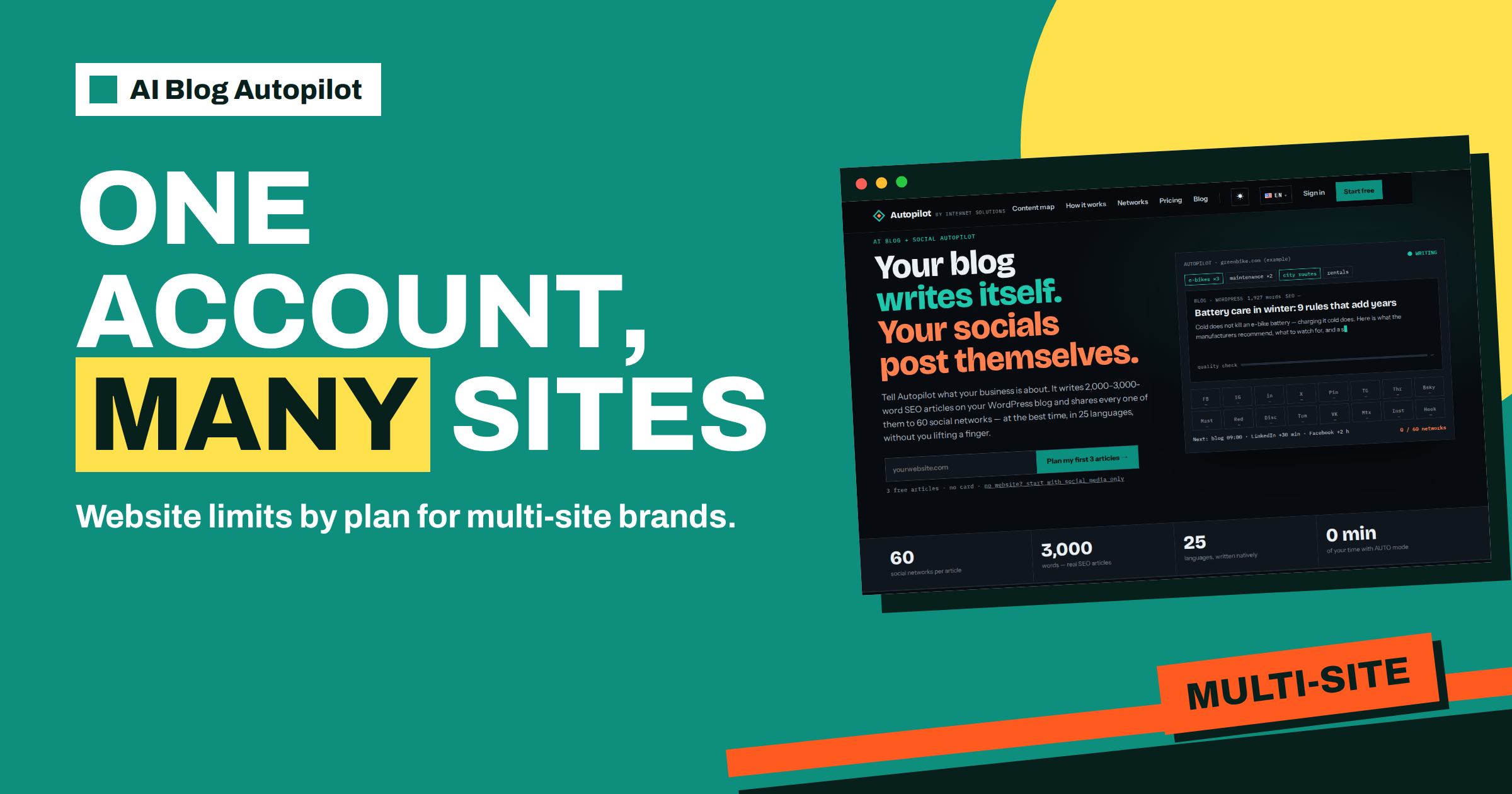
Short answer: A business with several locations or brands can run more than one blog from a single AI Blog Autopilot account, within each plan’s website limit: 1 on Starter, 2 on Growth, 5 on Pro and 20 on Agency. Give each site its own topics, audience and tone, avoid copying articles between sites and match the plan to how many articles you can review.
Companies with several branches, shops or brands face a particular content problem. One blog for everything is simple, but it blurs local relevance. A separate blog for each location earns local search visibility, but it multiplies the work. Many multi-site businesses end up with a few active blogs and several that were abandoned after a month.
This guide shows how to use the website limits on the AI Blog Autopilot pricing page to run several blogs sensibly, and how to avoid the traps, such as duplicated articles and inconsistent voice. Product facts come from the pricing page and the home page. Decisions about your structure depend on your business, so use the advice as a framework.
What the pricing page says about websites
The pricing page lists the number of websites for each plan. Starter includes 1 website, Growth 2, Pro 5 and Agency 20. The Social plan is for people with no website. Each paid plan also lists a monthly number of articles: 8, 30, 70 and 200 respectively, and the page says credits are monthly and do not roll over.
So the website limit and the article count work together. With Pro, you can connect up to five blogs, and share 70 articles a month between them. Agency allows 20 websites with 200 articles. The page does not say how articles are divided among sites, so plan the split yourself and check how it works in your account.
Languages matter too. Growth lists 3 languages, while Pro and Agency list all 25. A business with locations in several countries may need languages as well as websites, and this can decide which plan fits.
One blog or several
Before you use the limit, decide whether you need several blogs at all. One blog is easier to maintain and builds authority in one place. It suits a brand whose locations offer the same services, where location pages and a shared blog are enough.
Several blogs make sense when each location has its own site, address, audience or language. A restaurant group with separate websites per venue, a franchise with local sites, a clinic network in different cities or a company with distinct brands for distinct customers are typical cases. Each site then needs its own content.
Weigh the cost honestly. Every extra blog needs a brief, review and attention. If you cannot review articles for a site, do not connect it yet. The article on WordPress Multisite for several blogs weighs the technical side.
Give each site its own brief
The home page says you give Autopilot topics with weight, keywords, audience and tone. For each site, write a separate brief. A branch in a coastal town and a branch in a city centre have different customers, questions and seasons. A shared brief produces articles that could belong to either, and belong to neither.
Start from local facts: the area, the customers, the services offered there, local events and the questions asked at the counter or on the phone. Add keywords with place names where it is natural. Set the tone for each site: a family-run branch may be warmer than a corporate site.
Keep a shared core. Brand name, values, product facts and legal wording should be consistent across sites, so keep a company-wide fact sheet and copy it into each brief. The article on brand voice guidelines for AI content explains how to hold a voice steady while allowing local variation.
Avoid duplicate content across sites
The biggest risk with several blogs is publishing the same article on each. Search engines treat near-identical pages on different sites as duplicates, and the result may be that none ranks well. Customers who visit two sites also notice, and it makes the brand look lazy.
Instead, give each site its own angle. A guide on seasonal maintenance can be written for the local climate on one site and for a different one elsewhere. Case stories, staff profiles, local events and area guides are naturally different. If a topic is truly shared, publish it on the main brand site and link to it from the others.
Check the weights as well. If every site has the same topics at the same weights, the result will be similar articles. Vary them by what each location needs. The article on setting up topics in Autopilot shows how to use keywords and weights to steer.
Match the plan to your review capacity
It is tempting to choose the plan by the number of sites. Choose by review capacity first. Growth lists 30 articles for 2 websites, and Pro lists 70 for 5. If each site gets around eight articles a month, five sites need forty. Can someone read forty articles a month, and check facts for each location?
If not, start with fewer sites. Connect the two most important ones, run them for a month and add the others when the routine works. The home page says approval can be switched on at any time, which suits the first weeks. Remember that unused credits do not roll over, so connecting more sites later is better than letting articles go unread.
Also consider who reviews. A local manager knows the area and can spot a wrong detail, while a central marketer keeps the voice consistent. Many brands use both: local review for facts, central review for tone. The article on choosing an AI Blog Autopilot plan compares the plans.
Keep social channels organised
With several sites, social networks need thought too. The pricing page lists 5 social networks on Starter and all 60 on Growth, Pro and Agency. The networks page says you connect each network once in your account. Decide whether each location has its own social profile or the brand has one shared profile.
Separate profiles give local relevance and let customers talk to their own branch. A shared profile is simpler to manage but needs posts that suit every location. Either can work. The important thing is to avoid posting the same text from several profiles at the same time, which looks like spam.
Check the content map, which the home page describes as a calendar plus a network matrix, with each cell linked to the live post. Review it weekly to see that each site published and each network posted as planned.
Consider a short story. A bakery chain has four shops in four towns and a small central team. Each shop has a simple website with a local blog. The team writes a short brief for each: the town, the regular customers, the bestsellers and the local events. They start with two shops on Growth, review for a month and then upgrade to Pro for all four. Each blog now has its own articles about local festivals, seasonal bakes and opening hours, while the brand site carries the shared recipes. The shop managers read a draft each week and correct the details only they know.
The lesson is that local knowledge cannot be automated, but the routine around it can. The managers contribute facts and review, while Autopilot does the writing and publishing.
A rollout plan for several sites
Roll out in stages rather than all at once. In the first month, connect one site, the one with the clearest brief and the most active manager. Use approval, read every article and adjust the brief. In the second month, add a second site, using what you learned. Keep each stage small enough that review stays careful.
Write down what you learn at each step in a shared document: which instructions improved the articles, which facts needed correcting and how long review took. This becomes a template for the next site, and it shortens the setup for each new location. A short checklist for a new site might list the brief, the fact sheet, the review owner, the networks and the publishing hour.
Review the whole picture each quarter. Look at which sites produce articles that draw readers, which are quiet and why. Move weights and attention accordingly. A site that never gets reviewed is better disconnected than left to run unwatched, because unattended content can drift off brand. The article on planning your monthly credits in Autopilot helps with the numbers.
Working with franchisees and local managers
If your locations are run by franchisees or local managers, agree who owns what. The head office usually owns the brand voice, the product facts and the legal wording. The local team owns local facts: opening hours, staff, events and the neighbourhood. Put this split in writing, and give local managers a simple way to send corrections.
Keep the process light. A local manager who has to fill in long forms will stop. Give each one a short checklist: read the article, check the local facts, reply with changes or approval. Thank them when they help, and share examples of articles that worked, so the effort feels worthwhile.
Finally, keep the brand consistent. Share a style guide that covers names, tone, words to avoid and how to describe services. Local sites may differ in content, but readers should recognise the same company behind each of them.
How AI Blog Autopilot helps
The plans scale from one website to twenty, with the same quality check and the same native posts on each network, so a growing brand can add sites as its review capacity grows. Try it with the three free articles on AI Blog Autopilot, no card needed, and compare the plans on the pricing page.
Related reading
- Choosing an AI Blog Autopilot Plan: Social to Agency
- WordPress Multisite for Several Blogs: Pros and Cons
- AI Blog Autopilot for Agencies: What the Agency Plan Offers
The bottom line
Use one blog unless each location needs its own site, write a separate brief for each site, avoid copying articles between them, choose the plan by what you can review and add sites one at a time.
BUJ
How many websites can I connect?
The pricing page lists 1 on Starter, 2 on Growth, 5 on Pro and 20 on Agency.
Should every location have its own blog?
Only if each has its own site, audience or language and someone can review its articles.
Can I publish the same article on several sites?
It is better not to. Near-identical pages on different sites compete with each other.
Do unused credits move to the next month?
No. The pricing page says credits are monthly and do not roll over.
Which plan suits a four-site business?
Pro lists 5 websites and 70 articles. Choose by how many articles you can review.