ENEnglish
 LTLietuviškai
 DEDeutsch
 FRFrançais
 RUРусский
 ESEspañol
 PLPolski
 ITItaliano
 UKУкраїнська
 CSČeština
 PTPortuguês
 JA日本語
JA日本語 LVLatviešu valoda
 ETEesti
 HUMagyar
 IDBahasa Indonesia
 TRTürkçe
 HIहिन्दी
 ELΕλληνικά
 ARالعربية
 THไทย
THไทย VITiếng Việt
 RORomână
 MSBahasa Melayu
 BNবাংলা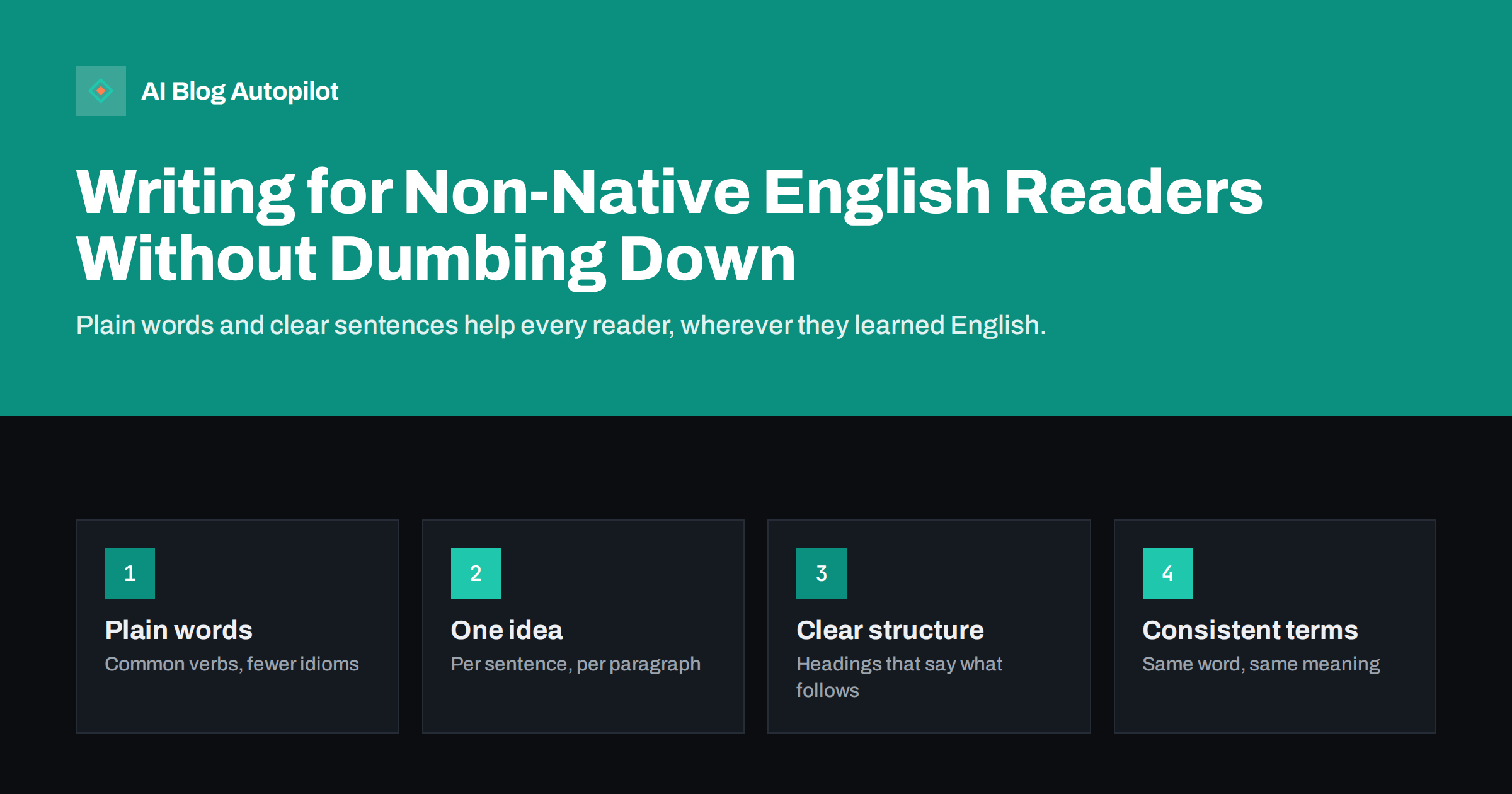
Short answer: many readers of English-language blogs learned English as a second language, and they read faster and understand more when the writing is plain. Use common words, short and direct sentences with one idea each, consistent terms, and few idioms, phrasal verbs or cultural references. Put the main point first, use descriptive headings, lists and examples, and explain abbreviations. This is not dumbing down: the ideas stay just as precise, but the reader spends their effort on the content rather than on decoding the language.
English is the most widely used language on the web, and a large share of the people who read English content are not native speakers. A business blog that sells internationally, a software product with users around the world, or a technical blog read by developers in many countries is written, to a large extent, for people who think in another language. Most writing advice assumes a native reader. This guide covers the habits that make articles easier for everyone else, without making them less expert.
Why it matters for a blog
Readers who struggle with your language do not complain; they leave. They may understand the general idea but miss the detail that matters, misread an instruction or give up halfway through a long paragraph. Clear writing helps in several ways:
- More readers finish the article and act on it.
- Fewer misunderstandings in instructions, prices or terms.
- Better results from translation tools. Many readers paste text into a translator or use their browser’s translation. Plain English translates far more accurately than idiomatic English.
- Clearer passages for search and AI answers. Short, direct statements are easier to quote and summarise correctly.
- Better accessibility for readers with cognitive or reading difficulties, and for native speakers who are busy or tired.
Guidance from public bodies, such as the plain language guidelines, reflects the same principles: write for the reader, use familiar words and make the structure clear.
Choose plain, common words
Non-native readers usually know the most common few thousand English words well and the rest less well. Prefer the common word when it says the same thing:
- “use” rather than “utilise”, “help” rather than “facilitate”, “start” rather than “commence”;
- “about” rather than “approximately”, “buy” rather than “procure”, “show” rather than “demonstrate”.
Technical terms are different. If your readers are developers or marketers, they know the terms of their field, often in English, even if their general English is limited. Keep the precise technical term, and explain it once if some readers may not know it.
Avoid using several words for the same thing. If you call something a “plan” in one paragraph, a “package” in the next and a “tier” later, a native reader understands they are the same; a non-native reader may think they are three different things.
Be careful with words that look like words in other languages but mean something different. “Eventually” means “in the end”, not “possibly”, which is what similar words mean in several European languages. “Actual” means “real”, not “current”. You cannot avoid every such word, but when a sentence depends on one, a short clarification or a different word prevents a misunderstanding.
Write clear, direct sentences
Long sentences with several clauses are the biggest obstacle for second-language readers. A few habits help:
- One main idea per sentence. Split sentences that join two ideas with “and”, “which” or “while”.
- Put the subject and verb early. “Search engines need clear titles” is easier than “Clear titles, which many site owners overlook in the rush to publish, are needed by search engines.”
- Prefer active voice. “The plugin creates the sitemap” is clearer than “The sitemap is created by the plugin.”
- Avoid double negatives. “This is not uncommon” makes readers work; “This is common” does not.
- Keep related words together. Do not separate a verb from its object with a long phrase.
Sentence length can vary; a text made only of very short sentences sounds childish. Aim for a comfortable average and break up anything that needs reading twice.
Be careful with idioms, phrasal verbs and references
Idioms are natural to native speakers and puzzling to others. “Low-hanging fruit”, “move the needle”, “a game changer” or “ballpark figure” may be understood by some readers, but each one is a small moment of uncertainty. Translation tools often translate them word for word, producing nonsense.
Phrasal verbs, such as “set up”, “carry out”, “put off” or “figure out”, are another difficulty because the meaning often cannot be guessed from the words. Many are common enough to keep, but where a single clear verb exists, such as “postpone” for “put off”, consider using it. Use judgement: “set up” is so common in tech writing that replacing it can sound odd.
Cultural references, sports metaphors and jokes based on wordplay rarely travel well. Baseball, cricket and American football metaphors are especially local. Humour is still welcome, but make sure the meaning of the sentence does not depend on getting the joke.
Structure does half the work
A clear structure lets readers understand an article even when some sentences are difficult for them:
- Put the answer first. A short summary at the top tells readers what to expect and what matters.
- Use descriptive headings. “How to set the time zone” says more than “Getting started”.
- Keep paragraphs short, with one topic each and the main point in the first sentence.
- Use numbered lists for steps and bullet lists for options or features.
- Add examples. A concrete example often explains an idea better than a second paragraph of description.
- Use tables for comparisons, so readers do not need to hold several facts in memory while reading.
Readers who skim, which includes many native speakers, benefit just as much.
Pictures help too. A screenshot with the relevant button highlighted, a simple diagram of a process or a short annotated example can explain in seconds what would take a paragraph to describe. Add a caption and alt text in the same plain language as the rest of the article, so the image and the text support each other.
Numbers, dates and abbreviations
Small details cause real confusion across countries:
- Dates. 03/04 means 3 April in much of the world and 4 March in the United States. Write dates with the month as a word: “3 April 2026” or “April 3, 2026”.
- Numbers. Decimal points and thousand separators differ between countries. Where it matters, write clearly and avoid ambiguous formats.
- Currencies and units. State the currency and give metric units, or both systems, where your readers vary.
- Times and time zones. Name the time zone for events and deadlines.
- Abbreviations. Spell out an abbreviation the first time you use it, unless it is universally known in your field. Avoid internal shorthand and texting abbreviations.
Spelling, tone and consistency
Choose British or American spelling and stick to it. Both are understood everywhere, but switching between them looks careless and can make readers wonder whether two spellings mean two different words.
Keep the tone friendly and direct. Non-native readers are not less intelligent and do not need to be addressed as beginners. Very informal writing full of slang can be as hard to read as very formal writing full of long words; the middle ground of clear, professional and warm works for most audiences.
A short style guide helps keep a blog consistent when several people write for it. It can list preferred terms, spellings, how to write dates and numbers, and words to avoid.
Finally, remember that clear writing is also kind to native speakers. People read on phones, between meetings or in a hurry, and plain sentences save them time as well. When you edit for international readers, you rarely lose anyone; you usually gain readers you did not know you had.
Testing your text
You do not need special software to check readability, though tools can help:
- Readability scores give a rough indication of sentence and word difficulty. Use them as a signal, not a target; the W3C guidance on reading level explains why simpler text helps many readers.
- Translate a paragraph into another language and back with a translation tool. If the meaning comes back confused, the original is probably unclear.
- Ask a reader. A colleague or customer who reads English as a second language is the best judge. Ask which sentences they read twice.
- Read aloud. Sentences you stumble over are likely to trouble other readers too.
When to write in other languages instead
Plain English widens your audience, but it is not a full substitute for content in readers’ own languages. If a large share of your customers speak one language, articles written natively in that language will serve them better and can rank in their local search results. Many businesses use both: clear English for the international audience, and native articles for their most important markets.
How AI Blog Autopilot helps
AI Blog Autopilot writes articles in 25 languages, each written directly in that language rather than machine-translated from English, and publishes them to your WordPress blog with FAQ, tags and SEO meta. You set the audience and tone for your topics, and the number of languages depends on your plan, as shown on the pricing page.
Related reading
- Readability: Writing So People Finish the Article
- British vs American Spelling: Does It Matter for SEO?
- Translating Articles or Writing Natively in Each Language
- An Editorial Style Guide in One Page
The bottom line
Writing for non-native English readers means writing plainly, not simply. Use common words and consistent terms, keep sentences direct with one idea each, limit idioms and local references, and let headings, lists and examples carry the structure. Write dates, numbers and abbreviations in ways no one can misread, test a few paragraphs with real readers or a translation tool, and consider native-language articles for your biggest markets.
DUK
Is plain English the same as dumbing down?
No. Plain English keeps ideas precise and complete but uses familiar words, clear sentences and good structure. The reader spends effort on the content instead of decoding the language.
Should I avoid technical terms for non-native readers?
Not when your readers work in the field. Specialists often know the English technical terms well. Keep precise terms, explain them once if needed, and use them consistently.
Do idioms hurt international readers?
They can. Idioms and many phrasal verbs are hard to guess and are often mistranslated by translation tools. Use them sparingly and make sure the meaning does not depend on them.
How should I write dates for an international audience?
Write the month as a word, such as 3 April 2026, because numeric formats like 03/04 are read differently in different countries. Name the time zone for times.
How can I test whether my writing is clear enough?
Ask a reader who uses English as a second language which sentences they read twice, read the text aloud, or translate a paragraph into another language and back to see if the meaning survives.