ENEnglish
 LTLietuviškai
 DEDeutsch
 FRFrançais
 RUРусский
 ESEspañol
 PLPolski
 ITItaliano
 UKУкраїнська
 CSČeština
 PTPortuguês
 JA日本語
 LVLatviešu valoda
 ETEesti
 HUMagyar
 IDBahasa Indonesia
 TRTürkçe
 HIहिन्दी
 ELΕλληνικά
 ARالعربية
 THไทย
 VITiếng Việt
 RORomână
 MSBahasa Melayu
 BNবাংলা
Short answer: Threads is a text-first social network where short, conversational posts do better than bare links. A small blog can use it by posting a real thought or question from each article, adding the link once with a reason to click, replying to people promptly and measuring clicks and replies. Treat it as an optional channel, test it for a few weeks and keep it only if it brings readers.
New social networks attract a rush of advice, and most of it assumes that every blog must be everywhere. A small blog has limited time, so the question is not whether a network exists but whether it fits your readers and your routine. This guide gives a practical way to try Threads without wasting effort, and without behaving like the accounts that fill feeds with links.
What Threads is and who it suits
Threads is a social network run by the company behind Instagram and Facebook. It is built around short text posts, with the option to add images or video and to reply in a conversation. Accounts are connected to Instagram profiles, which makes it easy for existing Instagram users to join. Features and limits change from time to time, so check the current rules before you plan, for example the maximum length of a post and how links appear.
It tends to suit topics that people like to discuss: opinions, advice, news in your field, behind-the-scenes updates and questions. It is less suited to material that depends on detailed visuals or long reading, unless you use the post to lead into it. If your readers are professionals who use other networks for work, they may be elsewhere. Our guide to choosing social networks for a blog helps you decide where to spend your time.
The simplest test of fit is to look. Search for the topics you write about and see who is talking, how they write and whether links to blog posts get replies. If you find lively conversation among people like your readers, it may be worth a trial. If you find mainly entertainment and little on your subject, skip it for now.
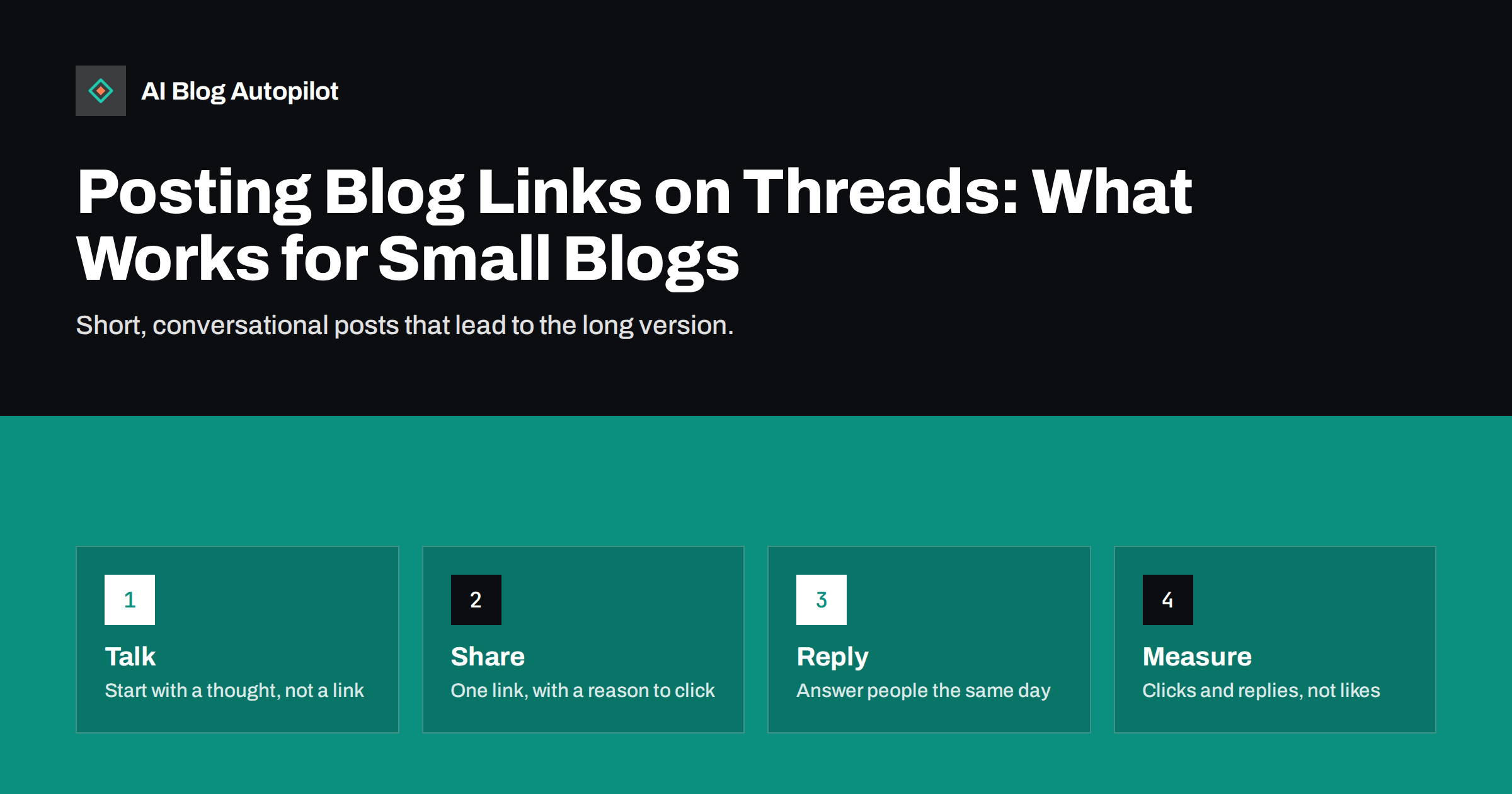
Start with a thought, not a link
A post that contains only a title and a link tells the reader nothing about why it matters. A better post shares one useful idea from the article in your own words, in one to three short sentences, and then offers the link for people who want the full story. The idea should stand alone: someone who never clicks should still learn something.
Open with the point that would make a reader stop. It might be a surprising figure from your own data, a mistake you see often, a short tip or a direct question. Avoid empty hooks such as “you will not believe”. Honest, specific openings work better, and they match the guidance in social post first lines.
Write the way you would talk to a customer. Contractions, simple words and a friendly tone are normal on this network. Avoid corporate phrases and long chains of hashtags. If you use a tag, keep to one or two that people really follow, as described in hashtags for blog posts.
Share the link without spamming
Place the link once, with a short reason to follow it: what the reader will find, or what problem it solves. Do not repeat the same post several times in a day, and do not post the same text on every network. Each place has its own habits, and our guide to turning blog posts into social posts shows how to adapt a message for each.
Sometimes the link is better placed in a reply to your own post, so that the first post reads as a normal thought. Test both and see which brings more clicks. Keep your link addresses tidy, and use tracking tags so that your analytics can tell you which posts bring visitors. See UTM tags for social shares for a simple setup.
Share other people’s work too. A feed made only of your own links reads as advertising. Mention a useful article, answer a question with a link to a source that is not yours and thank people who help. Our guide to curating content for social explains how to balance the two.
Post at a sustainable pace
Pick a rhythm that you can keep for months. For most small blogs that means one to three posts a day on days that you work, or a smaller number if the blog itself is infrequent. A burst of posts followed by silence does little, and a steady presence builds familiarity.
Mix the types. A typical week may have two posts that share an idea from a new article, one question to readers, one behind-the-scenes note and one share of somebody else’s work. Reuse older posts that are still accurate, as in resharing old blog posts, with new wording each time.
Think about timing, but do not obsess over it. Your readers’ habits matter more than general advice, and the only way to learn them is to look at your own results. See the best time to share blog posts for a method that uses your own data.
Reply and join conversations
The strength of a conversational network is the conversation. Reply to people who respond to your posts, ideally on the same day, and keep replies short and useful. Ask follow-up questions, and thank people who correct you. A reply that adds information is worth more than a like.
Join conversations that others start. Read posts in your field and add a helpful comment, without a link unless it truly answers the question. Over weeks you become a familiar name, and some people will visit your profile and then your blog. This is slow work, but it is the way small accounts grow without paying for attention.
Handle disagreement calmly. Do not argue in public with people who want a fight, and do not delete honest criticism. Our guide to negative comments on social posts has a short routine for difficult replies.
Keep the account safe and consistent
Use the same name, picture and short description that you use elsewhere, so that people recognise you. A short profile line that says what you write about and a link to your blog is enough. Our guide to consistent social profiles lists the details to keep aligned.
Protect the login with a strong, unique password and two-step verification, and limit who can post. If several people manage the account, agree who is allowed to reply in your name. See securing social media accounts for more advice.
Check the platform’s current rules for automation and for links. Do not use tools that break them or that pretend to be you in conversations. Any scheduling you do should be limited to posts that you would be happy to write by hand.
Mistakes small blogs make
The first mistake is copying a post from another network without changing it. A long caption written for a photo network, or a post that depends on a picture, can read oddly in a text feed. Rewrite for the place, even if it only takes two minutes. The second is posting and leaving. A post without any follow-up is a missed conversation, and an account that never replies looks like an advertisement.
The third is chasing every trend. Jumping into each popular topic of the day with a forced link to your blog is easy to spot and rarely helps. Join a trend only when you have something to add. The fourth is ignoring accuracy. A short post is easy to write fast, but facts still matter, and a correction in public is more awkward than a pause to check the source.
The last is expecting quick results. A new account has few followers, and the first weeks may bring almost no visits. That is normal. What you are building is a small group of people who recognise your name and trust your advice, and that takes months, not days. Decide in advance how long you will try, and then review honestly.
It also helps to keep a short bank of ideas ready: questions customers sent this week, a chart from your analytics, a before-and-after of an old post you updated, or a mistake you made and fixed. When you have ten ideas in a note, a quiet afternoon no longer stops you posting, and you can choose the best one for the day.
Measure for a few weeks, then decide
Set a trial of four to six weeks with a few simple measures: clicks from the network to your blog, replies to your posts, new followers who look like readers and, where relevant, sign-ups or enquiries. Likes are pleasant but weak evidence. Use your analytics to separate traffic by source, as explained in social media metrics for bloggers.
At the end of the trial, compare the effort with the result. If the network brings readers who stay and return, continue and refine. If it brings very little, stop and spend the time on a channel that works better for you, such as email or search. There is no shame in closing a test, and you can return when the network or your audience changes.
Write down what you learned, even if you stop. A few lines about what worked and what did not will help the next time that a new network appears and everybody tells you to join.
How AI Blog Autopilot helps
AI Blog Autopilot writes full SEO articles for your WordPress blog and shares each one to your social networks, with native text for each network and its own timing. It can post to many networks per article, so you can keep your attention on the channels that bring readers and on replying to people. See the pricing page for plans.
Related reading
- Choosing Social Networks for a Blog
- Social Post First Lines That Earn the Click
- Social Media Metrics for Bloggers That Matter
The bottom line
Lead with a real thought, add the link once with a reason, reply quickly, keep a pace you can sustain and judge the network after a short trial by clicks and conversations, not by likes.
DUK
Should every blog use Threads?
No. Try it if your readers are there and you have time to reply, and drop it if it brings no visits.
Can I post only links?
You can, but posts with a real idea and one link usually get more replies and clicks.
How often should I post?
Choose a pace you can keep for months, often one to three posts on working days for a small blog.
Should I use hashtags?
Use one or two relevant tags at most. Clear wording matters more than tags.
How do I know if it works?
Track clicks to your blog with tags on your links, and replies, over a trial of four to six weeks.