ENEnglish
 LTLietuviškai
 DEDeutsch
 FRFrançais
 RUРусский
 ESEspañol
 PLPolski
 ITItaliano
 UKУкраїнська
 CSČeština
 PTPortuguês
 JA日本語
JA日本語 LVLatviešu valoda
 ETEesti
 HUMagyar
 IDBahasa Indonesia
 TRTürkçe
 HIहिन्दी
 ELΕλληνικά
 ARالعربية
 THไทย
THไทย VITiếng Việt
 RORomână
 MSBahasa Melayu
 BNবাংলা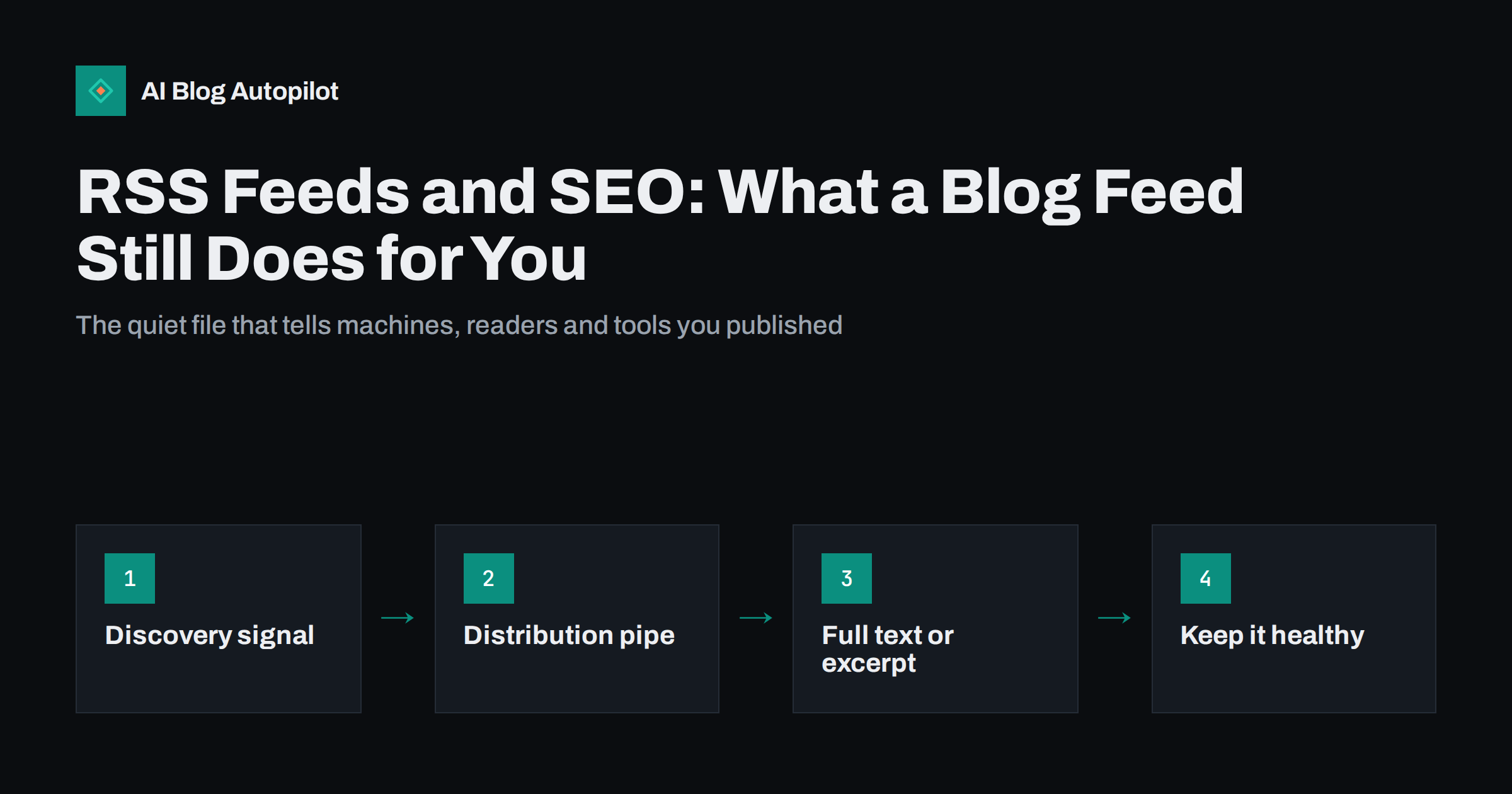
Short answer: an RSS feed is a machine-readable list of your latest posts. It does not improve rankings directly, but it still does useful work: search engines can use it to discover new posts quickly, it can be submitted as a sitemap, and it powers feed readers, email newsletters, aggregators and social sharing tools. For most blogs, the right approach is to keep the feed enabled, valid and linked from the site, and to choose deliberately between full text and excerpts.
RSS is one of the oldest technologies still quietly running the web. Many people assume it died years ago, yet almost every blog platform still publishes a feed by default, and a surprising number of tools depend on it.
This guide explains what a blog feed does for search and distribution today, which settings matter, and the few mistakes that turn a useful feed into a problem.
What an RSS feed is
A feed is a file, usually in RSS or Atom format, that lists a site’s most recent items. For each post it typically includes the title, link, publish date, author, categories and either an excerpt or the full content. When you publish, the feed updates automatically.
Programs that “subscribe” to the feed check it periodically and notice new items. That simple mechanism is the basis of feed readers, podcast apps, many newsletter tools and a large number of automation services.
In WordPress, the main feed usually lives at /feed/. There are also feeds for each category, tag and author, and one for comments. Other platforms have similar addresses, and the feed is usually advertised in the page’s HTML head with a link element so that browsers and tools can find it.
What a feed does for search engines
A feed is not a ranking factor, and feed URLs are generally not something search engines show in results. Its value for search lies in discovery.
- Fresh URL discovery. A feed lists only recent items and changes whenever you publish, which makes it a compact way for crawlers to spot new posts.
- Sitemap submission. Google accepts RSS and Atom feeds as sitemaps, as described in its sitemap documentation. Many sites submit both an XML sitemap, for complete coverage, and a feed, for recent changes.
- Update signals. The publish and update dates in the feed give crawlers another signal about what changed.
For a small blog with a working XML sitemap and good internal links, the discovery benefit is modest. It becomes more noticeable on sites that publish frequently, where new posts should be picked up quickly.
What a feed does for distribution
The larger value of a feed today is outside search. A single, standard file lets many kinds of tools know that you published something.
- Feed readers. A loyal minority of readers still follow blogs through feed reader apps, and they tend to be highly engaged.
- Email newsletters. Many email tools can send a digest of new posts automatically from a feed, so subscribers hear about each article without manual work.
- Social sharing and automation. Tools that post new articles to social networks or connect services together often watch a feed as their trigger.
- Aggregators and communities. Industry news sites, curated lists and internal company dashboards sometimes pull from feeds.
- Podcasts. If you publish audio, the podcast ecosystem is built entirely on feeds.
In each case, the feed does the notifying for you. That makes it one of the lowest-effort ways to make sure a new post reaches more than the people who happen to visit your site that day.
Full text or excerpt?
Most platforms let you choose whether the feed carries the full post or only a summary. In WordPress this is under Settings, then Reading. Each option has trade-offs.
| Full text | Excerpt | |
|---|---|---|
| Reader experience | Better: people can read in their feed app | Readers must click through to finish |
| Visits to your site | Fewer from feed readers | More, because reading requires a visit |
| Newsletters and tools | Can include the whole article | Include the teaser and link |
| Scraping risk | Higher: copying the whole post is trivial | Lower: only the summary is exposed |
| Calls to action and layout | Stripped or simplified in readers | Seen on your own pages |
There is no universally correct answer. Blogs that value reader goodwill and reach often choose full text. Business blogs that want visits, leads and control over how posts look often choose excerpts. If you use excerpts, write them properly: a one or two sentence summary that makes the click worthwhile is better than the first fifty words cut off mid-sentence.
Feeds and duplicate content
A common worry is that a full-text feed creates duplicate content. For the feed itself, this is not a real problem: search engines understand feeds and do not treat them as competing pages.
The real risk is scrapers. Some sites republish full-text feeds automatically, sometimes before search engines have crawled the original. Search engines usually identify the original source, but it helps to make it obvious.
- Include links in the feed content. Internal links inside your posts remain in full-text feeds, so scraped copies link back to you.
- Add an attribution line. Some SEO plugins can append a line such as “This post first appeared on…” with a link to the original to every feed item.
- Get new posts crawled quickly. A submitted feed and sitemap help search engines see your version first.
- Consider excerpts if scraping becomes a persistent problem.
Settings and checks worth doing
A feed runs unattended for years, so it is worth checking once and then after every major change to the site.
- Open the feed. Visit
/feed/on your blog. Most browsers now show the raw file or offer to download it. Check that recent posts appear. - Validate it. A feed validator will catch broken characters, invalid dates or malformed markup that can make tools reject the feed.
- Check the number of items. WordPress shows ten items by default, set under Settings, then Reading. If you publish several posts a day, a slightly larger number helps tools that check less often avoid missing items.
- Check images. Featured images are not always included in feeds by default. If your newsletter or sharing tools need them, check whether your theme or a plugin adds them.
- Keep it linked. Make sure the page head advertises the feed. Some themes and “performance” plugins remove the link or disable feeds entirely.
- Do not block it by accident. Firewalls and security plugins sometimes block feed requests from automated tools. If a service reports that it cannot read your feed, check those rules.
- Check caching. Aggressive page caching can serve an old version of the feed, delaying everything that depends on it.
Category and tag feeds are underused
Most attention goes to the main feed, but the per-category and per-tag feeds can be more useful for specific audiences. A reader who only cares about one topic on a broad blog can subscribe to that category alone. A partner site can pull only the posts relevant to its audience. An internal dashboard can show only the articles about a particular product line.
These feeds also let you route content differently. A newsletter for one customer segment can draw from a single category feed, while a social account focused on one theme can share only the matching posts. If your categories are clean and meaningful, the feeds come for free.
Common feed problems and their causes
- New posts missing from the feed. Usually caching. Clear the cache or exclude the feed address from page caching rules.
- Feed shows an error instead of posts. Often a plugin or theme outputs stray whitespace or text before the feed begins, which makes the file invalid. Disabling plugins one by one on a staging copy usually finds the culprit.
- Strange characters in titles. Encoding problems, often from text pasted from word processors. A validator points to the exact item.
- Tools report the feed as unreachable. Check firewall and bot-protection rules, which sometimes treat automated feed requests as suspicious.
- Old posts reappearing as new. Changing publish dates or bulk-editing posts can move them back to the top of the feed, which may trigger automations a second time.
Should you disable feeds?
Occasionally, advice circulates suggesting that you disable feeds to “save crawl budget” or stop scraping. For most blogs, this does more harm than good. It cuts off feed readers, breaks newsletter and sharing automations, and removes a useful discovery signal, in exchange for solving problems that small blogs rarely have.
A more targeted approach is better. If comment feeds or certain archive feeds are useless for your site, some SEO plugins let you disable those specific feeds while keeping the main post feed. If scraping is the issue, switching to excerpts addresses it directly.
How AI Blog Autopilot fits in
AI Blog Autopilot writes SEO articles, publishes them to your WordPress blog on a schedule and shares each one to your social networks with its own text and timing. Because the posts are ordinary WordPress posts, they appear in your blog’s feed automatically, so feed readers, newsletter tools and any other services that watch your feed see every new article as soon as it is published. You can see how publishing works on the AI Blog Autopilot home page.
Related reading
- XML Sitemaps Explained for People Who Publish
- Building a Newsletter From Your Blog Posts
- IndexNow: Telling Search Engines About New Pages Immediately
- Auto-Post Every New Blog Article to Social Media Automatically
The bottom line
An RSS feed will not lift your rankings, but it is far from obsolete. It helps search engines discover new posts, can be submitted as a sitemap, and quietly feeds readers, newsletters and sharing tools. Keep it enabled, valid and linked, choose full text or excerpts on purpose, and check it after any theme, plugin or security change.
DUK
Does an RSS feed help SEO?
Not as a ranking factor. It helps search engines discover new posts quickly, and Google accepts RSS and Atom feeds as sitemaps. Its bigger value is distribution to feed readers, newsletters and automation tools.
Should my blog feed show full text or excerpts?
Full text is friendlier to feed readers and newsletters, while excerpts bring more visits to your site and reduce the impact of scraping. Choose based on whether reach or site visits matter more for your blog.
Can a full-text feed cause duplicate content problems?
The feed itself does not. The risk comes from sites that scrape full-text feeds. Keeping internal links in posts, adding an attribution link and getting posts crawled quickly help search engines recognise your original.
Where is the RSS feed on a WordPress blog?
Usually at /feed/ on your domain. WordPress also creates feeds for each category, tag and author, typically by adding /feed/ to the end of those archive addresses.
Should I disable RSS feeds on my blog?
Usually not. Disabling feeds breaks feed readers, newsletter automations and sharing tools, and removes a discovery signal. If specific feeds are useless, disable only those and keep the main post feed.