ENEnglish
 LTLietuviškai
 DEDeutsch
 FRFrançais
 RUРусский
 ESEspañol
 PLPolski
 ITItaliano
 UKУкраїнська
 CSČeština
 PTPortuguês
 JA日本語
JA日本語 LVLatviešu valoda
 ETEesti
 HUMagyar
 IDBahasa Indonesia
 TRTürkçe
 HIहिन्दी
 ELΕλληνικά
 ARالعربية
 THไทย
THไทย VITiếng Việt
 RORomână
 MSBahasa Melayu
 BNবাংলা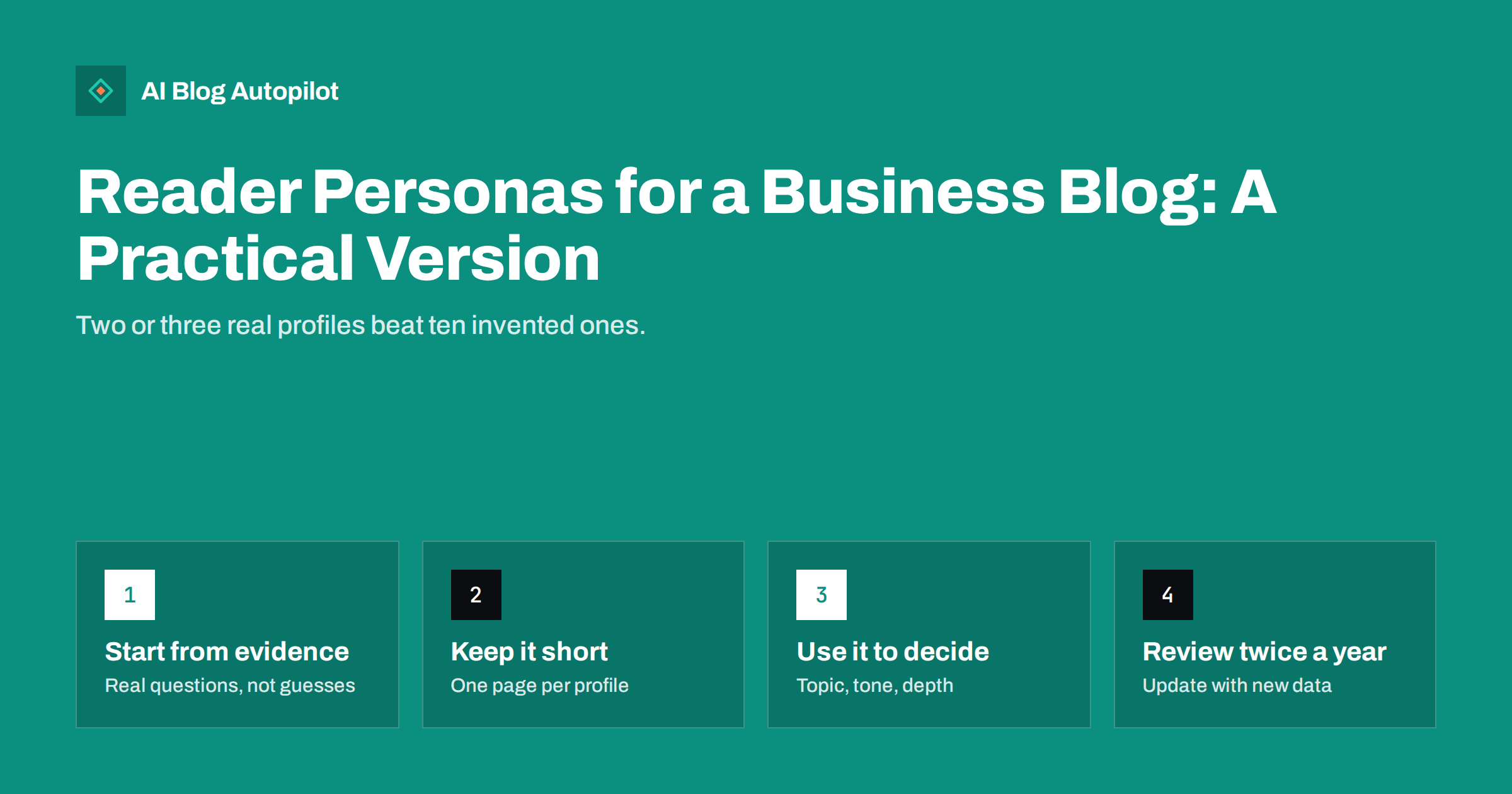
Short answer: a reader persona is useful only if it helps you make decisions. Build two or three short profiles from real evidence, such as customer questions, survey answers, sales calls and search queries. For each, note the goal, the starting knowledge, the questions, the obstacles and what would make them act. Then use the profiles to choose topics, set depth and tone, and write calls to action. If a persona does not change what you write, it is decoration and should be dropped.
Personas have a poor reputation, and often deserve it. Many are invented in a workshop, given a name, an age and a stock photo, and filed away. The writer then goes on writing for an imagined general reader. A practical version is different: it is short, based on facts and consulted each time you plan an article. This guide shows how to build one without special tools, how to keep it honest and how to use it for a blog that serves a business.
What problem a persona solves
Writers who do not know exactly who they write for tend to make the same few mistakes. They explain too much to experts or too little to beginners, they use words their readers do not use, and they end every article with the same generic call to action. A persona gives a concrete reader to keep in mind and to check the draft against.
- Topic choice: which questions matter to this person, and which do not?
- Depth: how much background do they need, and how much would bore them?
- Language: which terms do they use, and which need explanation?
- Next step: what could they sensibly do after reading, given where they are?
It also helps a team. When several people write for one blog, a shared description of the reader makes the voice and level more consistent.
Gather evidence before you write anything
A persona is a summary of what you know, so collect that first. You do not need a research budget. Use what the business already has.
- Customer conversations: emails, support tickets, chat transcripts and sales call notes. Look for repeated questions and the words customers use.
- Search data: queries in Search Console and the site’s own search box show what readers look for.
- Analytics: which pages are read, where readers come from, what they do next. Use them as hints about interests, not about individuals.
- A short survey of readers or customers, with open questions about their biggest challenge.
- Colleagues who meet customers, such as sales and support, who often know the real obstacles better than anyone.
- Reviews and comments, including those about competitors, which show what people value and dislike.
Collect only what is needed and respect privacy. Persona work does not require personal data about named people. Patterns are enough.
Find the two or three groups that matter
Look for groups of readers whose needs differ in ways that affect your writing. Differences in age or job title are rarely the most useful. Better dividers are the goal, the starting knowledge and the stage of decision.
- A beginner who is trying to understand the basics, and an experienced user who wants advanced detail.
- Someone researching options, and someone ready to buy who needs reassurance on specifics.
- The person who uses your product, and the person who approves the budget.
- A reader who wants to do the task themselves, and one who wants to hire someone.
Pick two or three groups at most. If you end up with eight, you have described segments of the market, not people to write for. Choose the ones that bring the most value and that you can serve with your content today. You can add more later.
Write each profile on one page
Keep each profile short enough to read in a minute. A simple template works well.
- A descriptive label, such as “The cautious first-time buyer” or “The overloaded owner-manager”. A name and photo are optional and often distracting.
- Goal: what are they trying to achieve, in their words?
- Starting point: what do they already know, and what have they tried?
- Questions: the five to ten questions they ask, copied from real sources.
- Obstacles and worries: time, cost, risk, jargon, trust, internal approval.
- Where they look: search, social networks, communities, colleagues, newsletters.
- What helps them act: examples, a checklist, a comparison, a conversation.
- Evidence: where each point came from, with the date. Mark anything that is a guess.
The last item matters. A persona that cites its sources can be checked and updated, and one that does not turns into opinion.
Use the profiles when you plan and write
A persona earns its place when you consult it. Build it into the way you work.
- When planning topics, tag each idea with the profile it serves. If every idea serves one profile, you are neglecting the others.
- Before drafting, write one sentence: “This article helps [profile] to [do or understand] so that [result].”
- While editing, read the draft as that person. Is any term unexplained? Is any section too basic? Does it answer the question that brought them here?
- For the call to action, choose a step that fits their stage, such as a checklist for a researcher or a contact form for a ready buyer.
- For headings and the FAQ, use the questions from the profile, in their wording.
Over time you will see that different profiles read different articles, and you can balance the plan so that each gets regular attention.
Avoid the common traps
Persona work can go wrong in familiar ways.
- Invented detail. Hobbies, favourite brands and imaginary quotes make a profile feel real without making it true. Leave them out.
- Stereotypes. Assumptions based on age, gender or nationality rarely help and can offend. Base profiles on needs and behaviour.
- Too many profiles. More than three or four become impossible to use.
- Never updating. Markets change. Review the profiles every six months or after a major change in the business.
- Using the persona to justify decisions already made. If you only cite it to approve your own ideas, it is not helping.
Remember that real readers move between profiles: the beginner of this year may be the experienced user next year, so make sure your older, more basic articles link forward to deeper ones. Test the profiles against reality now and then. Ask a few customers whether the description sounds like them, and see whether the topics you chose from the persona actually perform.
A short example
A concrete case shows how the pieces fit together, and how a small business can apply the method without special software or long workshops.
Suppose a small company sells scheduling software to clinics. From support emails and sales calls, it finds two main groups. The first is the practice manager, who wants fewer missed appointments and a simple setup, and who is wary of anything that needs training. The second is the clinician, who cares about how the tool affects patients and the day’s flow, and who is sceptical of new systems.
For the manager, the blog plans articles on reducing no-shows, how to switch systems without disruption and what to check before choosing software, each with a checklist and a clear next step. For the clinician, it plans shorter pieces on how scheduling affects the working day, with practical, specific points and no sales language. The tone differs too: the first is reassuring and step-by-step, the second direct and concise. A single “healthcare professional” persona would have blurred these needs. The company also notes what it does not know, such as how much influence the clinicians have on the final purchase, and plans to ask in its next customer survey. Marking gaps like this keeps the profiles honest and gives the next review a clear agenda.
Keeping profiles alive
A profile is a snapshot, and it needs a simple routine to stay accurate. Choose an owner for the personas, someone who will remember to look at them, and agree where they live, for example a shared document linked from the content plan.
- Add a “last reviewed” date to each profile, and diarise a review every six months.
- Keep a running list of new evidence, such as a surprising customer question, a new objection in a sales call or a change in search queries, and fold it in at the review.
- Check performance by profile. Which articles do well for which reader, and which profile gets too little attention?
- Retire what no longer fits. If a group stops appearing in your questions and sales, remove its profile instead of keeping it out of habit.
- Share the profiles with anyone who writes, edits or approves content, and brief new team members with them.
This light routine keeps the profiles grounded in real evidence and prevents them from becoming a document nobody opens. It also gives you a record of how your understanding of your readers has changed, which is useful when you review your strategy.
How AI Blog Autopilot helps
AI Blog Autopilot asks for your topics, keywords, audience and tone, and writes full SEO articles with FAQ, tags and meta for your WordPress blog. Your reader profiles are a good way to fill in the audience and topics clearly, so the articles speak to the right people. See the pricing page for plans.
Related reading
- Top, Middle and Bottom of Funnel: Mapping Blog Topics
- Search Intent: The Four Types and What Each Needs
- Turning Customer Questions Into Useful Blog Topics
- Writing for Decision-Makers Who Skim
The bottom line
A reader persona is a working tool, not a poster. Base two or three short profiles on real questions and evidence, describe goals, knowledge, obstacles and what helps people act, and then use them every time you plan, draft and edit. Leave out invented detail, review the profiles twice a year and drop any that do not change your decisions. The result is a blog that speaks to specific people.
DUK
How many personas does a business blog need?
Two or three are enough for most blogs. More than that usually means you are describing market segments, not readers you can write for.
Do I need a name and photo for each persona?
No. A descriptive label is enough. Names and photos add a feeling of realism without adding information.
Where do I get the information?
From support emails, sales calls, search queries, site search, surveys and reviews. Use what the business already has.
How often should I update them?
Review them about twice a year and after any major change to your product, audience or market.
How do personas relate to search intent?
Search intent describes what a query needs. A persona describes who is asking and what they know. Using both helps you choose the right content.