ENEnglish
 LTLietuviškai
 DEDeutsch
 FRFrançais
 RUРусский
 ESEspañol
 PLPolski
 ITItaliano
 UKУкраїнська
 CSČeština
 PTPortuguês
 JA日本語
JA日本語 LVLatviešu valoda
 ETEesti
 HUMagyar
 IDBahasa Indonesia
 TRTürkçe
 HIहिन्दी
 ELΕλληνικά
 ARالعربية
 THไทย
THไทย VITiếng Việt
 RORomână
 MSBahasa Melayu
 BNবাংলা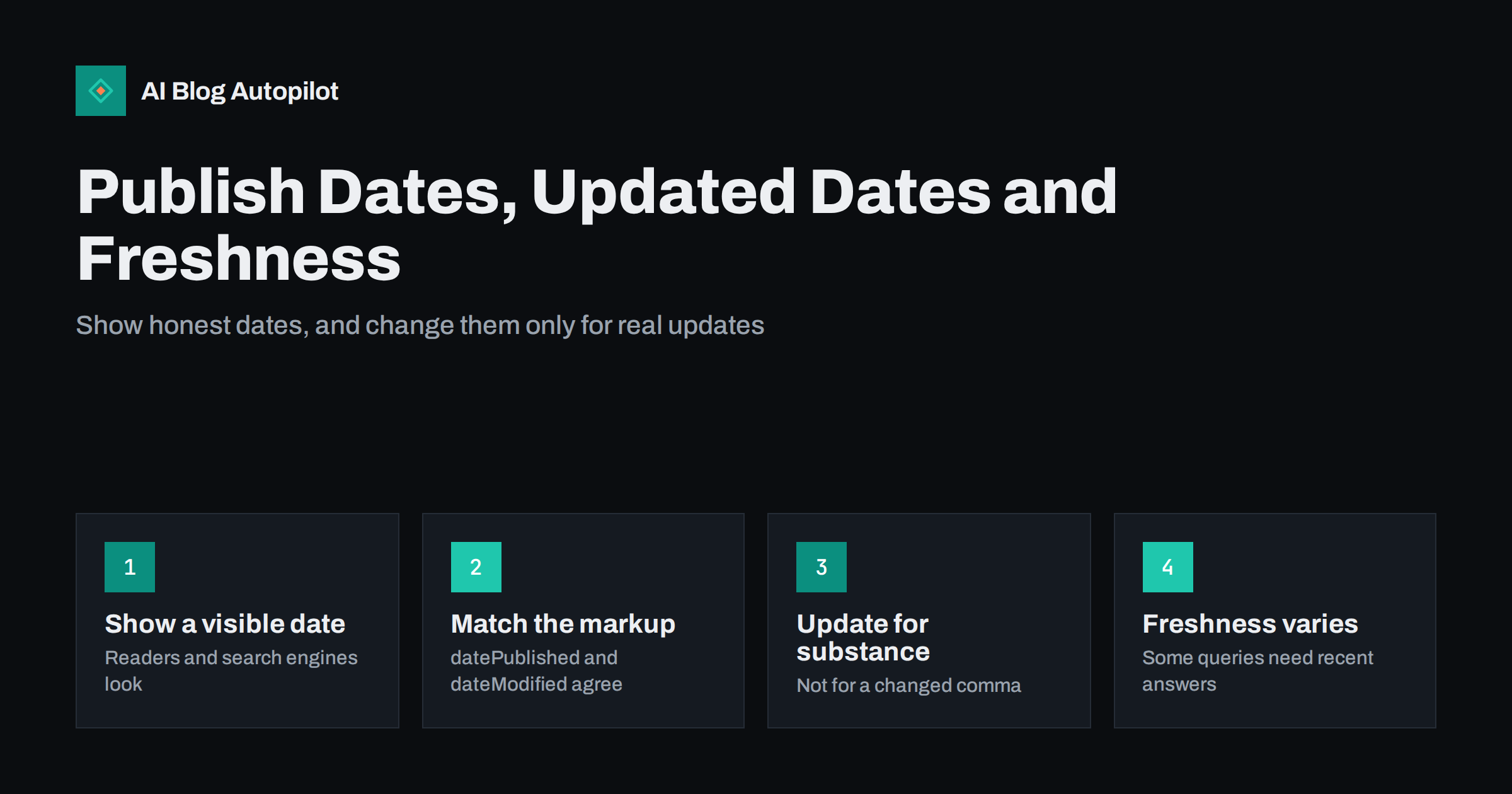
Short answer: show a clear, visible date on every blog post, and when you make a substantial update, show the updated date too. Make sure the same dates appear in the page’s structured data as datePublished and dateModified, and that they agree with what readers see. Search engines use dates to judge freshness, which matters a great deal for time-sensitive topics and much less for evergreen ones. Changing dates without changing content does not make a page fresher and risks eroding trust in all your dates.
Dates look like a small detail on a blog post. They affect more than you might expect: whether a reader trusts the advice, which date appears next to your result in search, and whether a search engine considers the page current enough for a time-sensitive query.
This article covers which dates to show, how to mark them up correctly, when an update deserves a new date, and the common mistakes that confuse readers and search engines alike.
Why dates matter to readers
Readers use dates as a quick credibility check. An article about software settings, regulations, prices or platform features is only useful if it is current, and the date is the first place people look.
- A recent date reassures readers that the steps and facts still apply.
- An old date on a time-sensitive topic prompts readers to leave and look for something newer, even if the content is still correct.
- No date at all makes some readers suspicious, especially on topics that change often.
Removing dates to hide the age of content is a tempting shortcut and a poor one. Readers still judge age from the content, and search engines estimate dates from other signals anyway.
Why dates matter to search engines
Search engines try to show the most useful result for each query, and for some queries usefulness depends heavily on recency. News, recent events, current software versions, annual regulations and anything with a year in the query are obvious examples. For these, a recently published or updated page has an advantage.
For evergreen queries, such as how a concept works or how to do something that rarely changes, recency matters much less. An older, excellent page can outrank a newer, weaker one for years.
Dates also appear in search results. Google may show a date next to a result, taken from the page. Its documentation on influencing byline dates explains that it uses several signals, including the visible date and structured data, and recommends making them clear and consistent.
Which dates to show on a blog post
There are three common approaches, each with trade-offs.
| Approach | Suits | Watch out for |
|---|---|---|
| Published date only | News, announcements, opinion pieces that are not updated | Updated guides look older than they are |
| Updated date only | Guides that are maintained over time | Readers cannot tell when it was first written; temptation to fake updates |
| Both dates | Most business blogs with a mix of content | Needs a clear label for each date |
For most business blogs, showing both is the clearest option: “Published 12 March 2025 · Updated 4 September 2026”, with the updated date shown only when a meaningful update has happened. It is honest about the history of the article and gives readers the information they need.
Label each date explicitly. An unlabelled date is ambiguous, and search engines may pick the wrong one.
Marking dates up correctly
Structured data gives search engines an unambiguous version of the dates. For a blog post, Article or BlogPosting markup should include:
- datePublished: when the article was first published.
- dateModified: when it was last meaningfully updated. If it has never been updated, it can equal the published date.
Use a full date and time with a time zone, in the ISO 8601 format, for example 2026-09-04T09:30:00+03:00. Most WordPress themes and SEO plugins generate this automatically from the post’s publish and modified dates.
Two checks are worth doing once:
- Confirm the markup dates match the visible dates on the page. A theme showing one date while a plugin outputs another creates exactly the inconsistency search engines warn about.
- Confirm there is only one Article block per page. Duplicate markup from a theme and a plugin often carries conflicting dates.
Article structured data covers the rest of the markup.
What counts as a real update
The modified date should mean something. A useful rule: update the date when a returning reader would notice and benefit from the change.
Changes that justify a new updated date:
- Adding new sections or substantially expanding existing ones.
- Correcting facts, steps or advice that had become outdated.
- Replacing figures, examples or screenshots with current ones.
- Reworking the article’s structure to answer the question better.
Changes that do not:
- Fixing a typo or a broken link.
- Changing formatting, images or the featured image alone.
- Adding an internal link.
- Rewording a sentence without changing its meaning.
WordPress updates the modified date on every save, which means the technical modified date can drift from the meaningful one. Some SEO plugins and themes let you control which date is displayed and marked up; if yours does not, be aware that minor edits will show as updates.
Why faking freshness backfires
Changing dates without changing content is a well-known tactic, and search engines are well aware of it.
- It does not change the content. Search engines compare versions of pages. A new date on identical text is not a meaningful update.
- It damages trust in your dates. If dates on a site change without substance, the date becomes a weak signal for all its pages, including genuinely updated ones.
- Readers notice. An article marked as updated last week that describes an interface from three years ago loses credibility instantly.
- It can conflict with guidelines. Google’s documentation advises against artificially freshening a page without significant changes.
If an article needs to look fresher, the only effective approach is to make it fresher. Refreshing old blog posts explains how to do that efficiently.
Dates in titles and URLs
Years in titles, such as “Best tools in 2026”, can improve clicks for time-sensitive topics, because searchers look for current information. They also create an obligation: the title must be updated every year, along with the content, or it will advertise that the page is out of date.
Guidelines that help:
- Use a year in the title only when the topic really changes year to year.
- Keep the year out of the URL slug, so the same URL can be updated annually. URL slugs that work explains why.
- Avoid date-based URL structures (year and month folders) for evergreen blogs. They make every article look dated as soon as it is published.
Dates beyond the article page
An article’s dates appear in more places than the post itself, and inconsistencies elsewhere can undermine a careful setup.
- Blog listings and archives. Category and tag pages often show a date under each post title. Make sure they show the same date as the article, and preferably the same type of date. A listing that shows the modified date while the article shows the published date confuses readers.
- XML sitemaps. The lastmod value in a sitemap tells search engines when a page last changed. It should reflect meaningful changes, just like dateModified. Sitemaps whose lastmod values change on every page every day are generally treated as unreliable.
- RSS feeds. Feeds carry the publish date of each item. Readers and tools that consume feeds rely on it to order posts, so republishing an old post as new can push it to the top of feed readers unexpectedly.
- Social shares. When an older article is reshared on social media, the shared post has today’s date but the article does not. That is fine, provided the article is still accurate. If it is not, update it before resharing.
The general rule holds everywhere: one honest version of each date, shown consistently, changed only when the content meaningfully changes. XML sitemaps explained covers the sitemap side in more detail.
One more practical point concerns scheduled posts. If you write articles in advance and schedule them, the published date is the moment the post goes live, not when it was drafted. That is correct and needs no adjustment; it simply means that time-sensitive details should be checked shortly before the scheduled date, not only when the draft was written.
A date audit for an existing blog
- Open three typical posts and check that a labelled date is visible near the title.
- View the source and confirm datePublished and dateModified match the visible dates.
- Check for duplicate Article markup from theme and plugin.
- Search one post’s title and see which date, if any, appears in the result.
- List time-sensitive articles older than a year and schedule them for review.
- Look for titles containing a past year and update or remove the year.
This takes under an hour and prevents most date-related confusion.
How AI Blog Autopilot handles dates
AI Blog Autopilot publishes articles to WordPress at the hour you choose, as normal posts, so their publish dates come from the actual publishing time. How dates are displayed and marked up is controlled by your theme and SEO plugin, which is worth checking once with the audit above. See the AI Blog Autopilot home page for how scheduling works.
Related reading
- How to Refresh Old Blog Posts
- Evergreen or News Content: What a Business Blog Should Publish
- Content Decay: Spotting Articles That Are Slowly Fading
- How to Handle Corrections on a Blog
The bottom line
Show a clear, labelled published date on every post and an updated date when an update is substantial. Make the structured data dates match the visible ones and avoid duplicate markup. Freshness matters most for time-sensitive topics, and the only reliable way to be fresh is to update the content itself. Changing dates without substance erodes trust with readers and search engines.
DUK
Should blog posts show a date?
Yes, in most cases. A visible date helps readers judge whether advice is current and helps search engines understand the page. Hiding dates rarely helps, because age can be inferred from the content and other signals.
Should I show the published date or the updated date?
For most business blogs, show both with clear labels: the original publication date and, when a substantial update has been made, the updated date. Pages that are never updated only need the published date.
Does updating the date improve rankings?
Not on its own. Search engines look at the content, not just the date, and changing a date without meaningful changes does not make a page fresher. Substantial, useful updates are what can help.
What is the difference between datePublished and dateModified?
datePublished is when the article first appeared; dateModified is when it was last meaningfully changed. Both belong in the Article structured data and should match the dates visible on the page.
Should I include the year in my blog post titles?
Only for topics that genuinely change every year, and only if you will update the article and title annually. Keep the year out of the URL so the same page can be refreshed.