ENEnglish
 LTLietuviškai
 DEDeutsch
 FRFrançais
 RUРусский
 ESEspañol
 PLPolski
 ITItaliano
 UKУкраїнська
 CSČeština
 PTPortuguês
 JA日本語
JA日本語 LVLatviešu valoda
 ETEesti
 HUMagyar
 IDBahasa Indonesia
 TRTürkçe
 HIहिन्दी
 ELΕλληνικά
 ARالعربية
 THไทย
THไทย VITiếng Việt
 RORomână
 MSBahasa Melayu
 BNবাংলা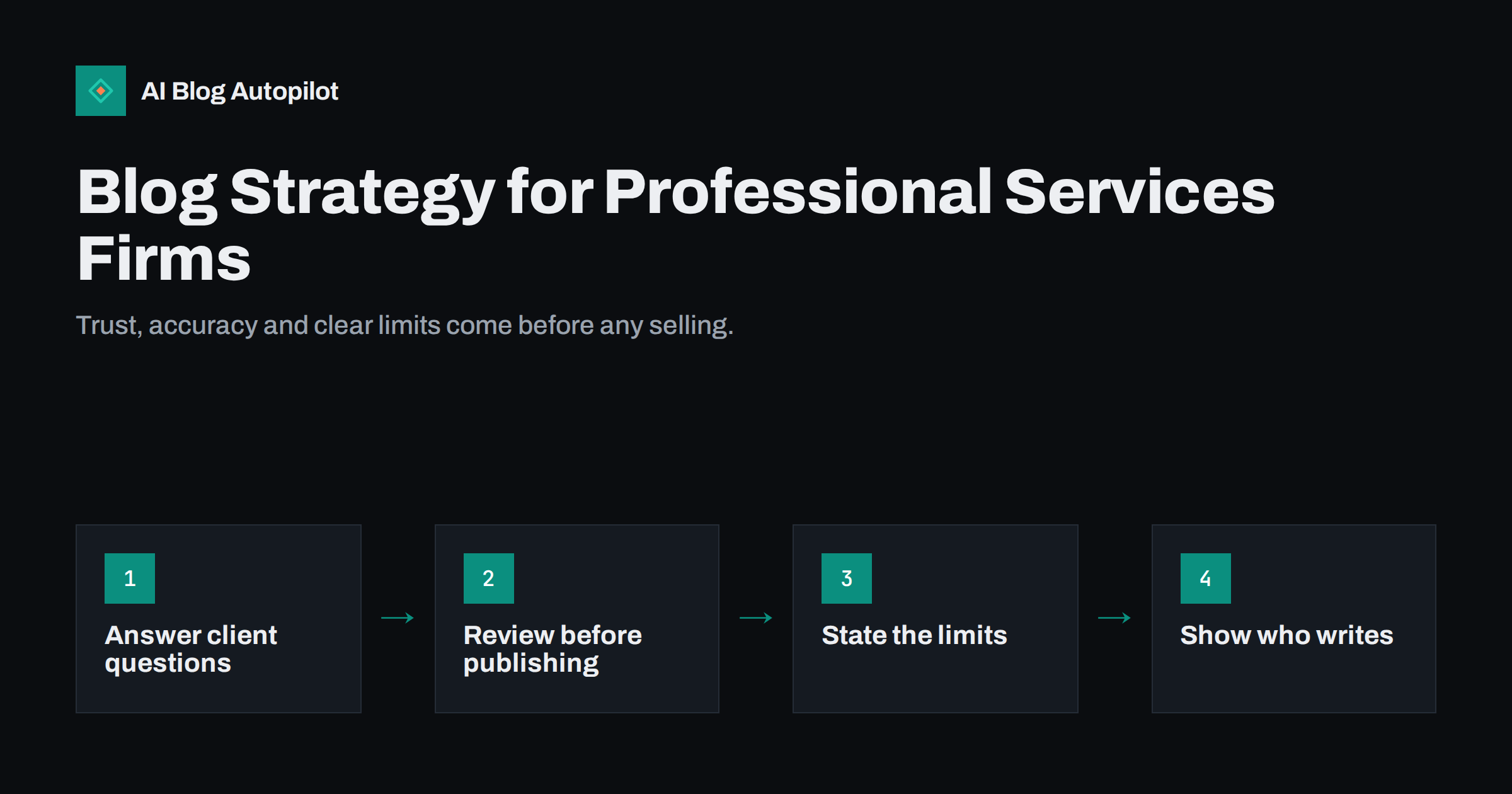
Short answer: a blog for a professional services firm, such as an accountancy, a law practice, an engineering consultancy or an advisory business, works best when it answers the questions clients actually ask, in plain language, with accuracy checked by a qualified person. Show who wrote or reviewed each article, state what the article does not cover, keep the tone calm instead of salesy, and make it easy to contact the firm. The blog’s job is to build trust, so a client feels confident before the first conversation.
Clients of professional firms are cautious. They are buying judgement, and they cannot easily check the quality of advice before they pay for it. A blog gives them a way to see how you think. It can also reduce the number of repetitive questions you answer by email. At the same time, professional topics carry risks: out-of-date rules, advice that does not fit a reader’s situation, and claims that regulators or professional bodies may restrict. This article covers the topics, structure and safeguards that suit a firm’s blog.
What the blog is for
Before choosing topics, decide the job of the blog. For most firms there are four.
- Be found by people who search for answers to a problem you solve.
- Build trust by demonstrating clear thinking and honest explanations.
- Save time by giving staff a page to send when the same question comes up again.
- Support selection by helping prospective clients understand how you work, what it costs in general terms, and what to expect.
The blog is not there to impress colleagues or to show every technical detail. Write for the client who has a problem and little time, and the readers who are professionals will still find the content solid.
Choose topics from real client questions
The best source of topics is your own inbox and meeting notes. Ask partners and staff what they explain most often, and what clients get wrong before they call you.
- Frequently asked questions: “Do I need X before I do Y?” and “What happens if I miss Z?”
- Process explanations: what happens at each step, who does what, how long it usually takes.
- Preparation guides: what to bring to the first meeting, which documents to gather.
- Common mistakes: errors you see repeatedly and how to avoid them.
- Changes that affect clients: new rules, deadlines or procedures, explained in plain language, with a date.
- Comparisons: the difference between two options, and the situations in which each fits.
Keep a list of these questions and write one article for each. Search Console and the site’s own search box can show what people look for, and the topics are close to the way real clients phrase their problems.
Write plainly, and define the jargon
Professional language is precise for colleagues and baffling for clients. Translate it without losing accuracy.
- Use short sentences and everyday words, and explain a technical term the first time it appears.
- Lead with the answer, then explain why. A client who reads only the first paragraph should leave with something useful.
- Use examples with invented, anonymous figures, and say that they are examples.
- Avoid exaggerated claims such as guaranteed outcomes. Describe typical situations and say that individual cases vary.
Plain writing is not a sign of low expertise. Clients usually trust the person who explains clearly more than the one who hides behind terminology.
Accuracy, review and updates
An outdated article can cause real harm and embarrass the firm. Build a review habit into the way the blog works.
- Assign a qualified reviewer for each article. The reviewer checks facts, rules, thresholds and wording, and signs off before publication.
- Date every article, with a visible published date and, when content is reviewed, a “last reviewed” date.
- Link to primary sources, such as official guidance, where they exist.
- Schedule reviews for articles on rules that change, for example every six or twelve months, and update or retire those that are no longer correct.
- Keep a log of changes, so you can show what was true at a given time.
Topics about money, health or legal matters are sensitive. Search engines expect higher standards of accuracy and authorship for them, so be careful, and prefer to explain concepts than to promise results.
Show who is behind the advice
Trust is personal in professional services. Put names and roles on the articles, with a short bio that lists qualifications and areas of work, as far as your professional body allows. Link the author’s name to a page that shows their background. If an article is written by one person and reviewed by another, say so.
- Use real photographs and accurate titles on team pages.
- Mention professional memberships only where they are true and current.
- Do not publish testimonials or case results unless you have permission and the rules of your profession allow it.
- Make the contact details easy to find from every article.
Rules on advertising and client communications differ between professions and countries. Check the guidance of your professional body before you publish claims, comparisons or client stories.
State the limits of general information. A blog article cannot know the reader’s circumstances. Say so, in a short note near the top or bottom: this article gives general information, rules and facts can change, and it is not a substitute for advice on a specific situation. Then give a clear next step, such as how to book a conversation.
Avoid the opposite error of hiding everything behind disclaimers. A page that says “this is not advice” in every paragraph helps nobody. One plain statement plus an honest, helpful article is better. Where a question really needs a professional’s input, explain what information the professional would need, so the reader arrives better prepared.
Connect articles to enquiries
Many professional firms publish good articles and then give readers nowhere to go. Make the path obvious but not pushy.
- End each article with a relevant next step: a checklist to download, a related article, or a way to contact the firm.
- Link related articles together so a reader can follow a topic from first question to detailed process.
- Explain how an engagement works and what the first meeting involves, on a page the articles link to.
- Measure which articles lead to enquiries by asking new clients how they found you, and by looking at the pages visited before a contact form is sent.
Over time, the articles that produce enquiries show you where to invest. Update them first and write more on the same subject.
A sample editorial plan
A small firm can start with a modest plan and grow it. Here is an example for a firm that offers accounting services to small businesses, which could be adapted to other professions.
- Month one: foundations. Four articles on the questions new clients ask most: how the engagement works, what documents to prepare, how long the common processes take, and what drives the cost.
- Month two: mistakes and checklists. Articles on the errors that cause delays, with downloadable checklists for the first meeting and for year-end.
- Month three: changes and deadlines. Plain-language explanations of rule changes affecting clients, each dated and linked to official sources.
- Ongoing: comparisons and case-style examples. Articles comparing two options, with invented, labelled examples.
Each article has an owner, a reviewer and a review date. The firm keeps a short style note: plain language, no guarantees, a named author, a clear next step. After a quarter, the partners look at which articles brought enquiries, which were read to the end and which questions staff still receive by email, and they adjust the plan. The aim is a library of reliable pages that staff are happy to send to clients and that new visitors can trust at first sight.
Whatever the profession, remember the audience that rarely comments: prospective clients reading quietly and comparing firms. They do not need clever writing. They need to see that you understand their problem, that your explanations are accurate and that you will be easy to work with.
Mistakes professional firms make with blogs
A few patterns appear again and again, and each can be corrected without much cost.
- Writing for peers. Articles full of references and shorthand impress colleagues and lose clients. Write for the person with the problem.
- Publishing news without explanation. Reposting a rule change is not helpful unless you explain what it means for the client and what to do about it.
- Letting old articles stand. A page with last year’s threshold or deadline can mislead a reader. Review and date everything that depends on rules.
- Hiding the people. Anonymous articles on a firm’s site feel less trustworthy than ones signed by named professionals.
- Treating the blog as a side project with no owner. Someone must be responsible for the plan, the reviews and the updates, otherwise the blog stops after a few months.
Fixing these five points will do more for the blog than any technical tweak.
How AI Blog Autopilot helps
AI Blog Autopilot can draft full SEO articles with FAQ, tags and meta for your WordPress blog, and it has an optional approval mode so you can see each article before it goes live. For a professional firm, that review step matters: the firm’s qualified people should check every article for accuracy before publication. See the pricing page for plans.
Related reading
- YMYL Topics on a Business Blog: Health, Money and Legal Posts
- A Blog for a Consultant or Freelancer
- Turning Customer Questions Into Useful Blog Topics
- Bylines and Author Bios: Who Signs an Automated Post
The bottom line
A professional services blog earns its place by answering real client questions plainly, with checked facts, named authors and honest limits. Plan topics from your own enquiries, review every article, date and update them, and give readers a clear next step. Trust is the product of the blog, and enquiries tend to follow from it.
DUK
How often should a professional firm publish?
Consistency matters more than volume. A steady rhythm that you can sustain with proper review is better than bursts of unchecked posts.
Should articles include prices?
Only if you can keep them accurate. Explaining what affects cost, and how to get a quote, is often safer than a fixed figure that can go out of date.
Who should write the articles?
Anyone who understands the subject can draft, but a qualified person should review. Name the author and the reviewer where possible.
Can I use client stories?
Only with clear permission and within the rules of your profession. Anonymised, invented examples are often a safe alternative when labelled as examples.
How do I handle changes in the rules?
Keep a list of articles that depend on rules, review them on a schedule, update the content and the date, and retire pages that are no longer correct.