ENEnglish
 LTLietuviškai
 DEDeutsch
 FRFrançais
 RUРусский
 ESEspañol
 PLPolski
 ITItaliano
 UKУкраїнська
 CSČeština
 PTPortuguês
 JA日本語
 LVLatviešu valoda
 ETEesti
 HUMagyar
 IDBahasa Indonesia
 TRTürkçe
 HIहिन्दी
 ELΕλληνικά
 ARالعربية
 THไทย
 VITiếng Việt
 RORomână
 MSBahasa Melayu
 BNবাংলা
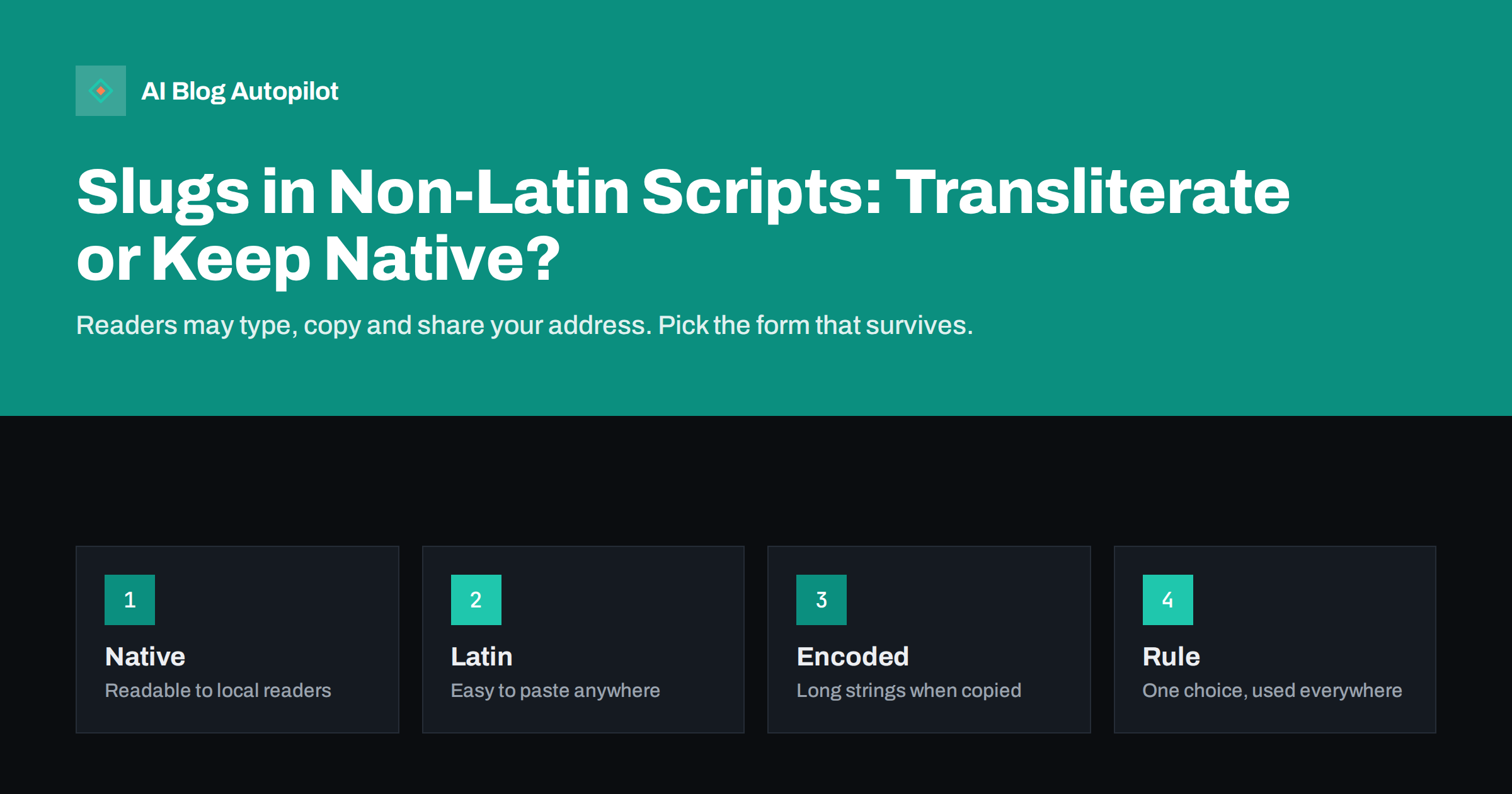
Short answer: both options work, so choose one rule for each language and keep to it. Native slugs, written in the script of the article, are easy for local readers to understand, and search engines can handle them. Their drawback is that they turn into long encoded strings when copied into some tools. Transliterated slugs, written in Latin letters, are shorter to share but may look unnatural to local readers. The worst choice is to mix both styles without a plan.
Publishers who write in Russian, Ukrainian, Greek, Arabic, Hindi, Thai, Japanese, Bengali or other languages that do not use the Latin alphabet face a small question at the end of every article. What should the web address say? This article compares the two approaches, explains the technical background in plain words and suggests a method that you can apply to a whole site.
The advice is aimed at blogs on WordPress, but the principles apply to any platform. The key is to decide once, write it down and make it easy for everyone who publishes to follow.
What a slug is and how non-Latin text is stored
The slug is the part of the address that names the page, such as the words after the domain and folder. In a good address, it describes the content in a few words. The earlier guide on URL slugs that still make sense covers the general rules.
Web addresses were designed around a small set of characters. Letters from other scripts can be used, but they are converted into a code made of percent signs and numbers when they are sent over the network. A browser usually shows the readable version in its address bar, while the encoded version appears when you copy the link into some tools, e-mails or documents.
WordPress allows slugs in many scripts and stores them in encoded form. Search engines can read both forms, and they treat the two as the same address. So the question is not whether native slugs are possible, but whether they are convenient for your readers and your team.
The case for native slugs
A slug in the reader’s own script feels natural. Someone who reads Greek will understand a Greek address at a glance, and it can match the title of the article. When the address is shown in a search result or a message, it can reassure the reader that the page is in their language and is about what they expect.
Native slugs may also match how people search. A person who types a query in their own script may find that the words in the address match the query, which can make a result look more relevant. The effect on ranking is small, but the effect on clicks and trust can be real, since readers like to see familiar words.
The cost is practical. When a native address is copied into a plain text field, a spreadsheet or an older system, it may appear as a long chain of codes that is hard to read and easy to break. Some tools cut long addresses, and some messaging apps do not make the link clickable if it contains unusual characters. Test your own addresses in the tools you use most.
The case for transliterated slugs
Transliteration means writing the sounds of the words with Latin letters, for example a Russian title written in the Latin alphabet according to a standard scheme. The result is short, safe in every tool and easy to paste. Teams that work across languages find it easier to handle, since everyone can read and check the addresses.
It has drawbacks, too. There is often more than one scheme, so two editors may transliterate the same word in two ways. Local readers may find the result odd, and it does not match how they would type the words. For some scripts, such as Japanese or Chinese, transliteration loses meaning because many words sound the same.
A third option is an English-language slug that describes the topic, with the article written in the local language. This is simple for a team to manage, but it can confuse readers who do not know the language of the address, and it may suggest that the page is in English. If you choose it, be sure that the language is clear from the rest of the page and the settings.
Social networks and messaging apps behave differently from search engines. Some fetch the page from an encoded address without trouble, while others fail to make a link clickable when it contains certain characters at the end of a sentence. If your readers share links often, run a short test on the networks that matter most to you before deciding.
What search engines do
Search engines support addresses in many scripts, and they decode the encoded characters for display and for matching. A native slug will not cause an indexing problem as long as the address is written correctly and consistently. Likewise, a transliterated slug is no problem.
The address is a small signal among many. The title, the headings, the text and the links matter far more. Do not expect a ranking jump from changing the form of the slug, and do not change an existing slug for this reason alone. A change brings the cost of a redirect, as explained in the article on 301 or 302 redirects.
Consistency is what counts. The same page must always use the same form of its address in links, in the sitemap and in canonical tags. If one internal link uses the encoded form and another uses the readable form, the two should still resolve to one address, but it is simpler to avoid the mix entirely.
Write the rule in one or two sentences, for example: “Greek articles use a Greek slug of three to five words, without small words, in lower case.” Add a good and a bad example. A rule this clear can be followed by any editor, and it removes the small daily decisions that lead to a messy mix over time.
Choosing a rule for each language
Think about your readers and your team. If your readers are local and your team is local, native slugs are a good default. If your team works across languages and relies on shared tools, transliteration or a short description in Latin letters may be easier. Both are acceptable, so pick the one that you can keep up for years.
Apply the rule per language and not per article. A set of articles in Arabic should all follow the same approach, and so should those in Greek. Record the rule on one page, with an example, and share it with every writer and editor. The article on permalink structure in WordPress shows how to set the pattern for the whole site.
Keep slugs short. In non-Latin scripts, a long title makes a very long address once it is encoded. Use three to five key words, and leave out small connecting words, as you would in English.
Right-to-left languages add one more point. Mixing an Arabic or Hebrew word with Latin letters or numbers in one slug can display in a confusing order in some tools, because the direction of the text changes within the address. Keep slugs for these languages simple, and check how they look in the address bar and in your reports.
Multilingual setups and hreflang
If you publish the same article in several languages, the addresses of the versions do not need to match. Each language version may have its own slug, and the hreflang annotations tell search engines which pages are versions of each other. The guide to hreflang for a multilingual blog explains the markup.
The structure of the site matters more than the slug. Many publishers put each language in its own folder or on its own domain, as discussed in international site structure, so a reader can tell the language from the address before reading the slug. Choose the structure first and the slug rule second.
When you write natively in each language, the slug can follow the local title. When you translate, the slug of the translation should follow the translated title, not the original one. This avoids a page in one language that has an address in another.
Finally, keep a sheet that lists each language, its slug rule, an example and the date of the last check. When someone new joins the team, or when you add a language, the sheet saves time. Review it once a year, since tools, browsers and networks keep improving how they treat addresses in other scripts.
Testing before you publish at scale
Before you apply a rule to hundreds of articles, test a handful. Publish a few test pages, then copy their addresses into e-mail, a messaging app, a social network, a spreadsheet and your analytics tool. Check that each one opens the right page and that reports show readable names.
Check your own tools, too. Some analytics reports show encoded addresses, which are hard to read in a long list. If your team will look at these reports often, you may prefer slugs that are readable in the report, or you may add a tool that decodes them.
Also check that your sitemap, your internal links and your canonical tags use the same form of each address. A short crawl of the site will show any mismatch. The article on translating or writing natively may help you to align the whole process.
How AI Blog Autopilot helps
AI Blog Autopilot writes articles directly in 25 languages, including many with non-Latin scripts, and publishes them to your WordPress blog with FAQ sections, tags and SEO meta. Before you start, decide your slug rule for each language and check that it works in your tools. See the pricing page for plans and for the number of languages on each plan.
Related reading
- How to Write a URL Slug That Still Makes Sense in Two Years
- Hreflang for a Multilingual Blog, Without the Headaches
- Blogging in 25 Languages: How to Reach International Readers with AI
The bottom line
Native and transliterated slugs both work. Pick one rule per language, keep the slugs short, test them in your tools and use the same form everywhere.
DUK
Can search engines index slugs in non-Latin scripts?
Yes. They decode the characters and treat the encoded and readable forms as the same address.
Why do native links look so long when I copy them?
Non-Latin characters are converted to percent-encoded codes when sent over the network. The browser shows the readable form, but copied text may show the codes.
Is transliteration better for SEO?
Not clearly. The slug is a minor signal, so choose by convenience for readers and your team and stay consistent.
Should I change existing slugs to follow a new rule?
Usually not. A change needs redirects and brings little benefit. Apply the new rule to new articles.
What if my team cannot read the local script?
Consider a short transliterated slug that the whole team can check, and document the transliteration scheme.