ENEnglish
 LTLietuviškai
 DEDeutsch
 FRFrançais
 RUРусский
 ESEspañol
 PLPolski
 ITItaliano
 UKУкраїнська
 CSČeština
 PTPortuguês
 JA日本語
 LVLatviešu valoda
 ETEesti
 HUMagyar
 IDBahasa Indonesia
 TRTürkçe
 HIहिन्दी
 ELΕλληνικά
 ARالعربية
 THไทย
 VITiếng Việt
 RORomână
 MSBahasa Melayu
 BNবাংলা
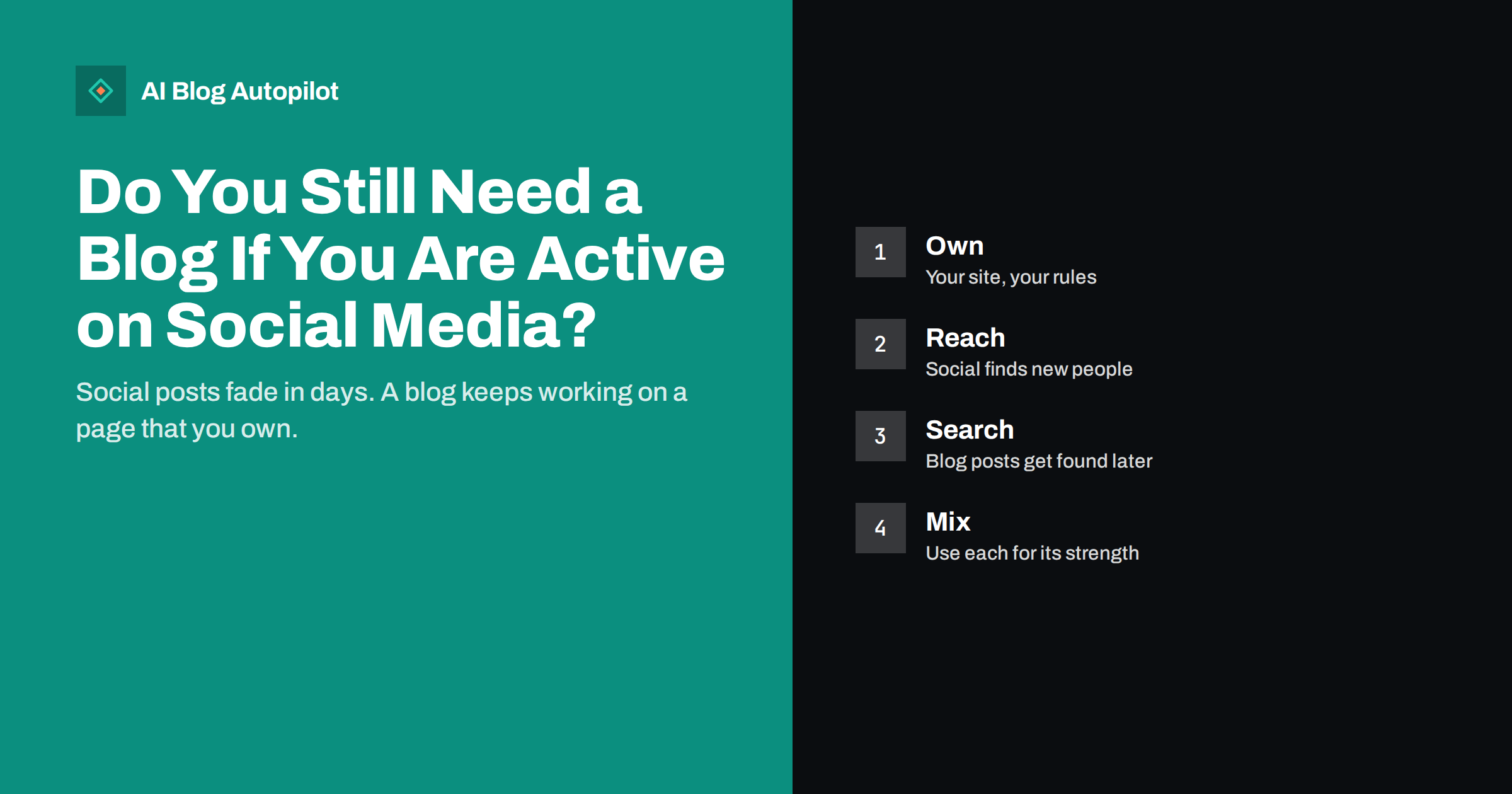
Short answer: yes, in most cases a business still benefits from a blog, even when its social accounts are busy. Social media is good at quick reach and conversation. A blog is good at lasting answers, search traffic and a place that no platform can change under you. Social alone can work for a few kinds of business, but it carries risks that are easy to miss until an account is lost or a feed changes.
Many small businesses ask this question because posting on social networks feels faster and more rewarding. You publish, people react and you see numbers within minutes. A blog feels slower. This article compares the two honestly, explains when social alone is a reasonable choice and shows how the two can support each other without doubling your workload.
The answer depends on what you want from your content. If you want a quick reaction to news, social is a good fit. If you want people to find you months from now by typing a question, you need pages that search engines and AI assistants can read.
What social media does well
Social networks put your message in front of people who did not search for you. A short video, a helpful picture or a clear opinion can travel far in a day. You can also talk with followers, answer questions and show the people behind the business. For many brands, this builds a sense of familiarity that is hard to get in any other way.
Social is also useful for timing. If you have an event, a seasonal offer or news, you can announce it within minutes. Posts can be tuned to each network, with a different length and tone for each audience. The article on choosing social networks for a blog explains how to pick where to spend effort.
The weakness is how short the life of a post is. Most posts get their views in the first hours or days. After that, the post sinks in the feed, and a new visitor has little chance of finding it. You must keep posting to keep being seen, which makes social a treadmill rather than an asset that grows.
What a blog does well
A blog article lives at one address that stays the same. People can find it through search, follow a link from another site or read it after an AI assistant mentions it. A good article can bring visitors for years, with little extra work, because it answers a question that people keep asking.
A blog is also where you can give a full answer. A social post may have room for a few lines, but an article can explain the steps, show the details and link to related pages. That depth builds trust with people who are close to a decision, and it gives search engines enough text to understand what you offer.
Finally, a blog is yours. You decide the layout, the links and what is shown next to the text. You can add a sign-up form, a product link or a contact page. On a social network, you work within the rules and design of someone else, and those rules change without notice.
The risk of building only on rented land
When all your content lives on one or two platforms, you depend on decisions that you do not control. An account can be limited or closed by mistake, reach can fall after an algorithm change, and a network can lose popularity or change its terms. Many businesses have seen a large audience become hard to reach after such a change.
You also do not own the list of people who follow you. If a network disappears or changes how it shows your posts, you cannot send those followers a message. A blog with an email sign-up, as described in building a newsletter from your blog posts, gives you a direct line that does not depend on a feed.
This does not mean that social is a bad idea. It means that it works best when it points to something you own. A short post that leads to an article or page gives each new follower a place to go and gives you a way to measure what interests them.
When social alone can be enough
There are cases where a blog adds little. A business that sells to people who find it only through a visual platform, such as a street food stall, a performer or a very local shop, may do well with social and a simple page with opening hours and contact details. A short-term project or an event can also run on social alone.
Even then, a basic website helps. People who hear about you may search for your name and expect to find a proper page. If they find only a social profile, some will doubt that you are established. Add a clear home page, a contact page and the facts people ask for most.
If you decide to skip a blog, make that a conscious decision. Write down why, and review it once a year. As the business grows or its customers change, the answer may change as well.
Where search and AI answers fit in
More people now ask search engines and AI assistants for advice before they buy. These tools read web pages. They do not browse a social feed in the same way, and a short post rarely gives enough detail to be quoted. A blog article that answers a question clearly has a much better chance of being used. The article on how to get your blog cited by AI search explains what helps.
Search traffic also differs in intent. A person who types a question wants an answer now, and a person who scrolls a feed is often just passing time. For topics where customers research before they buy, such as services, repairs or software, search readers are often closer to a decision.
This is why measuring both is useful. Compare what brings enquiries, not just likes. The guide on blog traffic or leads shows how to think about the numbers that count.
Think about audience stages too. Someone who meets you on social is often at the start, and may only want to see whether you are trustworthy. Someone who reads your article is further along and wants details. A blog lets you serve the second group properly, while social serves the first. If you try to do the second job on social, posts become too long, and if you do the first job on a blog, articles feel thin.
Cost matters as well. A social post costs little to make, but it has a short life, so you pay again each day. An article costs more at the start, but it can serve readers for a long time and it can be updated. Over a year, a small set of strong articles often gives better value than hundreds of posts that nobody sees again, though the posts help to carry the articles to readers.
Using both without doubling the work
The simplest approach is to treat the blog as the source and social as the way to spread it. Write one useful article, then turn it into several short posts that point back to it. That way one piece of thinking feeds both channels. The article on turning blog posts into social posts shows how to do this without repeating yourself.
Give each network a version that fits it. A professional network may like a short lesson from the article, while a visual network needs a clear image and a hook. Add the link where the network allows it, and use the best place for it, as discussed in the piece on links in comments or in the post.
Keep a simple routine. Publish a few strong articles each month, share each one in several ways and reply to the people who respond. A steady rhythm beats bursts of effort followed by silence.
Look at your own results before you decide. Check how many people came to your website from each social network, how many enquiries came from search and which pages they read first. A few weeks of notes will tell you more than any general advice. If search brings people who ask good questions, that is a sign that a blog will help. If nearly all contact comes through direct messages from social, then social deserves more of your time at present.
A simple way to decide
Ask four questions. Do customers search for answers before they buy from you? Do you have knowledge that you can explain in more than a few lines? Would you be harmed if one social account disappeared tomorrow? Do you want your content to keep working next year? If the answer to most of these is yes, a blog is worth the effort.
If the answers are mostly no, start with social and a simple website, and add a blog later. The work you do on social is not wasted, since good posts often become the first ideas for articles. Keep a list of the posts that got the most response, because they show what your audience cares about.
How AI Blog Autopilot helps
AI Blog Autopilot is built around this idea of one source and many outlets. It writes 2,000 to 3,000 word SEO articles for your WordPress blog and shares each one to your social networks, with text and timing that fit each network. If you do not have a website yet, it can also run social media on its own and you can add a blog later. See the pricing page for the plans.
Related reading
- Your Own Blog or Medium and Substack: Where to Publish
- Which Social Networks Should a Business Blog Use? A Method
- Building a Newsletter From Your Blog Posts
The bottom line
Social media gives quick reach, and a blog gives a lasting home that you own and that search and AI tools can read. Most businesses do best with both, using the blog as the source and social as the way to spread it.
DUK
Can I run a business with social media only?
Some small local businesses can, but they depend on platforms they do not control. A simple website with your key facts is still a sensible minimum.
Which brings more customers, a blog or social media?
It depends on your market. Social is better for quick reach, while a blog is better for people who search for answers before buying. Measure enquiries from each.
Do I need to post on every network?
No. Choose the few networks where your customers already spend time, and do those well.
How often should a small business blog?
Regular beats frequent. A few solid articles a month, shared on social, is a realistic start.
Can social posts replace a blog for AI search?
Rarely. AI tools tend to rely on pages with clear, detailed answers, which a short social post usually cannot provide.