ENEnglish
 LTLietuviškai
 DEDeutsch
 FRFrançais
 RUРусский
 ESEspañol
 PLPolski
 ITItaliano
 UKУкраїнська
 CSČeština
 PTPortuguês
 JA日本語
JA日本語 LVLatviešu valoda
 ETEesti
 HUMagyar
 IDBahasa Indonesia
 TRTürkçe
 HIहिन्दी
 ELΕλληνικά
 ARالعربية
 THไทย
THไทย VITiếng Việt
 RORomână
 MSBahasa Melayu
 BNবাংলা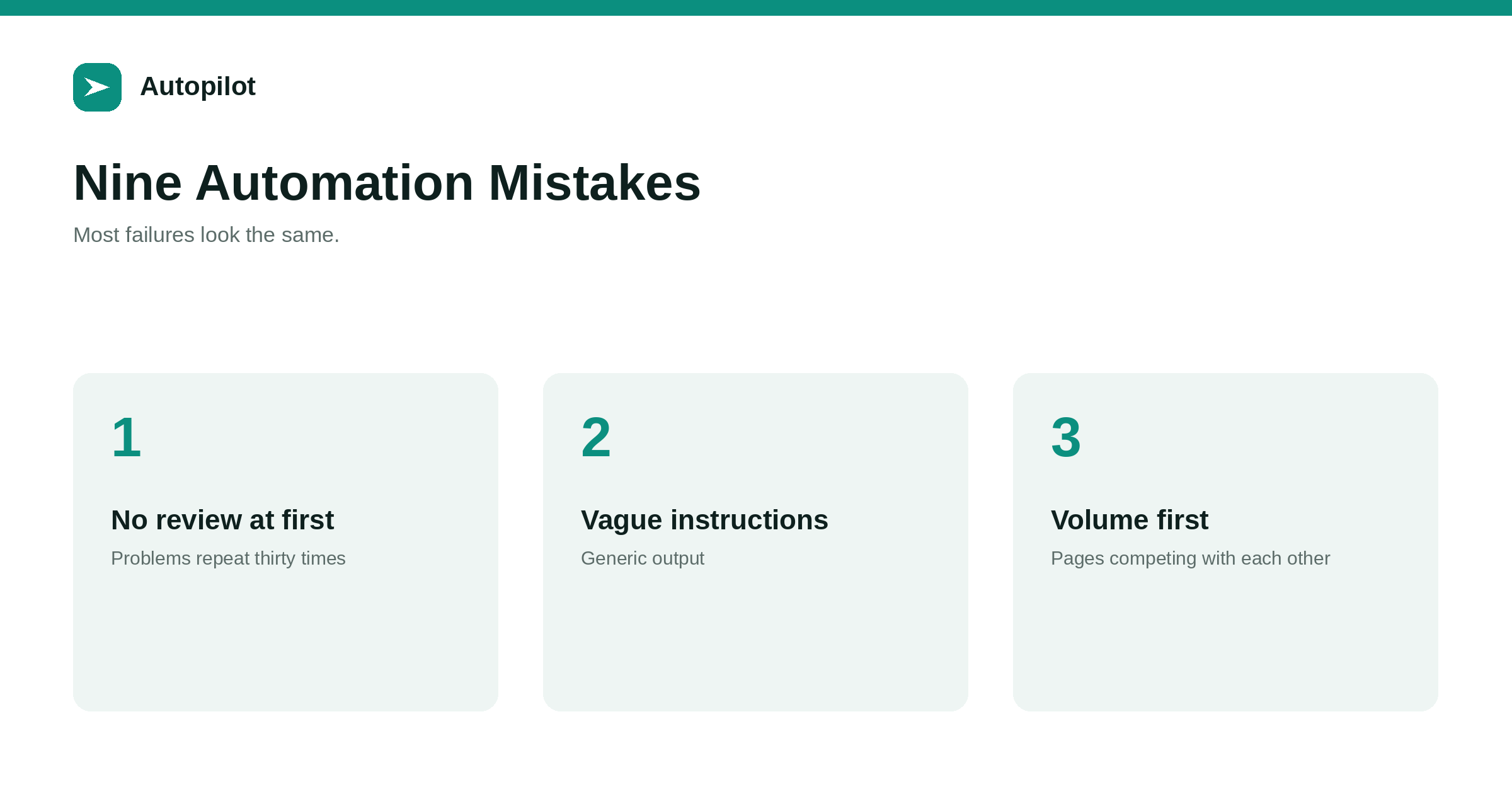
Short answer: the common ones are: switching on unattended publishing from day one, giving vague or no standing instructions, choosing volume before checking quality, letting topics overlap, never adding anything only the business knows, handing over an administrator password, publishing on sensitive subjects without review, ignoring what the published pages actually look like, and not measuring anything. Each has a simple fix, and nearly all of them come down to watching closely for the first month before loosening control.
Automated blogs that go wrong tend to go wrong in the same ways. The tools differ; the mistakes do not. And almost none of them are about the technology.
They are decisions made in the first week, usually in a hurry to see the blog fill up.
1. Unattended publishing from day one
The most consequential mistake. The first articles reveal what the instructions got wrong — a claim you would never make, a tone that is off, a recurring structural problem. If they publish unattended, that problem repeats across every article before anyone notices.
The fix is to review everything for the first month, then loosen control only for categories where review stopped finding problems — the progression in draft, approve or full auto.
2. Vague or missing instructions
A tool with no standing instructions writes for a generic reader in a generic voice. The output is competent and indistinguishable from everyone else’s.
One page of instructions changes this: who the reader is, what you never claim, how you sound, and what the business actually offers. writing a brief an AI can use and writing down your brand voice cover the two halves.
3. Volume before quality
It is tempting to start at the highest cadence the plan allows. But thirty mediocre articles a month is not better than eight good ones; it is thirty pages that need fixing later.
Start at a pace you can review properly. Increase it once the review is consistently short, not before — how often to publish covers choosing a sustainable rhythm.
4. Topics that overlap
At volume, topic lists drift towards repetition: three articles on meta descriptions, two on posting frequency, each slightly differently titled.
They compete with each other rather than adding coverage. Plan one distinct question per article and check new topics against published ones before approving a month — how many keywords one article should target explains the test.
5. Nothing only the business knows
An automated article without additions is a well-organised summary of what is already published. Readers and search engines have no particular reason to choose it.
Two additions per article — a number from your own operations, a real customer situation, a screenshot of your own tool — change that. adding something original lists where they come from.
6 to 9: access, sensitivity, inspection and measurement
The remaining four are quicker to describe and just as common.
| Mistake | Consequence | Fix |
|---|---|---|
| 6. Handing over the admin password | Full site access to a third party | Application password, Editor role |
| 7. Sensitive subjects unreviewed | Wrong claims about money, health or law | Always route these to review |
| 8. Never looking at published pages | Broken images, wrong categories unnoticed | Check each new post on a phone |
| 9. Measuring nothing | No idea whether it is working | One outcome metric, reviewed quarterly |
Number eight is surprisingly frequent. The tool reports success, nobody opens the page, and months later someone discovers every featured image was missing or every post landed in Uncategorized.
Number nine is the reason the others persist. Without one outcome measured every quarter, there is no moment at which anyone asks whether the blog is working, so nobody notices that the topics overlap, the articles say nothing specific, or the pages are never read. measuring whether a blog is working covers choosing the measure.
What a good first month looks like
Avoiding all nine is mostly a matter of how the first month is run.
Week one: write the standing instructions, connect with a limited account, and publish two or three articles as drafts. Read them properly and note every correction.
Week two: turn the corrections into instructions. If you removed the same kind of claim twice, forbid it. If the tone was off, add an example paragraph. Publish a few more, still reviewed.
Week three: check the published pages on a phone, confirm categories, images and descriptions are right, and look at the topic list for overlaps.
Week four: decide which categories, if any, can move to lighter review, and choose the one outcome you will measure. By the end of the month you know what the tool produces on your site with your instructions, which no demo can tell you.
The pattern behind all nine
Every mistake on the list is a version of the same one: treating automation as a way to stop paying attention rather than a way to spend attention better.
The teams that make automation work spend less time producing content and more time on the parts that need judgement: instructions, topic selection, review, additions, measurement. The total time falls sharply; the attention per article on what matters actually rises.
And no setup, however careful, guarantees results. What it does is make sure that when an article fails, it fails for reasons outside your control rather than one of the nine above.
Related reading
If this was useful, these cover the questions that usually come next.
- Whether a blog can really be automated — what success looks like instead
- Draft, approve or full auto — avoiding the first mistake
- Writing a brief an AI can use — avoiding the second
The bottom line
Review everything for the first month. Write one page of standing instructions. Start at a pace you can check, plan distinct topics, add something only you know, and connect with a limited account. Route sensitive subjects to review, look at every published page, and measure one outcome. Automation should redirect attention, not remove it.
DUK
What is the biggest mistake when automating a blog?
Switching on unattended publishing immediately. The first articles show what the instructions got wrong, and without review that problem repeats across every article.
How many articles should I start with?
As many as you can review properly, which for most teams means a few a week at first. Increase the pace once reviews are consistently quick.
Why do automated articles sound generic?
Usually because there are no standing instructions about audience, voice and forbidden claims, and nothing specific to the business has been added. Both are fixable.
Should sensitive topics be automated?
They can be drafted automatically, but anything affecting money, health, safety or legal matters should always be reviewed by someone with relevant knowledge before publishing.
How do I avoid duplicate topics at volume?
Plan one distinct question per article, and check each new month’s topics against what is already published before approving them.
Does avoiding these mistakes guarantee results?
No. It removes the avoidable causes of failure. Results still depend on competition, your market and search changes that nobody controls.