ENEnglish
 LTLietuviškai
 DEDeutsch
 FRFrançais
 RUРусский
 ESEspañol
 PLPolski
 ITItaliano
 UKУкраїнська
 CSČeština
 PTPortuguês
 JA日本語
 LVLatviešu valoda
 ETEesti
 HUMagyar
 IDBahasa Indonesia
 TRTürkçe
 HIहिन्दी
 ELΕλληνικά
 ARالعربية
 THไทย
 VITiếng Việt
 RORomână
 MSBahasa Melayu
 BNবাংলা
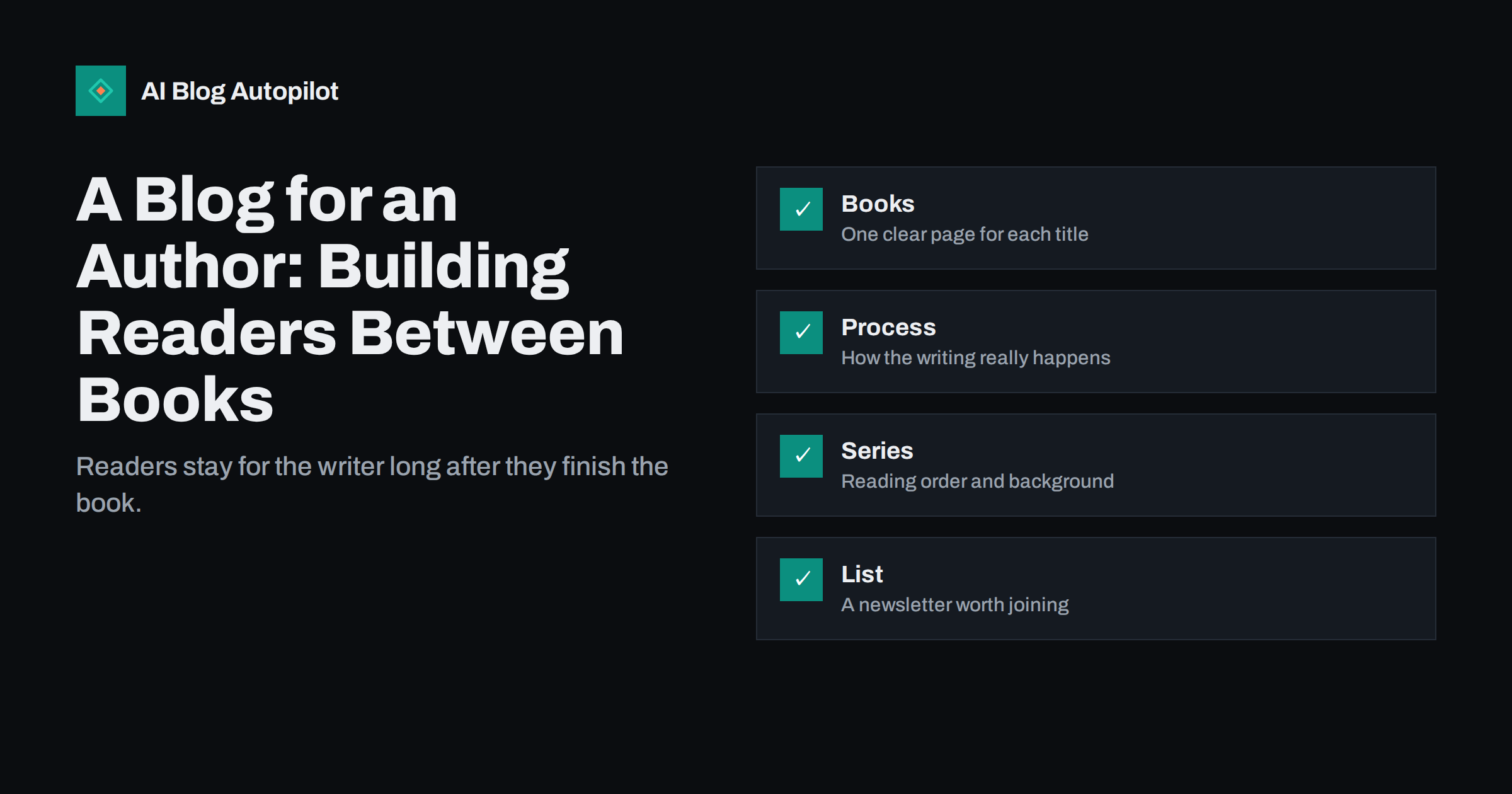
Short answer: an author’s blog works best as a home base that gives readers more of what they already enjoy: a clear page for each book, the story behind it, a reading order for a series, honest news about what is coming next and a simple way to join a mailing list. Write for the reader who has just finished a book and wants to know what to do next.
Most authors are told to blog and then run out of ideas within a month. The difficulty is usually the audience. If you write for other writers, you compete with thousands of advice sites. If you write for readers, you have a natural subject, because the books themselves, and the world and thinking behind them, are what readers want to hear about. A modest blog aimed at that audience can sit quietly in the background for years and still bring in new readers.
Give every book a proper page
The first job of an author site is to make it easy to find and buy the books. Each title needs its own page with the cover, a short description, the series and reading order, the formats available, an excerpt if you have one and clear links to the shops that stock it. Write the description in your own voice rather than copying the jacket text, and keep the key information in plain text, not only in an image.
Add what a curious reader wants to know: the length, the age range, any content notes, whether it works as a standalone and what to read next. This answers the questions that readers ask in reviews and on social media, and it helps search engines understand what the page is about. Keep the addresses permanent, so that links from reviews, libraries and other sites continue to work as the catalogue grows.
Write the story behind the story
Readers are curious about where ideas come from. Short pieces on the research, the places that inspired a scene, the real events that shaped a character or the drafts that did not survive make good content, because only you can write them. Keep them free of spoilers, or mark the spoilers clearly and place them after a warning, so that new readers do not feel cheated.
Photographs, maps, playlists and sketches add interest, as long as you own the rights. Our guide to storytelling in business blog posts has ideas on structure that carry over to this kind of writing: a clear opening, one strong detail and an ending that gives the reader something to take away.
Be careful with what you reveal. Behind-the-scenes posts are most welcome when they deepen the reading, not when they explain every choice. A reader who enjoys an ambiguous ending may not want the author to settle it in a blog post. Share the craft, the place and the people, and leave the meaning of the book to the reader, who has earned it.
Help readers follow a series
A series is an advantage for search and for loyalty, but only if readers can find the order. Create a page that lists the books in sequence, with the publication year, a one-line summary and a note on whether each can be read alone. Link every book page to the series page and to the next title. If there are novellas or short stories, say where they fit.
The same principle applies to a serial on the blog itself. Our article on linking multi-part posts well explains how to connect parts, so that a reader who arrives at episode four can find episode one. Add a short recap at the start of each part for newcomers, and avoid relying on memory of a previous post.
Give the series page extra care because it often becomes the most linked page on the site. Readers, librarians and reviewers will point to it as the answer to “which book comes first?”. Keep a clear note on content for younger readers or sensitive subjects where it applies, and update the page as each new title is announced. A series page that is always right is a quiet but powerful asset.
Be honest about what is coming next
Readers value regular, truthful updates more than hype. A short note on what you are writing, roughly when it might appear and what has changed since the last post is welcome. Avoid fixed dates unless a publisher has confirmed them, because publishing schedules shift, and a missed date damages trust more than a vague promise. If a book is delayed, say so plainly and briefly.
Keep a permanent “news” or “next book” page that you update, and use blog posts for the longer notes. This gives readers one place to look and spares you the task of repeating the same information in many places. When the book is available for pre-order, add the links and dates the same day, and check them again after launch.
Build a mailing list readers want to join
Social networks come and go, and a mailing list is the one audience you own. Offer something that costs you little and readers value: a short story, a deleted scene, a map, a reading guide or an early look at a cover. Our guide to templates, checklists and other reasons to subscribe explains how to choose and present such a gift, and our piece on building a newsletter from your blog posts shows how to feed it without extra work.
Say what subscribers will receive and how often, make unsubscribing easy and keep the promise. A short, warm monthly message from the author is usually better than a long newsletter that appears once a year. Do not add readers who have not asked, and keep their data safe.
Think about the questions that readers send you by email or ask at events: where do you get your ideas, how long does a book take, do you plan or discover as you go, which authors do you read. Collect them into a short questions page and answer each in a few honest sentences. This page is easy to write, it is the kind of content that people search for, and it saves you from repeating the same answers many times.
Show who you are without oversharing
Your about page is often the most visited page on an author site, because readers want to know the person behind the words. Write a short biography in the third person for press use and a warmer first-person version for readers, with a photograph and a few facts that fit your genre. Mention previous books, awards and events, but only those you can substantiate.
Decide in advance what you will share and what you will keep private. Posts about your daily routine, pets or workspace can be charming, but family details and locations should stay under your control. Our guide to the about page a blog needs and the article on bylines and author bios cover the basics of presenting yourself with credibility.
Think too about the books and writers who shaped yours. A page of recommendations in your genre, with a line on why each matters, gives readers a trustworthy guide, builds goodwill with other authors and helps people who have just run out of your books and want something similar. Link to bookshops and libraries where possible, and say that you are recommending as a reader, which keeps the tone friendly and honest.
Make the most of events, reviews and press
Readings, festivals, library visits and interviews all deserve a record on your site. List upcoming appearances with dates, places and booking links, and keep a separate page for past events and media coverage, which helps journalists and organisers who are deciding whether to invite you. A press kit page with a short biography, high-resolution images, book covers and contact details saves them time and reduces mistakes.
Handle reviews with care. Quote praise sparingly and accurately, name the source and never invent or edit a quotation. If you thank reviewers, do so publicly and briefly. Do not argue with critical reviews on your own site or elsewhere, and do not ask readers to post only favourable comments. A calm, professional tone does more for your reputation than any promotional line.
Keep a rhythm that does not take over the writing
The blog must not eat the time you need for books. Decide on a small, sustainable pattern, such as one post a month, and let the rest of the site be pages that rarely change. Batch the work: write several short pieces after finishing a draft, when the material is fresh, and schedule them across the following months. Keep a list of reader questions from events and emails, because each is a ready-made post.
Review the site twice a year. Update the book pages, the news page and the links to shops, and check that every buy link still works. Retire anything that is out of date. A tidy author site with a few good pages serves readers better than a long archive of notes that no longer apply.
How AI Blog Autopilot helps
AI Blog Autopilot writes full SEO articles for your WordPress blog from the topics, keywords, audience and tone you set, with FAQ sections, tags and SEO meta included, and it shares each one to your social networks. For an author whose time belongs to the next book, supporting articles on reading order, genre background and reader questions can keep appearing while you write. Approval mode lets you read each article first, which matters for titles, dates and anything about your own work. See the pricing page for plans.
Related reading
- Building a Newsletter From Your Blog Posts
- Article Series on a Blog: Linking Multi-Part Posts Well
- The About Page a Business Blog Needs
- Templates, Checklists and Other Reasons to Subscribe
The bottom line
An author’s blog should serve readers who have finished a book and want more. Give each title a clear page, share the story behind it, make a series easy to follow, be honest about what is next, build a mailing list and keep the rhythm gentle enough to leave time for writing.
DUK
Does an author need a blog at all?
Not necessarily, but a site with book pages, an about page and a mailing list sign-up is valuable. A blog adds more ways for new readers to find you.
What should an author blog about?
Write for readers, not other writers: the story behind the books, series guides, research notes, honest news and recommendations in your genre.
How do I avoid spoilers?
Keep spoilers on separate pages or under a clear warning, and make sure the book pages and series guide are safe for new readers.
How often should an author post?
Once a month is plenty for most authors. A steady small rhythm that leaves time for writing beats a burst that stops.
What is a good free gift for a mailing list?
Something you can make once, such as a short story, a deleted scene, a map or a reading guide, that suits the readers of your genre.