ENEnglish
 LTLietuviškai
 DEDeutsch
 FRFrançais
 RUРусский
 ESEspañol
 PLPolski
 ITItaliano
 UKУкраїнська
 CSČeština
 PTPortuguês
 JA日本語
JA日本語 LVLatviešu valoda
 ETEesti
 HUMagyar
 IDBahasa Indonesia
 TRTürkçe
 HIहिन्दी
 ELΕλληνικά
 ARالعربية
 THไทย
THไทย VITiếng Việt
 RORomână
 MSBahasa Melayu
 BNবাংলা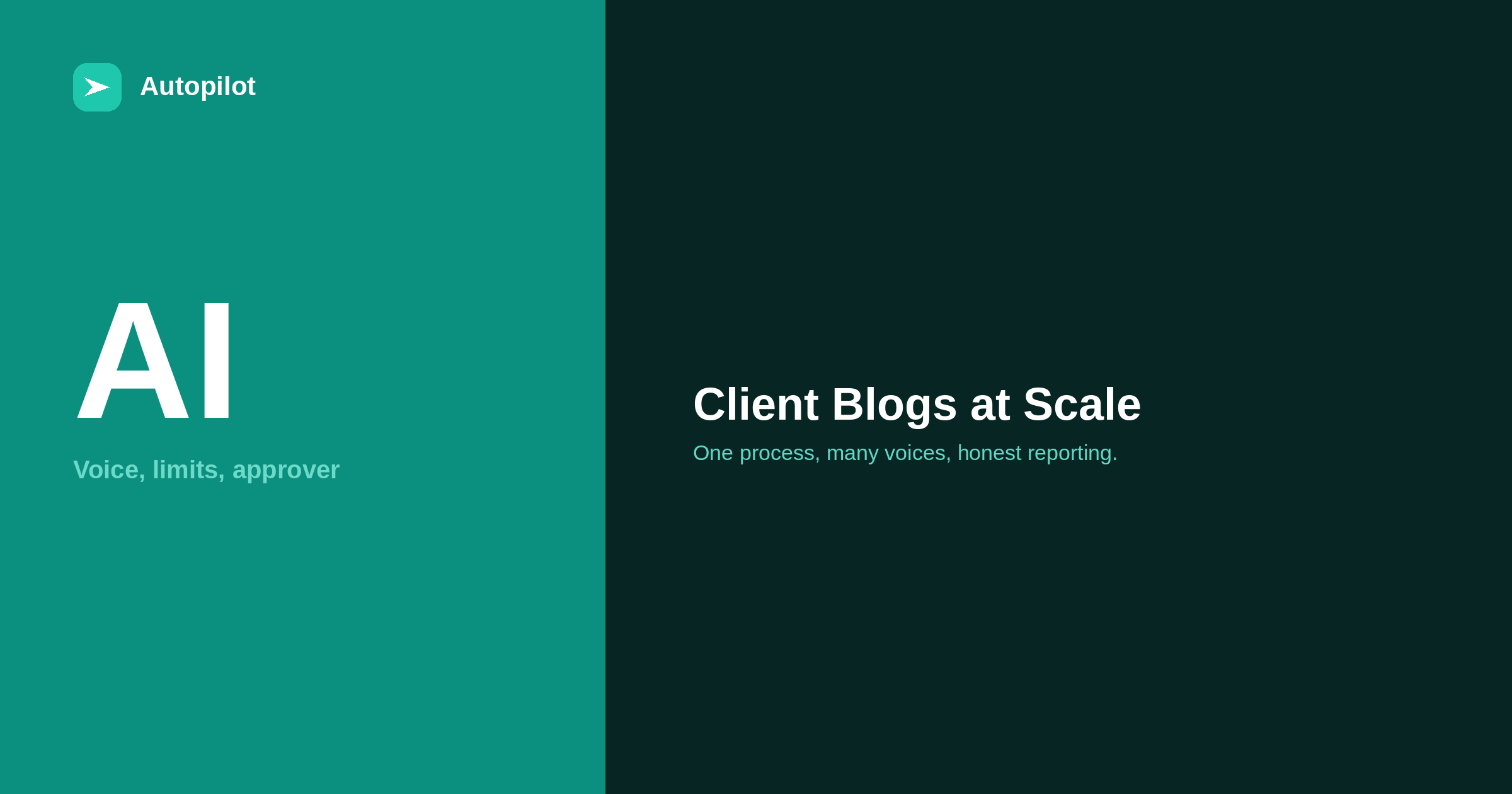
Short answer: give every client a one-page profile — reader, voice, forbidden claims, approver, goals — before any article is produced. Agree the approval process in writing: who approves, how quickly, and what happens if they do not respond. Automate drafting, images, publishing and sharing, and spend agency time on topic selection, review and client-specific additions. Report monthly on the outcome each client cares about, not only traffic, and be clear from the start that nobody can guarantee rankings.
Running one blog well is a manageable job. Running twenty for different clients multiplies every weakness: vague briefs, slow approvals, inconsistent quality, reports nobody reads.
Agencies that handle this well standardise the process and keep the content specific to each client. The two are not in conflict, if the right things are standardised.
A profile for every client
Before the first article, produce a one-page profile for each client and agree it with them.
| Section | Contents |
|---|---|
| Reader | Who the blog is for, in two sentences |
| Voice | Rules, a never list and example paragraphs |
| Forbidden claims | Things the client never says or promises |
| Subjects | Three to five, linked to what they sell |
| Approver | One named person, with a deadline |
| Goal | The outcome the blog is measured on |
This page becomes the standing instructions for every article. writing down your brand voice covers the voice section in detail.
Approval that does not stall
The most common bottleneck in client content is approval: drafts waiting weeks for a busy client to read them.
Agree the process in writing at the start. One named approver. A response time, such as five working days. And what happens if they do not respond: the article publishes, or it moves to the next month. Different clients can have different levels — full approval, approval for certain categories only, or post-publication review — as described in draft, approve or full auto.
Batching helps: one approval session for the month’s topics, then one for the month’s drafts, rather than a stream of individual requests.
What to automate
Across many clients, the mechanical work adds up quickly: drafting, formatting, featured images, publishing, social sharing, search engine notification. These should be automated.
AI Blog Autopilot’s Agency plan, listed on the pricing page, covers multiple websites with team and client approval and white-label reports. Whatever tool you use, automation changes the economics: the cost per article falls, and the agency’s value shifts to what automation cannot do.
Where agency time should go
With production automated, agency time goes into the parts that need judgement and client knowledge.
- Topic selection against each client’s goals and existing content.
- Review for accuracy and fit with the profile.
- Client-specific additions: data, customer examples, the client’s own view — gathered in a short monthly call.
- Reporting and advice.
The monthly call is the most valuable half-hour in the process. It produces the material that makes each client’s blog distinct — see adding something original.
Keeping voices distinct
At volume, client blogs drift towards one agency house style. The profile and example paragraphs prevent this, but only if they are applied to every article.
Every few months, read three recent articles from different clients side by side. If you could swap the logos without anyone noticing, the voices have converged and the profiles need tightening.
Reporting clients understand
Monthly reports often list traffic figures that clients neither understand nor care about. Report on the goal agreed in the profile.
A useful report is short: the outcome against target, the articles that contributed most, what was published, one observation, and one recommendation. Traffic and rankings can appear as context, not as the headline. measuring whether a blog is working covers choosing and measuring the outcome.
Being honest about results
Clients sometimes expect rankings to be guaranteed or traffic to rise within weeks. Correcting that at the start protects the relationship.
Explain that new pages take months to settle, that results depend on competition and search changes no agency controls, and that what you can promise is the process: consistent, accurate, well-structured articles and honest reporting. Agencies that promise positions tend to lose clients when the promise fails; agencies that promise process tend to keep them.
Pricing client content
Automation changes how client content can be priced. When production costs fall, charging per article at old rates becomes hard to justify, and clients increasingly know it.
Many agencies move to a monthly fee covering a defined service: a number of articles, review, client-specific additions, social distribution and a monthly report. The value the client pays for is the judgement, the knowledge of their business and the accountability, not the typing. Being open about that tends to strengthen relationships rather than weaken them, because the client can see exactly where the agency’s time goes.
Whatever the model, keep the review and the monthly call in the price. They are what distinguish an agency from a subscription the client could buy directly.
When a client wants to leave
Make leaving easy and clean: the client keeps every published article, the application password is revoked, and the profile document is handed over so the next person can continue in the same voice. Agencies that make departure painful earn a reputation that costs them more than the client did.
Onboarding a new client
A standard onboarding sequence keeps every client starting well.
- Profile agreed and signed off.
- Site connected with a limited account — connecting WordPress safely.
- Existing content reviewed for overlaps and gaps.
- First month’s topics approved.
- First three articles fully reviewed with the client, and the profile updated from what they change.
Step five is where most of the long-term quality comes from.
Related reading
If this was useful, these cover the questions that usually come next.
- Draft, approve or full auto — choosing review levels per client
- Writing down your brand voice — one guide per client
- Measuring whether a blog is working — what to report
The bottom line
Start every client with a one-page profile and a written approval process. Automate production, and spend agency time on topics, review and client-specific material from a monthly call. Check that voices stay distinct, report on each client’s own goal, and promise process rather than positions.
FAQ
How do agencies manage many client blogs?
With a standard process: a profile per client, an agreed approval flow, automated production, and agency time focused on topics, review, client-specific additions and reporting.
How do I stop client approvals from delaying content?
Agree one named approver, a response time and what happens without a response, in writing, before the first article. Batch approvals monthly.
How do I keep each client’s blog sounding different?
Use a voice section with rules, a never list and example paragraphs in each client’s profile, and periodically compare articles from different clients side by side.
What should a monthly client report include?
The agreed outcome against target, the articles that contributed most, what was published, one observation and one recommendation.
Can an agency promise rankings to clients?
Not honestly. Rankings depend on competition and search changes no agency controls. Promise the process and report honestly on results.
What should agencies automate?
Drafting, formatting, images, publishing, social sharing and search notification. Keep topic selection, review and client-specific material in human hands.