ENEnglish
 LTLietuviškai
 DEDeutsch
 FRFrançais
 RUРусский
 ESEspañol
 PLPolski
 ITItaliano
 UKУкраїнська
 CSČeština
 PTPortuguês
 JA日本語
 LVLatviešu valoda
 ETEesti
 HUMagyar
 IDBahasa Indonesia
 TRTürkçe
 HIहिन्दी
 ELΕλληνικά
 ARالعربية
 THไทย
 VITiếng Việt
 RORomână
 MSBahasa Melayu
 BNবাংলা
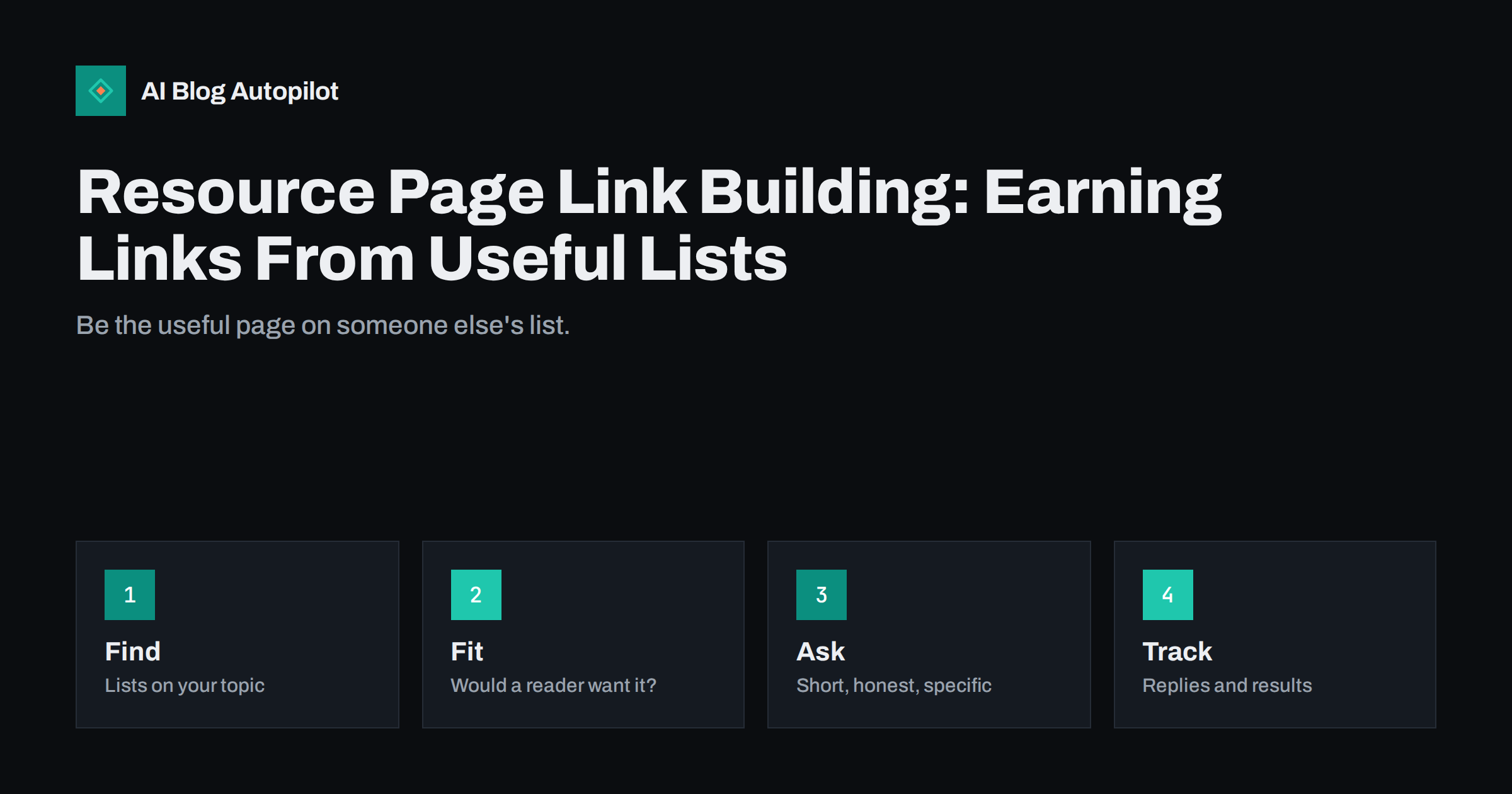
Short answer: resource page link building means finding pages that collect helpful links on one subject, such as a guide for new landlords or a list of tools for teachers, and asking the owner to consider adding your page if it truly belongs. It works only when your page is useful on its own and fits the list. Send a short, specific, polite message, accept a no and never offer payment or send the same request to hundreds of sites.
Many sites keep a page that gathers useful links: a library guide, a club page, a local council page for residents, a trade association list or a blogger’s collection of favourite tools. Such a page exists to help its readers find good material, so a link to a really useful page is a service to the reader, not a favour to you.
This guide explains how to find these pages, how to judge whether your content deserves a place, how to write a request that gets read and how to measure the result. It is slow work with a modest return, but the links are relevant and the contacts often last.
What a resource page is
A resource page is a list, usually curated by a person or an organisation, that points to helpful material on a defined subject. It may be called resources, useful links, further reading, tools, links or recommended sites. Some are short and personal, others are long and maintained by a team. The best ones are updated and have a clear purpose.
The value of a link from such a page comes from relevance. A page about home energy advice that lists your guide to insulation is a natural fit. A page about travel that lists a guide to accounting software is not. Search engines look at context, and readers do too, so relevance is also the best test of whether to ask at all.
Be aware of the limits. A link from a resource page rarely changes rankings on its own, and many such pages are old and unloved. Treat the effort as one part of a wider approach that includes good content, honest outreach and the other methods described in the article on earning backlinks honestly.
Make something worth listing
Before you search for pages, look at your own content with a stranger’s eyes. Is there a page that explains one thing better than others do? A checklist, a glossary, a calculator, a template, a well-sourced comparison or a clear step-by-step guide can earn a place on a list. A sales page, a thin article or a page full of adverts cannot.
Improve the page first. Make sure it loads quickly, reads well on a phone, has a clear title, shows an updated date and does not hide the answer behind a form or a pop-up. Add sources where you state facts and remove claims you cannot support. The guide on calculators and free tools as content shows how useful tools can earn links without any outreach.
Think about the audience of the list. A page for teachers wants material that a teacher can use in class tomorrow. A page for new parents wants calm, clear and practical content. Match your page to the people who read the list, and if it does not match, do not ask.
Finding pages that fit
Start with simple searches. Combine your topic with words such as resources, useful links, recommended reading, further reading, tools or guides, and look at the results that are lists rather than articles. Try variations in the way people in your field speak, and search in the language of your audience. Make a note of each page that looks active and relevant.
Look for pages that already link to content like yours. If a list names three guides on your topic, check whether yours is as good, and if it is, note it. If a page has dead links, you may offer a working replacement, which helps the owner as well. The article on broken link building explains this approach in detail.
Check each page before you add it to your list. Is it updated? Does it have real visitors and a real owner? Does it link out to many unrelated sites, or only to a few that fit? Is it full of paid links or adverts? Skip pages that look like link farms, since a link there brings no value and may harm your reputation.
Add a short, real reason that a reader would care. For example, mention that your guide was reviewed this year, that it covers a question the page does not yet answer or that it is free to use without signing up. A concrete reason is easier to judge than a general claim, and the owner can decide in a few seconds whether to look at the page.
Check your message for tone before you send it. Read it aloud and remove anything that sounds like a template: flattering openings, vague phrases about mutual benefit and long explanations of your business. If you would not be pleased to receive the message yourself, rewrite it.
Writing the request
Write to a person, not to a mailbox. Find the name of the owner or editor and use it. Say in one sentence why you are writing, name the page you saw, explain what your page offers and say why you think it fits. Keep the whole message short enough to read in half a minute, with a clear link to your page.
Be specific. Say which section of their list your page would suit and what it adds that the listed pages do not. Avoid praise that sounds copied and avoid demands. Make it easy to say no by ending with a friendly line such as thanking them for their time whatever they decide.
Never offer money for a link, and do not accept a request for payment. Paid links that pass ranking value go against the rules of search engines, and a message that hints at a deal can damage trust. If a page owner suggests a fee, thank them and move on. Never use a false name or invent a connection to the owner.
Keep the long view. A request that does not succeed today may succeed in a year, when the owner updates the list or when your page has more to offer. Note the pages that were good fits, and revisit them after you publish something significant. Contacts built with respect often lead to other chances, such as a quote, an interview or a shared project.
Following up and keeping score
If you do not hear back, one polite follow-up after a week or two is enough. Mention your first message briefly and add something of value, such as a new section on your page. After that, leave it. Repeated messages annoy people and rarely work, and a reputation as a nuisance travels in small communities.
Keep a simple record of each request: the page, the contact, the date, the page you suggested, the reply and the result. This shows which kinds of pages respond and which messages work, and it prevents you from writing to the same person twice by mistake. Update the record when a link goes live and check later that it still works.
Measure results honestly. Look at referral visits from the page, at any change in enquiries and at the quality of the links, rather than at counts alone. If the effort brings few links but good ones, it is working. If it brings none after thirty well-chosen requests, improve the page or choose another method.
Ethics and long-term value
Treat resource page owners as partners, not targets. Offer something useful in return where it is natural, such as sharing their page with your readers when it is good. Thank people who add your link and tell them if you update the page, so that their list remains accurate.
Avoid tricks that damage trust, such as asking for a link and then changing the page, creating fake pages to be listed or sending automated requests in bulk. Search engines act on link schemes, and site owners notice them. The article on nofollow, sponsored and UGC links explains which link types are right when money or user content is involved.
Keep your own site tidy. Fix broken links on your pages, keep your content current and consider a short, honest resource page of your own that lists the best material in your field, including that of others. A good list earns readers and links in its own right, and it shows the same generosity you ask of others.
Where this fits in your plan
Resource page outreach is a supporting tactic. The first priority is a blog that answers real questions with care and shows real experience. Links follow useful content, and outreach helps useful content get noticed. Set a small monthly goal, such as ten well-chosen requests, and keep it separate from your publishing schedule.
Combine it with other signals. Local organisations, trade bodies, schools and clubs often keep lists, and being named there supports your reputation and your local presence as well as your rankings. For a small business, a link from a respected local list is worth more than many from unknown sites.
Review the work every quarter. Check which links still work, which pages brought visits and which messages were answered, and decide whether to continue, change or stop. A method that takes much time and brings little should be replaced by one that suits you better.
How AI Blog Autopilot helps
AI Blog Autopilot can write and publish articles on your chosen topics, with FAQ sections, tags and SEO meta, and share them to your social networks. Choose guides worth listing, check facts and sources before each article goes live, and do the outreach yourself with care. See the pricing page for plans and monthly credits.
Related reading
- Earning Backlinks Honestly: What Works for a Small Site
- Digital PR on a Small Budget
- Calculators and Free Tools as Content: When They Earn Links
The bottom line
Make a page worth listing, find lists that really fit, ask briefly and politely, never pay for a link and keep a record of what works.
FAQ
What is a resource page?
A page that collects helpful links on one subject, kept by a person or an organisation for its readers.
Does a resource page link improve rankings?
It can help when it is relevant, but it rarely changes rankings alone. Treat it as one part of a wider approach.
How many requests should I send?
A small number of well-chosen ones, with one polite follow-up at most. Mass requests rarely work and harm your name.
Can I pay for a place on a list?
No. Paid links that pass value go against search engine rules, so decline any request for payment.
What if the owner says no?
Thank them and move on. Improve your page if the reason was fit or quality.