ENEnglish
 LTLietuviškai
 DEDeutsch
 FRFrançais
 RUРусский
 ESEspañol
 PLPolski
 ITItaliano
 UKУкраїнська
 CSČeština
 PTPortuguês
 JA日本語
JA日本語 LVLatviešu valoda
 ETEesti
 HUMagyar
 IDBahasa Indonesia
 TRTürkçe
 HIहिन्दी
 ELΕλληνικά
 ARالعربية
 THไทย
THไทย VITiếng Việt
 RORomână
 MSBahasa Melayu
 BNবাংলা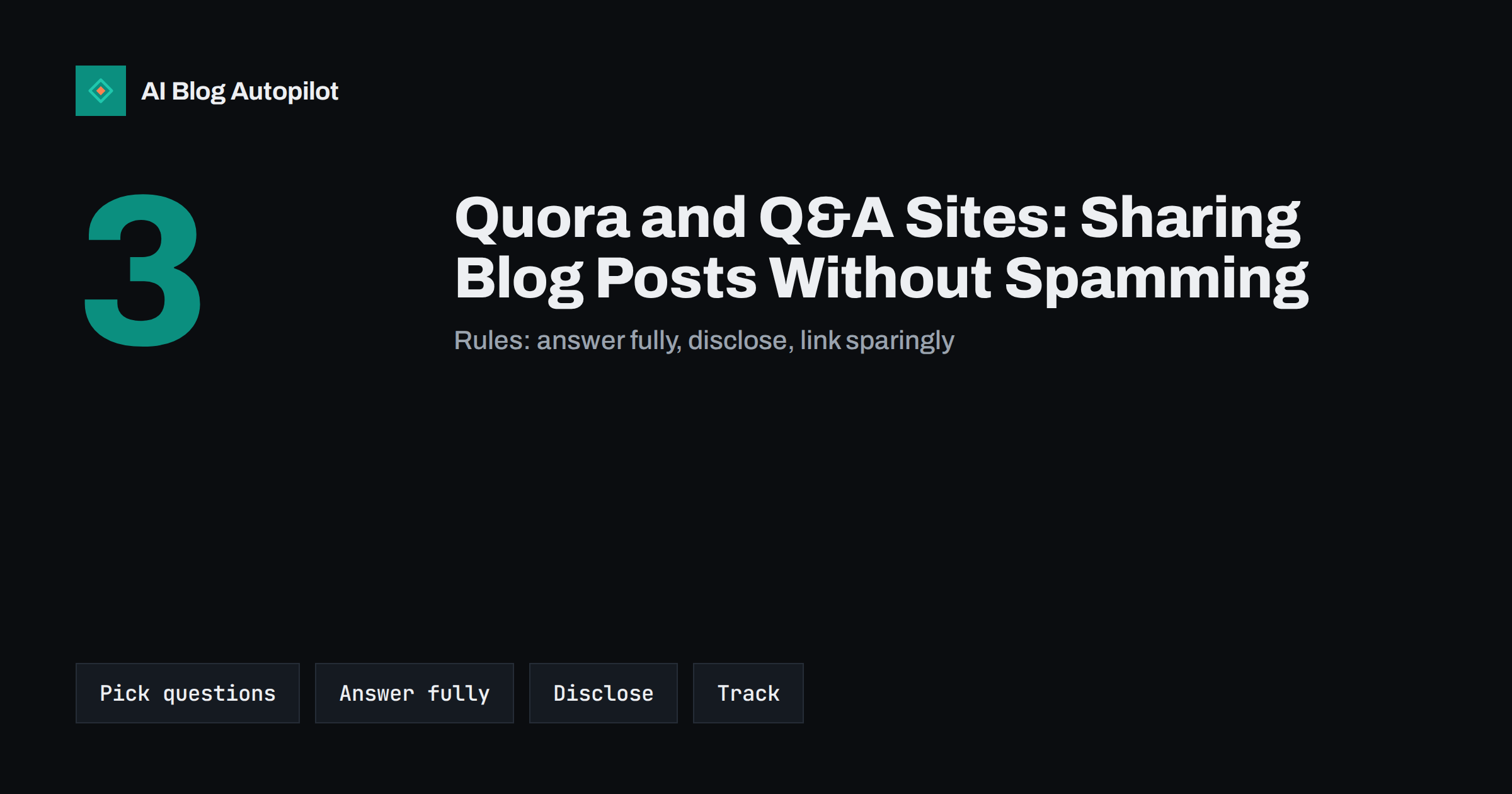
Short answer: question-and-answer sites can send a trickle of well-matched readers to a blog, but only if you behave like a helpful expert and not like an advertiser. Choose questions you can answer well, write a complete answer that is useful without any click, disclose your connection to the business, and link to an article only where it adds depth. Read each site’s current rules first, since self-promotion limits differ and change. Track the results with tagged links and treat the effort as a small, steady habit, not as a growth engine.
Questions on these sites are real: people write them because they need help. That is exactly the kind of demand a blog tries to meet. At the same time, the communities dislike drive-by promotion, and accounts that only drop links are often limited or removed. This guide shows a sustainable way to take part, what to expect and how to measure whether it is worth your time.
What these sites can and cannot do
Q&A platforms rank in search for many question-style queries, and some answers stay visible for years. A good answer can therefore reach readers long after you wrote it. The audience is often in a research mood, which suits guides and explainers better than sales pages.
There are limits. Links on most such sites are marked so that they do not pass ranking credit in the way an editorial link might, and the sites change how they show answers and what they allow. Traffic from one answer is usually small. And the sites can be crowded with low-quality replies. If you expect a steady flow of visitors from posting links, you will be disappointed. If you expect a modest number of qualified readers, a clearer sense of what people ask and a chance to build a reputation, the effort can be worthwhile.
Read the rules before you write
Each site and each community within it has its own rules on self-promotion, link use, disclosure and account behaviour. Some require you to state affiliation. Some limit the share of your contributions that may point to your own content. Some prohibit links in answers but allow them in a profile. Check the current rules and the style of top-rated answers before posting, and follow them even if you see others breaking them.
- Use your real name or a clear business identity, not a fake persona.
- Never create extra accounts to upvote your own answers or to disguise promotion.
- Do not buy votes, reviews or answers.
- Do not copy the same answer to many questions. Write for each one.
Rules are enforced by moderators and by other members. Being removed is the likely result of ignoring them, and a poor reputation on a site can follow you for a long time.
Choose questions you can answer well
Start from your expertise, not from a list of links to place. Search the site for the topics you write about, sort for questions with real activity and look for ones where the existing answers are thin, outdated or wrong. A question that is years old with an accepted answer and lots of replies may not be worth the effort. A recent question with few good answers is a better target.
- Match your topics. Choose questions that your articles genuinely cover.
- Check the intent. Is the asker a beginner or an expert, and are they looking for a quick answer or a long explanation?
- Read the current answers. Decide what you can add: a clearer explanation, an example, a correction or a missing step.
- Skip the rest. If you cannot add anything, move on. A weak answer harms your reputation.
A useful side effect is research. The questions you see repeated across the platform show how people phrase problems and what they find confusing, which is valuable input for article topics and FAQ sections.
Write an answer that stands alone
The answer itself should solve the problem. If readers have to click your link to find the answer, you have written an advertisement. Open with the direct answer in the first lines, then explain the reasoning, give an example and mention caveats. Keep the language simple and the structure easy to scan, with short paragraphs and lists where they help.
- Share your own experience where relevant, with honest detail, including what did not work.
- Be accurate. If you are not sure, say so, and do not guess at facts, figures or legal points.
- Avoid hype and unproven claims about results.
- Write in the same language as the question.
When an article of yours covers the topic in depth, add one sentence after the answer, such as “I wrote a longer guide with a checklist here”. This tells readers that the link is optional and gives a reason to click.
Here is a short example. Suppose you run a blog for a bicycle repair shop and see a question from a beginner asking why a chain keeps slipping. A weak reply says “read my article on chains”. A strong reply names the three most likely causes in order of how often they occur, explains how to check each in a few minutes with no special tools, says when it is safer to visit a workshop and adds that a longer illustrated guide exists, with a link at the end. The strong reply helps the asker even if nobody clicks, and anyone who wants more has a natural next step.
Disclose and link with care
If you link to your own work, say so. A short phrase such as “I work on this at…” or “this is my own guide” is honest and often required. Hiding the connection erodes trust and may break the rules. Use one link at most in an answer, point to the page that best fits the question and make sure that the page loads quickly and answers the same question without a pop-up in the way.
Think about the profile as well. On many sites the profile and the bio are the right place for a link to your site. Write a short, factual description of who you are and what you cover, and link to your home page or a main resource. Readers who like your answers will click through on their own.
Structure helps long answers. Use a short opening sentence that answers the question, a few numbered steps or bullet points for the detail and a final line that mentions where to learn more. Avoid walls of text, and avoid formatting tricks that look like advertising, such as capital letters or arrows. Check the answer on a phone, since many readers use the sites there. If a diagram or image would clarify the point, add one that you made or have the right to use.
Keep a modest routine
A sustainable pattern is small. For example, set aside twenty minutes twice a week. Search for new questions on your topics, answer one or two that you can improve, and check replies to your earlier answers. Respond politely to comments and corrections. If someone points out a mistake, thank them and fix your answer. The habit builds a record of helpful contributions that speaks for itself.
Avoid bursts. Posting thirty answers in a day and then disappearing looks like spam and rarely produces lasting results. Quality, regularity and patience matter more than volume.
Over time, your best answers become a source of reusable material. Keep a simple list of the questions you answered, the main points and the articles they relate to. When you write a new article, check the list for questions that readers asked and make sure the article answers them. When an older article is updated, revisit the related answers and correct them if the facts changed, so that people who find them later are not misled.
Track what comes of it
Tag any link you share with a clear source and medium so you can see visits in analytics. Compare the number of visits, the time on page and any sign-ups or enquiries with other channels. Keep expectations realistic: a few well-chosen answers may bring a small, steady stream. Review the results after two or three months and decide whether to continue, adjust the topics or stop.
Count the non-traffic benefits too. Note the questions that gave you ideas for articles, the corrections that improved your understanding and any contacts that arose from your answers. If the only benefit is research, that may still justify a brief weekly habit.
Be prepared for criticism. Communities sometimes push back on answers that seem promotional or incomplete, and the best reply is calm and useful. Add the missing detail, correct any error and move on. Do not delete an answer in anger if it can be improved, and do not retaliate against critics. Your public record on these sites is part of your reputation, and a reader who finds a polite, accurate history of answers is more likely to trust your blog than one who finds arguments.
Mistakes that get accounts restricted
- Link-only answers that say little more than “see my article”.
- Repeating the same text across many questions.
- Answering off-topic questions just to place a link.
- Arguing with critics instead of improving the answer.
- Automating posts in ways the platform forbids. Always follow the terms of use.
How AI Blog Autopilot helps
AI Blog Autopilot asks for your topics, keywords, audience and tone, and writes full SEO articles with FAQ, tags and meta for your WordPress blog. A library of articles built around real questions gives you accurate material to draw on when you answer people in communities. See the pricing page for plans.
Related reading
- Sharing Blog Posts on Reddit Without Getting Banned
- How to Promote a Blog Post After You Publish It
- UTM Tags for Social Shares: See Which Posts Bring Readers
- Earning Backlinks Honestly: What Works for a Small Site
The bottom line
Treat question-and-answer sites as places to help first. Read the rules, choose questions where you can add something, write answers that stand alone, disclose your link and use it sparingly, and keep a small regular routine. Track results with tagged links and judge the habit by qualified readers and the ideas it gives you, not by the number of links placed.
FAQ
Are links on Q&A sites worth having?
They can bring a few well-matched readers, but they are often marked so that they pass little ranking credit. Value them for visits and reputation.
Should I link to my blog in every answer?
No. Link only where the article adds real depth, and make sure the answer is useful without the click.
Do I have to say that the article is mine?
Yes, be open about it. Many sites require disclosure, and it builds trust with readers.
Can I reuse one answer on several questions?
Avoid pasting the same text. Write each reply for its own question, and reuse only your ideas and examples.
How much time should I spend on this?
Twenty minutes or so, twice a week, is plenty for most blogs. Review the results after a few months.