ENEnglish
 LTLietuviškai
 DEDeutsch
 FRFrançais
 RUРусский
 ESEspañol
 PLPolski
 ITItaliano
 UKУкраїнська
 CSČeština
 PTPortuguês
 JA日本語
 LVLatviešu valoda
 ETEesti
 HUMagyar
 IDBahasa Indonesia
 TRTürkçe
 HIहिन्दी
 ELΕλληνικά
 ARالعربية
 THไทย
 VITiếng Việt
 RORomână
 MSBahasa Melayu
 BNবাংলা
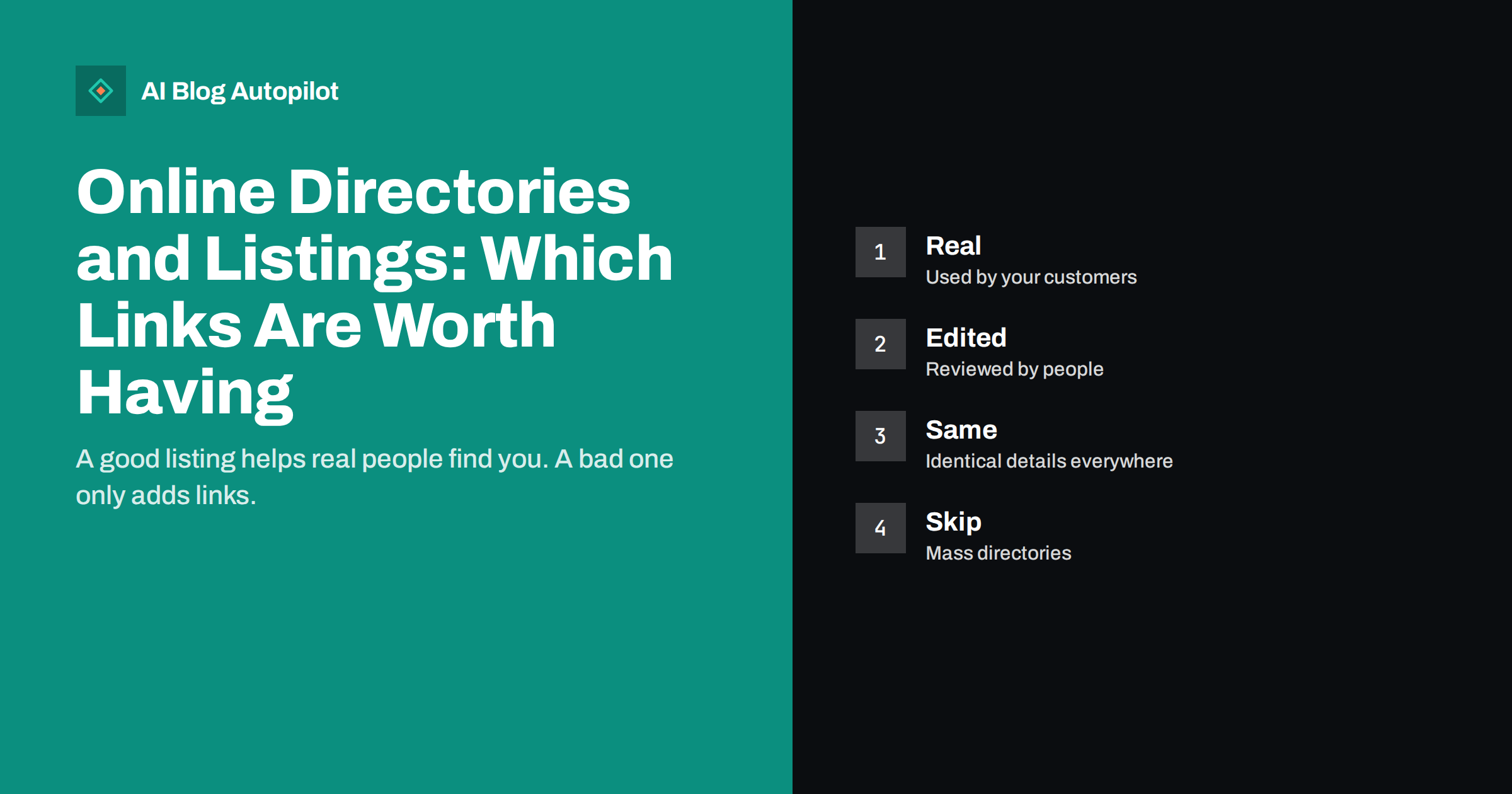
Short answer: list your business in a small number of directories that real customers use, such as your sector’s main directory, a local chamber or association and the major map and review services. Keep your details identical in each one. Skip mass directories that accept anything for a fee, since they offer little value to readers and can look like a link scheme. A listing is worth having if it can bring customers, not only a link.
Directories have a mixed reputation. In the early days of search, many people built hundreds of listings to gain links, and search engines learned to ignore or penalise the worst of them. Yet some directories remain useful, because people still use them to find suppliers, compare options and check facts. This article explains how to tell the two kinds apart, how to manage the ones you choose and how to avoid wasting money.
The advice applies to small businesses and to blogs that represent a firm, a practice or a project. The principle is simple: do it for customers, and the search benefit will follow where it is real.
What a directory is for
A directory collects entries about businesses, products or people in a field or place. Readers use it to find options, and they expect the entries to be accurate and organised. A good directory has a clear purpose, a selection process and some care for quality. It earns its place by being useful.
For a business, a listing has three possible benefits. It may bring visitors who use the directory. It may support your identity, by showing your name, address and facts in a trusted place. And it may give a link, which is the smallest of the three in most cases. If a directory gives only the link, it is probably not worth your time.
Think of each listing as a small page about you on someone else’s site. Its job is to be found, read and trusted. If you would be embarrassed to send a customer to it, do not create it.
Do not overlook the directories run by your own suppliers and partners. If you resell a product or use a platform, the maker may list approved partners, and a listing there brings visitors who are already interested in what you offer. Ask your contacts whether such a page exists and what is needed to be included.
Directories that tend to be worth it
Start with the places that your customers already know. These include the main map and business profile services, major review platforms in your field, and the large general directories in your country that people use. For some sectors, such as health, law, building or travel, there are well-known specialist directories with their own standards.
Add organisations that you really belong to. A trade association, a chamber of commerce, a professional register, a local business group or a supplier network usually list members, and these links are tied to real relationships. They carry trust, because they show that you are part of a community.
Include a few that are particular to your place or topic: a city guide, a regional tourism site or a hobby community. A short list of five to ten good listings is usually better than a long one. The guide to a blog strategy for a local business shows how listings fit with the rest of your presence.
Watch for directories that insert extra links, show advertisements for competitors on your page or sell your details to third parties. Search for the name of a directory together with words such as complaint or scam before you sign up. A few minutes of checking can spare you months of unwanted calls and emails.
Directories to skip
Skip directories that accept every submission without review, that list thousands of unrelated categories, or that charge for a link and promise a boost in rankings. These offer no value to readers, and search engines have long treated such links as low in value, and sometimes as spam.
Be wary of offers that arrive by email, claiming that your site has been selected, or promising hundreds of listings for a small fee. They are often automated schemes that create low-quality pages. Listings in bulk can also leave you with a mess of inconsistent details across many sites, which is harder to clean up than to create.
If you already have such links, do not panic. Most are simply ignored. Only if you see a pattern of manipulative links pointing to your site, and you have a record of actual problems, should you consider the steps in spammy backlinks and the disavow tool, and even then with care.
Keep your details consistent
For every listing, use the same name, address, phone number, website address and description. Small differences in wording are not a disaster, but real differences, such as an old phone number or a former address, cause confusion for customers and for assistants that gather facts from many sources.
Keep a master document with the correct details, the short description, the long description, the categories that you use and the logo and photographs. Use it when you create or update a listing. This also saves time, and it makes it easier to review everything once a year.
Record each listing: the address of the page, the login, the date of creation and the date of the last check. The advice in how a local business gets mentioned in AI answers explains why consistent facts matter for assistants as well as for search.
Add photographs that show your real premises, team or work, not only a logo. People trust listings that show a real place and real people, and the pictures often help a visitor to recognise your entrance or your van. Keep the file sizes sensible, and add a short description of each picture where the directory allows it.
Writing a good listing
Write for the reader of the directory. Say what you do, for whom and where, in plain words. Avoid stuffing the description with keywords or repeating the same phrase. A natural, clear text works better for readers and carries no risk of looking like spam.
Choose the right category, and add all the facts that the directory allows: hours, services, languages, payment methods and photographs. A complete listing looks more trustworthy than a bare one, and it answers questions that customers would otherwise have to ask.
Link to the most relevant page, which may be your home page or a page for a specific service or location. Use your own site name as the link text where you can choose, and avoid exact-match phrases. The notes in anchor text apply in spirit to external links too.
Reviews and replies
Many directories also host reviews. Ask real customers for honest reviews, and never write your own or pay for them. Reply to reviews politely, and thank the people who take the time to write. A calm answer to a complaint can persuade future customers more than a pile of praise.
Follow the rules of each platform. Many ban offering rewards in exchange for reviews, and they may remove reviews that look unnatural. Breaking the rules can cost you the listing and your reputation. The article on reviews in AI answers explains why honest reviews are valuable beyond the platform.
Make it easy for happy customers. A short message with a direct link to your review page, sent after a job is done, is enough. Do not pressure anyone, and do not ask only the customers you expect to be happy.
Test it as a customer would. Search for a service in your area, using the directory’s own search, and see which businesses appear and how complete their entries look. If the results are thin, outdated or full of obvious spam, move on. If you would use it yourself to find a supplier, it is probably a good place to be.
How to judge a directory
Ask a few questions. Does it have real visitors, which you can sometimes judge by activity and by searching for it in your field? Does it review entries? Would a customer find it helpful? Does it show up in the results when you search for your type of business and your place? Does it look cared for, with recent entries and working pages?
Treat metrics with caution. Scores such as domain authority are estimates made by tools, not official measures, as explained in domain authority scores. A directory with a high score may be worthless to your customers, and a small one may be valuable.
Check the terms. Some directories claim rights over your content, or they make cancelling hard, or they add links to your competitors on your page. Read the rules before you sign up, especially for paid listings.
Maintenance and review
Review your listings once or twice a year. Check the details, the links, the photographs and the reviews. Remove entries that are out of date or that no longer serve you, and claim any that were created without your knowledge, so that you control them.
When something changes, such as a move or a new service, update the master document first and then each listing. Put the task in your checklist for changes. If you work with an agency, agree who maintains the listings and who holds the logins.
Finally, remember where listings sit in the wider picture. They support your name and your reputation, but your own content is what earns real links and attention over time, as discussed in earning backlinks honestly.
How AI Blog Autopilot helps
AI Blog Autopilot publishes useful articles on your own WordPress blog, with FAQ sections, tags and SEO meta, and shares each one to your social networks, which gives directories, partners and customers something worth linking to. It writes in 25 languages. See the pricing page for plans.
Related reading
- Earning Backlinks Honestly: What Works for a Small Site
- Blog Strategy for a Local Business
- Unlinked Brand Mentions: Turning Them Into Real Links
The bottom line
Choose a few directories that real customers use, keep your details identical everywhere and skip mass listings. A listing is worth having when it can bring customers, not only a link.
FAQ
Do directory links help SEO?
Rarely by themselves. Links from real, trusted directories can support your identity and bring visitors, but mass directories offer little value.
How many directories should I join?
A short list of five to ten that your customers or your sector really use is usually enough.
Should I pay for a directory listing?
Only if the directory has real visitors and a clear benefit for your customers. Be wary of paid offers that promise rankings.
What details should be the same everywhere?
Your name, address, phone number, website and a short description. Keep a master document and update it first.
Can I ask customers for reviews?
Yes, honestly and without rewards where the platform forbids them. Never write or buy reviews.