ENEnglish
 LTLietuviškai
 DEDeutsch
 FRFrançais
 RUРусский
 ESEspañol
 PLPolski
 ITItaliano
 UKУкраїнська
 CSČeština
 PTPortuguês
 JA日本語
 LVLatviešu valoda
 ETEesti
 HUMagyar
 IDBahasa Indonesia
 TRTürkçe
 HIहिन्दी
 ELΕλληνικά
 ARالعربية
 THไทย
 VITiếng Việt
 RORomână
 MSBahasa Melayu
 BNবাংলা
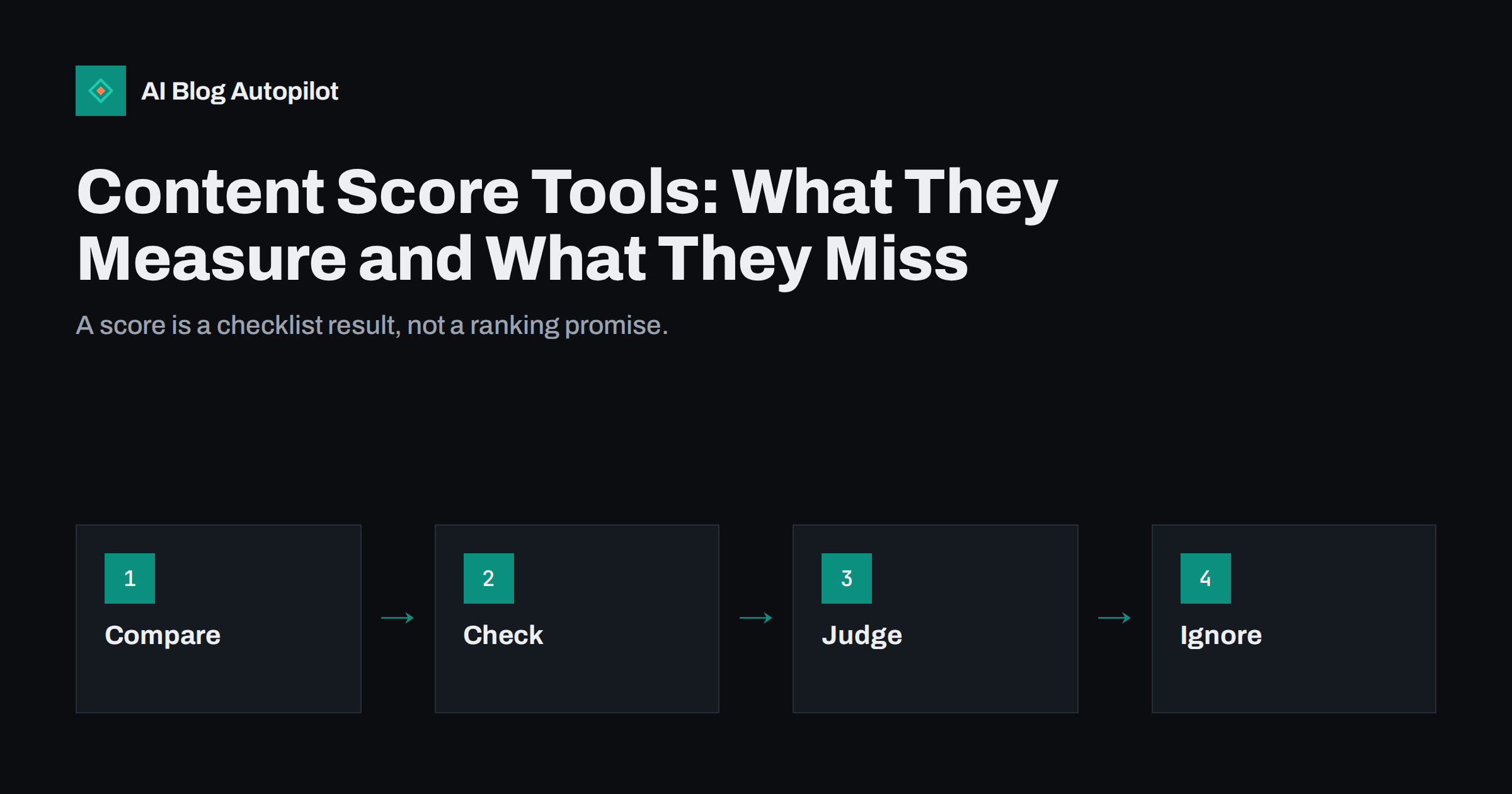
Short answer: content scoring tools compare your draft with pages that already rank for a phrase and give a number based on terms, length, headings and structure. They are useful as a checklist for gaps and missed subtopics, but they cannot judge accuracy, originality or usefulness, and no search engine uses their score. Use the score to find what is missing, and never write to raise it.
Many writers have met the green bar that turns from red to green as terms are added. It feels like progress, and it is tempting to keep going until the number reaches the top. The risk is that the draft becomes a list of expected words that no reader would want. This guide explains what such tools measure, where they help and how to keep the final say with a human.
What content scoring tools measure
Most tools work in a similar way. You enter a target phrase, the tool collects the top results, extracts the terms and headings they share and compares your draft with that set. The output is a score together with suggestions: terms to add, a recommended length range, headings to consider and sometimes questions to answer.
These signals describe what already ranks, not why it ranks. A page may rank because of its brand, its links, its age or its usefulness, and the tool sees only the text. The comparison is therefore a picture of the competition and a guide to topic coverage, and not a measure of quality.
The score is also specific to the tool. Two products will give different numbers for the same draft, because they use different sets of pages and different ways of weighting terms. A score of 85 in one tool says nothing about the score in another, and none of them is the number a search engine sees.
What a score cannot tell you
A tool cannot tell whether your facts are right. It cannot check that an example is real, that a figure is current or that a step works. It cannot see whether your post contains first-hand experience, which search engines and readers value highly, as discussed in E-E-A-T for automated blogs.
It cannot judge whether the answer is easy to find. A draft with every expected term can still bury the answer in the fourth paragraph, repeat itself or confuse the reader with a poor order. It cannot judge tone, and it does not know whether your reader is a beginner or a specialist.
It also cannot judge intent perfectly. If the top results for a phrase are mixed, for example a few guides and a few product pages, the tool may average them and recommend a hybrid that serves nobody. Look at the results yourself, using the approach in SERP analysis before writing, before trusting the advice.
Where scoring tools genuinely help
The best use is to find topics you overlooked. If most of the top pages mention a cost, a risk or a step that your draft does not, that is worth a look. You may decide to add a short section, or you may decide that the point is irrelevant for your readers. Either way you are deciding, not following.
They also help to check basic structure. Is there a clear heading hierarchy, a short opening answer, a section on common questions? Are the headings descriptive? The tools can flag a draft with no subheadings or a very thin treatment of a subject. See heading structure for SEO for the principles behind these checks.
They are useful for teams. A shared checklist reduces arguments about whether an article is ready, and it helps a new writer reach a basic standard. They also save time on briefs, since the research on competing pages is done in minutes. Our guide to how to write a content brief for AI shows where such research fits.
The danger of chasing a perfect number
Once a number is the goal, behaviour changes. Writers add terms where they do not fit, stretch a post to the recommended length with filler and repeat phrases that the tool wants to see. The text becomes heavier and less clear. Readers notice, and so do search systems that look for pages that truly help.
Length is a good example. A recommended range comes from the average of competing pages, which may be long because they are padded. If your answer is complete in fewer words, you gain nothing by adding more. Our guide on how long a blog post should be explains why completeness matters more than a count.
Keyword stuffing has a modern form: adding every related phrase in the hope of looking thorough. This has been discussed in over-optimisation in SEO, and in the LSI keywords myth. A text that covers a subject well will use the natural terms of that subject without being forced.
A sensible way to use a score
Treat the tool as one reviewer among several. Write the draft from what you know and from the reader’s question, and run the check afterwards. Look at the list of missing terms and read each one as a question: does the reader need this? If yes, add it in a natural place. If not, leave it out.
Set a modest threshold, such as “no major missing subtopics”, instead of a high number. If your article answers the question, is accurate, is organised and covers the main points, a middling score is nothing to fear. If it has a very low score, check whether you have misunderstood the intent or skipped something important.
Keep a note of what you accept and reject. After a few weeks you will see patterns: terms you always skip because they are generic, and gaps that you often miss. This turns the tool into a training aid for the writer.
Agree with your team what the tool is for. Some teams use it only at the brief stage, to list subtopics before writing, and never again. Others run it as a last check before publication. Either approach is fine, provided that nobody treats the number as a pass mark that overrides an editor’s judgement about accuracy and clarity.
If you work with freelance writers, avoid paying bonuses or setting targets based on scores. People respond to targets, and a writer who is paid for a high number will produce text for the tool. Ask instead for accuracy, originality and a clear answer, which are the qualities readers pay attention to.
Compare the score with real results
The only meaningful test is performance. After publishing, watch impressions, clicks and positions in your search console tool, and the engagement in your analytics. If posts with high scores do not do better than posts with moderate scores, you have learned how much the number is worth for your site.
Record the score at publication in your content inventory, next to the results after a few months. With twenty or thirty articles you will have a small and honest dataset. Our guide to a content inventory spreadsheet shows how to set one up.
Remember that rankings depend on many things that a content tool cannot see, including links, site reputation, page experience and competition. A good article with a moderate score may outrank a mediocre one with a perfect score, and the reverse is also possible. Make decisions on evidence from your own results, not on the score alone.
Choosing a tool, if you want one
If you decide to try a scoring tool, test it on three or four of your own articles that you already know well: one that performs strongly, one that performs poorly and one that you consider your best work. See whether the suggestions make sense. A tool that tells you to add irrelevant terms to your best post is not helping you.
Check how the tool chooses the pages it compares you with. It should let you set the country and language, and ideally let you remove results that do not match your intent, such as a giant marketplace or a video page. Check that it explains each suggestion and does not only show a number, since the explanation is what teaches you.
Look at the price in relation to the number of articles you publish. A small blog that posts a few articles a month may get as much from a free checklist and a careful read of the top results as from a monthly subscription. A free trial is a reasonable way to find out.
Scores and AI-written drafts
Drafts produced with the help of AI tend to be well organised and to include many of the expected terms, so they often score well at once. That can hide problems that the tool does not detect: vague statements, missing examples, repeated ideas and claims that nobody has checked. A high score on an automated draft is not a reason to skip the review.
Use the time you save to add what a tool cannot: a real example from your business, a figure you have measured, a screenshot, a clear opinion or a correction of a common mistake. These additions are what make a page different from the others, and they are exactly what scoring tools cannot reward. Our guide to how to add original data to blog posts offers ideas.
Read the finished text aloud or have a colleague read it. If a sentence seems to exist only to include a term, rewrite it or cut it. The reader should never be able to tell which terms came from a tool.
How AI Blog Autopilot helps
AI Blog Autopilot writes full SEO articles from the topics, keywords, audience and tone you set, with FAQ sections, tags and SEO meta included, and it runs an automatic quality check before anything goes live. Use your scoring tool as an extra review if you like: with approval switched on you can read each article first and decide what to change. See the pricing page for plans.
Related reading
- SERP Analysis Before Writing: What to Look For
- How to Edit AI-Written Drafts
- Over-Optimisation in SEO: How to Spot It
The bottom line
Use a content score to find missing subtopics and weak structure, then judge each suggestion yourself. A good article is accurate, clear and complete for its reader, and that is something no number can promise.
FAQ
Do search engines use content scores?
No. A score comes from a third-party tool and is not a signal that search engines read.
Is a high score worth paying for?
Only if you use it as a checklist for gaps. A number on its own does not improve rankings.
What score should I aim for?
There is no ideal number. Aim for a draft with no major missing subtopics and a clear answer.
Can a tool replace an editor?
No. It cannot check facts, tone, originality or whether the post helps a real reader.
Should I add every suggested term?
No. Add a term only if it answers a question the reader would ask.