ENEnglish
 LTLietuviškai
 DEDeutsch
 FRFrançais
 RUРусский
 ESEspañol
 PLPolski
 ITItaliano
 UKУкраїнська
 CSČeština
 PTPortuguês
 JA日本語
JA日本語 LVLatviešu valoda
 ETEesti
 HUMagyar
 IDBahasa Indonesia
 TRTürkçe
 HIहिन्दी
 ELΕλληνικά
 ARالعربية
 THไทย
THไทย VITiếng Việt
 RORomână
 MSBahasa Melayu
 BNবাংলা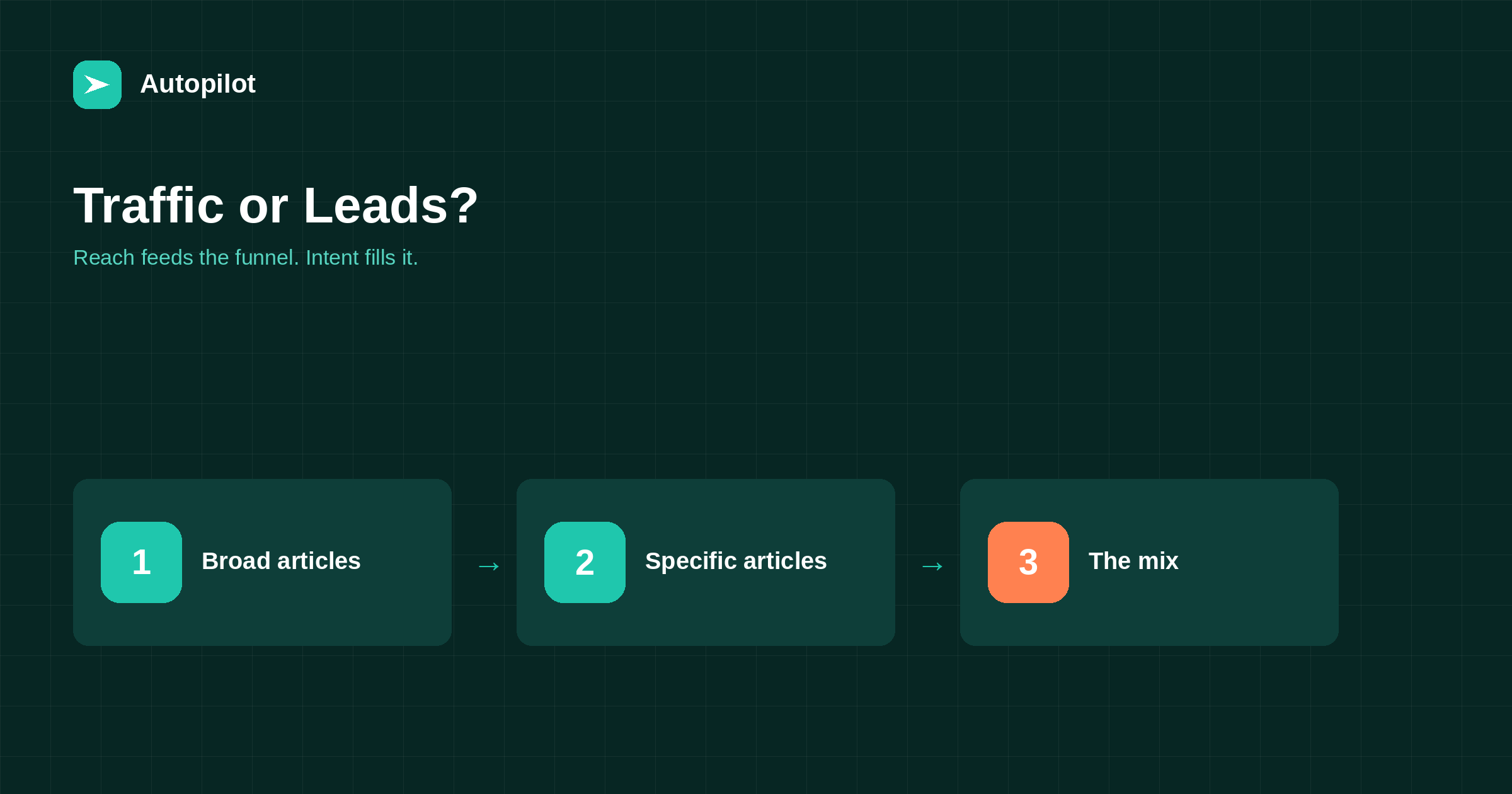
Short answer: for a business blog, leads — or whatever outcome the blog exists for — is the number that matters, and traffic is a means to it. Chasing traffic alone pushes you towards broad, popular subjects that attract readers who will never buy. Chasing leads alone can leave you with too little reach to be found at all. A sensible mix for most business blogs is mostly specific, high-intent articles close to what you sell, plus a smaller share of broader pieces that bring new readers into the subject.
There is a recognisable trajectory for business blogs. Traffic grows, a few articles become popular, the team writes more like them, traffic grows further — and enquiries stay flat, because the popular articles attracted people who were never going to become customers.
The opposite failure exists too, and it is quieter: a blog of product-adjacent articles that convert well and are read by almost nobody.
Why traffic and leads diverge
The articles that attract the most visitors are usually the broadest: definitions, general explanations, subjects with wide appeal. Their readers are curious rather than looking for a solution.
The articles that produce enquiries are usually specific: how to do a particular thing, how to choose between options, what something costs. Fewer people search for them, and those who do are much further along.
Both shapes are driven by intent, which is the subject of search intent. A blog that does not distinguish between them will drift towards whichever one the team happens to be measured on.
The mix that usually works
There is no universal ratio, but a pattern that holds across many business blogs is worth starting from.
| Article type | Condividi | Job |
|---|---|---|
| Specific how-to and problem-solving | About half | Help people close to a decision |
| Comparisons and choosing | A fifth or so | Serve people evaluating options |
| Broad explainers | A fifth or so | Bring new readers into the subject |
| Original material and opinion | The rest | Give people a reason to link and return |
Adjust from there based on what your own data shows, not on what another company reports. A blog selling to specialists needs fewer broad explainers; one in a new category needs more.
Making broad articles earn their place
Broad articles are not wasted; they are the start of a path. The question is whether the path exists.
A broad explainer should link naturally to the specific articles a curious reader would need next, and those should connect to the pages where they can act. Without that path, a popular explainer is a dead end with a lot of visitors.
This is what clusters are for — clusters and pillar pages covers the structure. The broad pillar draws the reach; the specific cluster articles convert it.
Calls to action that fit
A lead is only produced if the article offers a next step. The mistake is offering the same one everywhere.
Match the offer to the reader’s stage. A broad explainer can offer a related guide or a newsletter. A specific how-to can offer a trial or a template. A comparison can offer a direct conversation. A single book a demo banner on every page is wrong for most of them.
Place it where the reader has just been helped — after the section that solved their problem, not in the first paragraph before they have any reason to trust you. One well-placed relevant offer outperforms four generic ones.
What to measure, specifically
Track both numbers, but give them different jobs.
Traffic, per article and per type, tells you which subjects find readers. Outcomes, per article where you can attribute them, tell you which subjects find customers. The interesting articles are the ones where the two disagree: high traffic and no outcomes means the path is missing or the audience is wrong; low traffic and several outcomes means a subject worth expanding.
measuring whether a blog is working covers setting up attribution honestly, including the limits of what any analytics setup can see.
The traffic trap at volume
Publishing frequently makes the traffic trap easier to fall into, because broad subjects are easier to generate topics for and they produce visible growth quickly.
The defence is in planning. When topics are chosen a month at a time, as in planning a month of articles, label each by type and check the mix before approving the month. Ten broad explainers and two specific articles is a traffic plan; the reverse is a leads plan. Most business blogs want something closer to the second.
It also helps to take topics from customer questions rather than keyword tools, since customer questions skew specific by nature — the method in finding the gaps in your blog.
When traffic is the right goal
There are cases where reach genuinely is the objective: a publisher funded by advertising, a company building awareness in a category nobody searches for yet, or a brand whose sale happens offline long after any article is read.
Even then, it is worth measuring something downstream — newsletter sign-ups, return visits, branded search growth — because raw traffic from people who never return is the least durable asset a blog can have.
And for everyone, the honest caveat applies: neither traffic nor leads can be guaranteed by any content approach. What you control is the mix, the path and the offer.
Related reading
If this was useful, these cover the questions that usually come next.
- Measuring whether a blog is working — setting the target in the first place
- Search intent — why specific queries convert
- Long-tail keywords — where the leads usually are
The bottom line
Chase the outcome the blog exists for and treat traffic as a means to it. Weight the plan towards specific, high-intent articles, keep a smaller share of broad pieces for reach, and make sure every broad article has a path to the specific ones. Match each call to action to the reader’s stage, and study the articles where traffic and outcomes disagree.
FAQ
Should a business blog focus on traffic or leads?
On leads, or whatever outcome the blog exists for. Traffic is useful only to the extent it contains people who might act, and the most-read articles are often the least likely to produce enquiries.
Why do my most popular posts produce no enquiries?
Usually because they are broad and attract curious readers rather than people looking for a solution, or because there is no path from the article to anything relevant. Add links to specific follow-up articles and a fitting next step.
What mix of article types works for lead generation?
A common starting point is about half specific how-to and problem-solving articles, a fifth comparisons, a fifth broad explainers and the rest original material. Adjust based on your own results.
Where should a call to action go in a blog post?
After the section that solved the reader’s problem, and matched to their stage. A generic banner in the first paragraph performs worse than one relevant offer at the point of greatest trust.
Is high traffic with low conversions a problem?
It is a signal. Either the audience is wrong for what you sell, or the path from article to action is missing. The articles where traffic and outcomes disagree are the most informative ones to study.
When is traffic the right goal?
For advertising-funded publishers, brands building awareness in a new category, or businesses whose sale happens offline much later. Even then, measure something downstream such as sign-ups or return visits.