ENEnglish
 LTLietuviškai
 DEDeutsch
 FRFrançais
 RUРусский
 ESEspañol
 PLPolski
 ITItaliano
 UKУкраїнська
 CSČeština
 PTPortuguês
 JA日本語
JA日本語 LVLatviešu valoda
 ETEesti
 HUMagyar
 IDBahasa Indonesia
 TRTürkçe
 HIहिन्दी
 ELΕλληνικά
 ARالعربية
 THไทย
THไทย VITiếng Việt
 RORomână
 MSBahasa Melayu
 BNবাংলা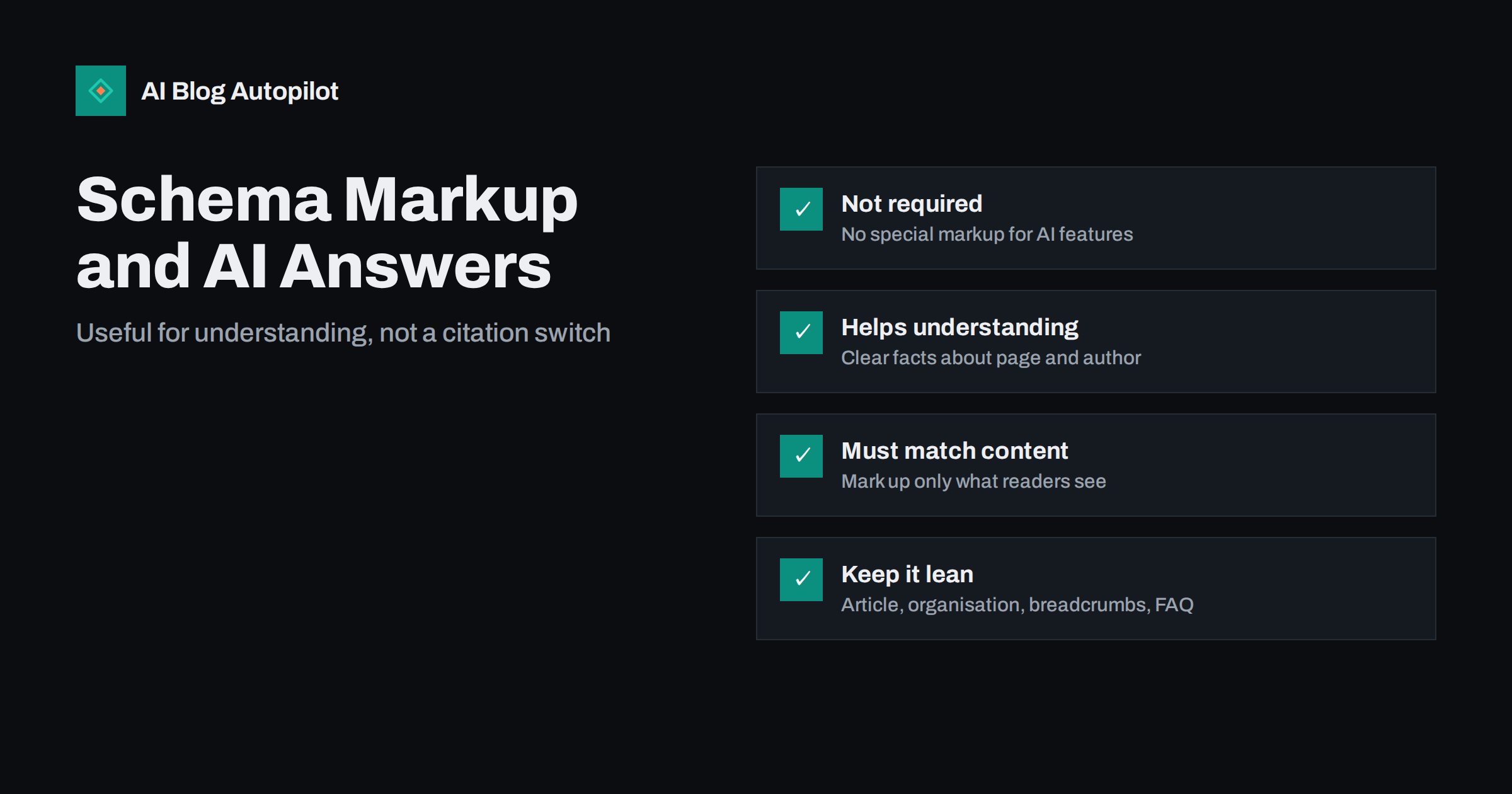
Short answer: schema markup is not required to appear in AI answers, and no type of structured data is known to guarantee a citation. Google states that its AI features need no special markup beyond being indexed and eligible for a snippet. Structured data still has value: it describes a page, its author and its organisation in an unambiguous, machine-readable way, and it powers rich results in conventional search. For a blog, a lean set of accurate markup (Article, Organization or Person, BreadcrumbList and, where there is a visible FAQ, FAQPage) is sensible. Content quality matters far more.
As AI-generated answers have spread across search, structured data has been promoted as a shortcut to being cited. Add the right schema, the claim goes, and AI systems will understand and prefer your page.
The reality is more modest and more useful. This article explains what schema markup actually does, what the search engines have said about it in the context of AI features, and which types are worth the effort on a typical blog.
What schema markup is
Schema markup is structured data added to a page, usually as a JSON-LD script in the HTML, using the shared vocabulary from schema.org. It states facts about the page in a format machines can read without interpretation: this is an article, this is its headline, this is the date it was published, this organisation published it, these are the questions and answers on the page.
Readers never see it. Search engines use it for two main purposes:
- Understanding. It removes ambiguity about what a page is, who is behind it and how it relates to other things.
- Eligibility for rich results. Certain types make a page eligible for enhanced displays in search, such as review stars, product details, breadcrumb trails or event listings.
Structured data does not make a page more relevant to a query in itself. It describes the content that is already there.
What the search engines say about AI features
Google’s documentation on AI features in search is explicit: there are no additional technical requirements to appear in AI Overviews or AI Mode, and site owners do not need to create new machine-readable files or add special schema. Pages need to be indexed and eligible to be shown with a snippet, as for normal search.
The same documentation recommends general good practice, including making sure structured data matches the visible content. That fits Google’s long-standing structured data guidelines, which state that markup must represent what is actually on the page and that misleading markup can lead to manual action.
Other AI search products publish less detail about how they process markup. It is reasonable to assume that well-formed, accurate structured data does no harm and may help some systems parse a page. It is not reasonable to assume it is a ranking or citation switch.
How structured data might still help AI answers
Even without being a requirement, there are plausible, indirect ways schema can support visibility in AI answers.
- Clear entity information. Organization and Person markup, with consistent names, logos and links to official profiles, helps systems connect your content to your business. That matters when an answer names a source or recommends a provider.
- Accurate dates. Article markup with datePublished and dateModified gives a clean signal about freshness, which matters for time-sensitive questions.
- Explicit question and answer pairs. FAQPage markup mirrors visible questions and answers. The value lies mainly in the visible FAQ itself, which is a compact, quotable passage, but the markup confirms the structure.
- Relationships between pages. BreadcrumbList shows where a page sits in the site, supporting the topical picture.
Notice that in every case the markup reinforces something already visible on the page. If the page has no clear author, no accurate dates and no FAQ, adding schema that claims them is both useless and against the guidelines.
What structured data cannot do
Some expectations are worth dropping entirely.
- It cannot make a weak answer strong. Retrieval systems select passages because they answer the question. Markup does not add information a passage lacks.
- It cannot override indexing problems. A page blocked by robots.txt or marked noindex will not be used, whatever its schema says.
- It cannot fake authority. Declaring an author as an expert in markup, without evidence on the page and elsewhere, adds nothing credible.
- It does not guarantee rich results. Eligibility is not entitlement; search engines decide when to show enhancements.
It is also worth knowing that some rich result types have been restricted over time. Google limited FAQ rich results in 2023 to well-known, authoritative government and health websites, and removed How-to rich results. FAQPage markup remains valid schema and harmless on a blog, but most blogs should not expect the expandable FAQ display in results.
The schema types worth having on a blog
| Jenis | Purpose | Where | Priority |
|---|---|---|---|
| Article or BlogPosting | Headline, dates, author, image, publisher | Every post | High |
| Organization or Person | Who is behind the site, logo, official profiles | Site-wide, usually homepage | High |
| BreadcrumbList | Page position in the site hierarchy | Posts and archives | Medium |
| FAQPage | Question and answer pairs | Posts with a visible FAQ | Medium |
| WebSite | Site name for search results | Homepage | Medium |
| Product, Review, Event, Recipe | Specific content types | Only where that content exists | As applicable |
Most WordPress themes and SEO plugins output Article, Organization, WebSite and BreadcrumbList automatically. The main job is to check that the output is correct and not duplicated. Article structured data and structured data for a blog go into each type.
What good Article markup contains
Because Article markup is the one type every post should carry, it is worth knowing what a complete, accurate block includes. You rarely write it by hand, but you should be able to read it and spot a problem.
- headline: the article title as shown on the page, not a keyword-stuffed variant.
- datePublished and dateModified: real dates in a full format with time zone, matching what readers see.
- author: a person or organisation, ideally with a URL pointing to an author or about page on your site.
- publisher: your organisation, with its name and logo.
- image: the featured image, at a reasonable resolution.
- mainEntityOfPage: the canonical URL of the article.
If any of these disagree with the visible page, fix the source rather than the markup. For example, if the author shown in markup is a generic admin account, the underlying problem is that posts are attributed to that account in WordPress. Changing the byline fixes the page and the markup together, which is exactly the kind of consistency search engines look for. Bylines and author bios covers how to handle attribution on a blog that publishes automatically.
The same principle applies to organisation details. Use one business name, one logo and one set of official profile links everywhere: in markup, in the site footer, on the about page and on external profiles. Consistency across these places is what allows any system, AI or otherwise, to connect your content to your business with confidence.
Common structured data mistakes on blogs
- Duplicate markup. A theme and a plugin both output Article schema, sometimes with different dates or authors. Pick one source.
- Markup that does not match the page. FAQ schema with questions that are not visible, or review ratings with no reviews on the page.
- Stale dates. dateModified updated on every minor edit, or never updated after major revisions. Both undermine trust in the signal.
- Missing or inconsistent organisation details. Different business names or logos across pages make entity connections weaker.
- Invalid JSON. A missing comma or unescaped quote can make the whole block unreadable. Validation catches it in seconds.
How to check your markup
- Run a typical post through Google’s Rich Results Test to see which types are detected and whether any are invalid.
- Use the Schema Markup Validator for a vocabulary-level check across all types, including those Google does not use for rich results.
- View the page source and search for application/ld+json to see how many blocks exist and where they come from.
- Check Search Console’s enhancement reports for errors across the whole site.
Google’s introduction to structured data links to both testing tools and lists the supported types.
Where to put the effort instead
If the goal is appearing in AI answers, the work that matters most is content and structure, not code:
- A direct answer near the top of each article.
- Descriptive headings, each followed by a clear answer.
- A visible FAQ covering real follow-up questions.
- Specific, accurate facts, with sources where relevant.
- Clear information about who wrote the content and which business stands behind it.
Structured data should describe these things accurately. It cannot substitute for them. How AI search picks its sources explains the retrieval side in more detail.
How AI Blog Autopilot handles structure
AI Blog Autopilot writes each article with a visible FAQ, tags and SEO meta, planned around a real search query, and runs an automatic quality check on length, structure, keyword and meta before publishing. Site-wide schema such as Article and Organization normally comes from your WordPress theme or SEO plugin, so it is worth checking that output once. See the AI Blog Autopilot home page for how the process works.
Related reading
- Article Structured Data: What Every Post Should Carry
- Structured Data for a Blog: What Is Worth Adding
- How to Write FAQ Sections That Rank
- AI Crawlers, robots.txt and llms.txt
The bottom line
Schema markup does not unlock AI answers, and Google says none is required for its AI features. It is still worth having a small, accurate set on a blog, because it describes pages, authors and organisations clearly and supports rich results in conventional search. Keep it truthful, avoid duplicates, validate it, and put the real effort into clear, well-structured content that answers questions directly.
FAQ
Do I need schema markup to appear in AI Overviews?
No. Google’s documentation says AI features require no special markup beyond being indexed and eligible to show a snippet. Structured data can help search engines understand a page but is not a requirement.
Which schema types should a blog use?
Article or BlogPosting on posts, Organization or Person for the site owner, BreadcrumbList for navigation and FAQPage where a post has a visible FAQ. Add other types only when the page genuinely contains that kind of content.
Is FAQ schema still worth adding?
It is harmless and accurately describes a visible FAQ, so it is reasonable to keep. However, Google shows FAQ rich results only for well-known government and health sites, so most blogs should not expect the expandable display.
Can structured data hurt my site?
Accurate markup does not. Markup that describes content not on the page, such as invisible FAQs or fake reviews, violates structured data guidelines and can lead to manual action. Duplicated or invalid markup mainly wastes the signal.
How do I test my structured data?
Use Google’s Rich Results Test for supported types and the Schema Markup Validator for general validation. Search Console’s enhancement reports show errors across the whole site.