ENEnglish
 LTLietuviškai
 DEDeutsch
 FRFrançais
 RUРусский
 ESEspañol
 PLPolski
 ITItaliano
 UKУкраїнська
 CSČeština
 PTPortuguês
 JA日本語
JA日本語 LVLatviešu valoda
 ETEesti
 HUMagyar
 IDBahasa Indonesia
 TRTürkçe
 HIहिन्दी
 ELΕλληνικά
 ARالعربية
 THไทย
THไทย VITiếng Việt
 RORomână
 MSBahasa Melayu
 BNবাংলা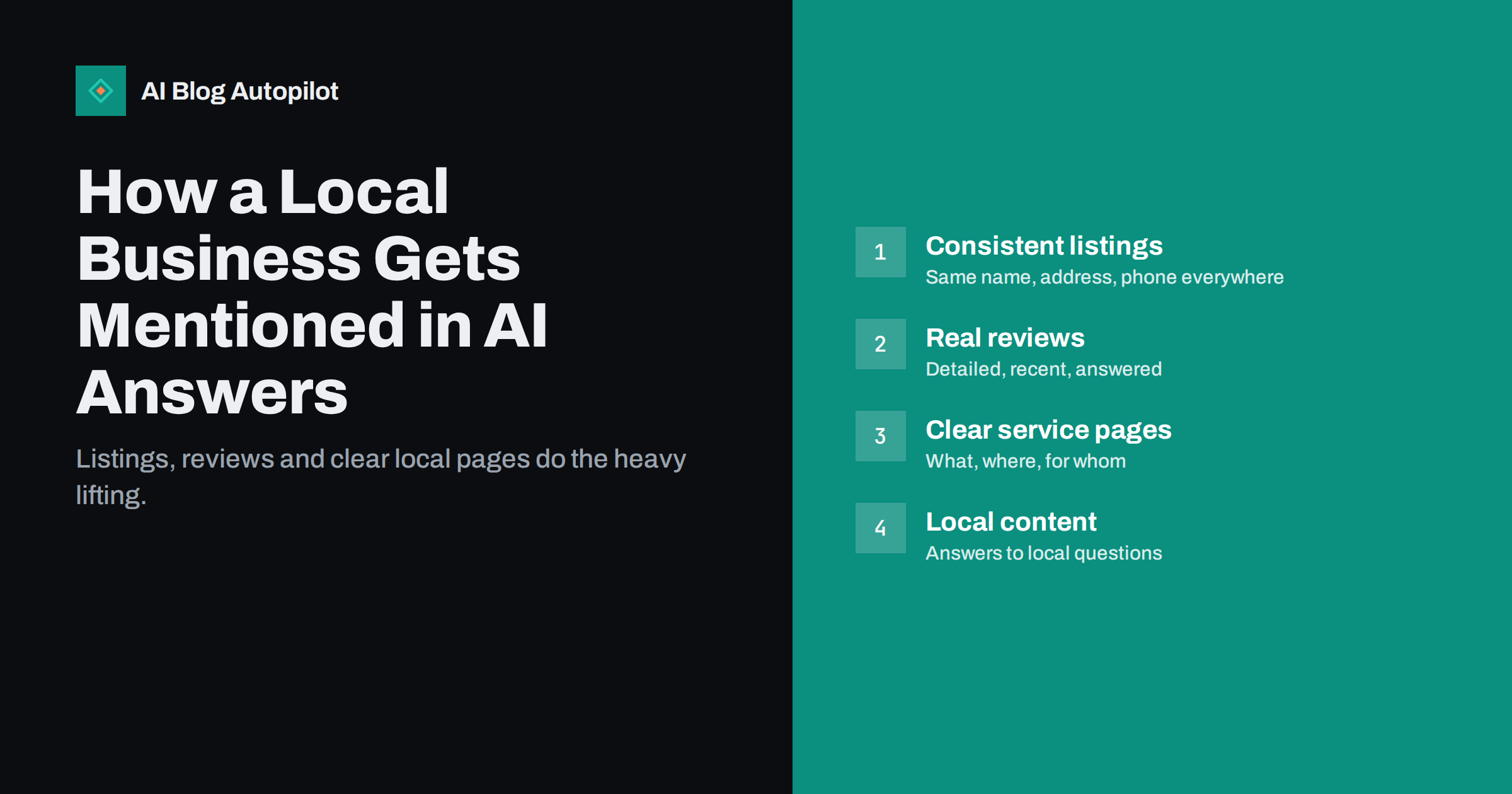
Short answer: AI assistants and AI search features recommend local businesses they can confidently identify and describe. That confidence comes from consistent business listings, a clear website that states what you do and where, genuine reviews on well-known platforms, and mentions on other local sites. A blog that answers real local questions adds context and gives AI answers specific pages to cite.
People now ask questions like “Who is a good family dentist near the old town?” or “Which bike shop in the city repairs e-bike motors?” in AI assistants and AI-powered search, not only in a map app. The answer is usually a short list of named businesses with one-line reasons. If your business is not on that list, a nearby competitor gets the call. This guide explains where those answers come from and what a local business can realistically do to be included.
Where AI answers get local information
There is no single “AI local index”. Different assistants and search features combine several kinds of sources, and the exact mix varies between products and changes over time. In general, local answers draw on:
- Business listings and map data. Profiles such as Google Business Profile, Bing Places and Apple Business Connect hold the basic facts: name, category, address, opening hours, phone number and website.
- Reviews. Ratings and, more importantly, the text of reviews on major platforms describe what customers actually experienced.
- Your own website. Service pages, location pages, about pages and blog articles explain what you offer and to whom.
- Third-party mentions. Local news, directories, industry associations, event pages and “best of” lists mention businesses and add independent confirmation.
- Search results. AI features built on top of a search engine typically retrieve pages that already rank for the query and summarise them.
The common thread is consistency. When many independent sources agree that a business exists, where it is, and what it is good at, an AI system can mention it with less risk of being wrong.
Why some businesses get recommended and others do not
When you compare businesses that appear in AI answers with those that do not, a few differences show up again and again:
- Clarity of category. A business that clearly presents itself as an “e-bike repair workshop” is easier to match to a specific question than one whose site says only “solutions for every cyclist”.
- Specific details in reviews. Reviews that mention particular services, such as “replaced the motor controller in two days”, give AI systems concrete reasons to cite.
- Consistent facts. Mismatched addresses, old phone numbers or different business names across listings create doubt.
- Evidence of activity. Recent reviews, updated hours and current content suggest the business is still operating.
- Presence beyond its own site. Mentions in local media, community sites and lists provide independent signals.
None of these are tricks. They are the same things that make a business easy to find and trust for a human searching for it.
It also helps to know the common mistakes that keep otherwise good businesses out of answers: a website that is mostly images with little readable text, service descriptions hidden inside PDFs or sliders, a business name that changed without the old listings being updated, and duplicate profiles created by previous owners or agencies. Each of these makes it harder for any system to connect the dots, so cleaning them up is often the quickest win.
Step 1: Fix your business listings first
Listings are the foundation. Before working on content, check the main profiles and directories where your business appears.
- Claim and verify your profiles on the major map and search platforms in your market.
- Use exactly the same business name, address and phone number everywhere. Small differences such as “Street” versus “St.” are usually fine, but a different name or an old address is not.
- Choose the most specific primary category available, then add secondary categories that genuinely apply.
- Keep opening hours current, including holiday hours.
- Write a factual description that names your main services and the area you serve.
- Add real photos of your premises, team and work.
Google publishes its own guidance on how local results are ranked, based on relevance, distance and prominence; it is worth reading the official page on improving your local ranking. The same basics make your business easier for AI answers built on search data to describe accurately.
Step 2: Earn reviews that say something
A high average rating helps, but the content of reviews matters just as much for AI answers, because those systems summarise text. You cannot write reviews yourself, and you should never pay for them or offer rewards in exchange for positive ones. You can make honest reviews more likely and more useful:
- Ask every satisfied customer at the right moment, such as right after a completed job.
- Make it easy with a short link to your review page.
- Suggest they mention what service they used, without scripting their words.
- Reply to reviews, positive and negative, briefly and professionally. Replies show that the business is active and attentive.
Over time, a steady flow of detailed reviews builds a clear picture of what your business is known for.
Step 3: Make your website easy to understand
Your website should answer the basic questions an AI system or a human would ask, in plain text that can be read without running scripts:
- What do you do? One clear sentence near the top of the homepage.
- Where? Your address, service area and the neighbourhoods or towns you cover.
- For whom? Types of customers you serve best.
- What exactly? A separate page for each main service, with details, typical process and frequently asked questions.
- Who are you? An about page with the people, history and qualifications behind the business.
Add LocalBusiness structured data with your name, address, phone, opening hours and website, matching the details in your listings. Structured data does not guarantee a mention, but it removes ambiguity about basic facts.
If you serve several towns or have more than one branch, give each real location its own page with its own address, hours and details. Avoid creating near-identical pages for every town you might drive to; thin location pages with only the place name changed help nobody and can look like doorway pages to search engines.
Step 4: Use a blog to answer local questions
A blog is where a local business can show expertise in a way listings cannot. Useful local articles answer questions your customers actually ask, for example:
- “How much does it typically cost to service an e-bike, and what affects the price?”
- “What to check before buying a used road bike in winter”
- “Best cycling routes for commuters in the city centre”
- “Do I need a permit for a home extension in our district?”
Write each article with a direct answer near the top, specific local detail, and honest advice. Avoid stuffing city names into every sentence; one natural mention where it matters is enough. Over months, a library of helpful local articles gives AI answers and search results more pages that connect your business with real questions.
Link each article to the relevant service page, and link service pages back to the most useful articles. That way a reader who arrives through a question can easily see that you also provide the service, and the site as a whole tells a consistent story about what you do.
Step 5: Get mentioned beyond your own site
Independent mentions help confirm that your business is real and relevant. Practical options for most local businesses:
- Join local business associations and chambers that list members.
- Sponsor or take part in community events that publish participant lists.
- Offer useful comments or data to local journalists.
- Make sure you appear in the main industry directories for your sector.
- Partner with complementary local businesses and mention each other where it is genuinely useful.
How to check whether AI answers mention you
Ask the questions your customers would ask, in several AI assistants and AI search features, from the location you serve. Note which businesses are named, which reasons are given, and which sources are cited when citations are shown. Repeat the same questions every month or two, because answers vary between sessions and change over time. If an answer contains wrong facts about you, find the source it relies on and correct the information there, starting with your listings and website.
How AI Blog Autopilot helps
AI Blog Autopilot writes and publishes long-form SEO articles to your WordPress blog on a regular schedule, around the topics, keywords and audience you set, and shares each article to your social networks. For a local business, that means a steady library of articles answering customer questions without having to find time to write every week. Listings, reviews and community presence remain your job; the blog side can run on its own. See how it works on the AI Blog Autopilot homepage.
Related reading
- Blog Strategy for a Local Business
- Brand Mentions: Why AI Answers Recommend Some Businesses
- When AI Answers Get Your Business Wrong: What to Do
- Entities and AI Search: Making Your Business Easy to Understand
The bottom line
AI answers recommend local businesses they can identify and describe with confidence. Start with consistent, complete listings, then earn detailed reviews, make your website state clearly what you do and where, and publish local articles that answer real customer questions. Add independent mentions over time and check the answers regularly. There is no shortcut, but the same work also improves your visibility in maps and ordinary search.
FAQ
Can I pay to be recommended in AI answers?
Organic AI answers generally cannot be bought in the way ads can. What you can do is make your business easy to identify and describe through accurate listings, genuine reviews, a clear website and independent mentions. Treat any service promising guaranteed AI recommendations with caution.
Do reviews affect whether AI assistants mention my business?
Reviews are one of the sources AI systems can draw on, and the text of reviews often explains what a business is good at. Detailed, recent and genuine reviews on well-known platforms help. Never buy reviews or offer rewards for positive ones.
Does a local business really need a blog for AI search?
It is not strictly required, but a blog gives AI answers and search engines specific pages that connect your business with real customer questions. Listings describe what you are; articles show what you know. Together they make a stronger case for a mention.
How often should I check AI answers for my business?
Every month or two is usually enough. Ask the same set of customer-style questions in several assistants and note which businesses appear and why. Answers vary between sessions, so look for patterns rather than single results.
What should I do if an AI answer lists wrong details about my business?
Find where the wrong information comes from, usually an outdated listing, directory entry or old page, and correct it there. Make sure your website and main profiles state the right facts clearly. Answers often update once the underlying sources are fixed.