ENEnglish
 LTLietuviškai
 DEDeutsch
 FRFrançais
 RUРусский
 ESEspañol
 PLPolski
 ITItaliano
 UKУкраїнська
 CSČeština
 PTPortuguês
 JA日本語
 LVLatviešu valoda
 ETEesti
 HUMagyar
 IDBahasa Indonesia
 TRTürkçe
 HIहिन्दी
 ELΕλληνικά
 ARالعربية
 THไทย
 VITiếng Việt
 RORomână
 MSBahasa Melayu
 BNবাংলা
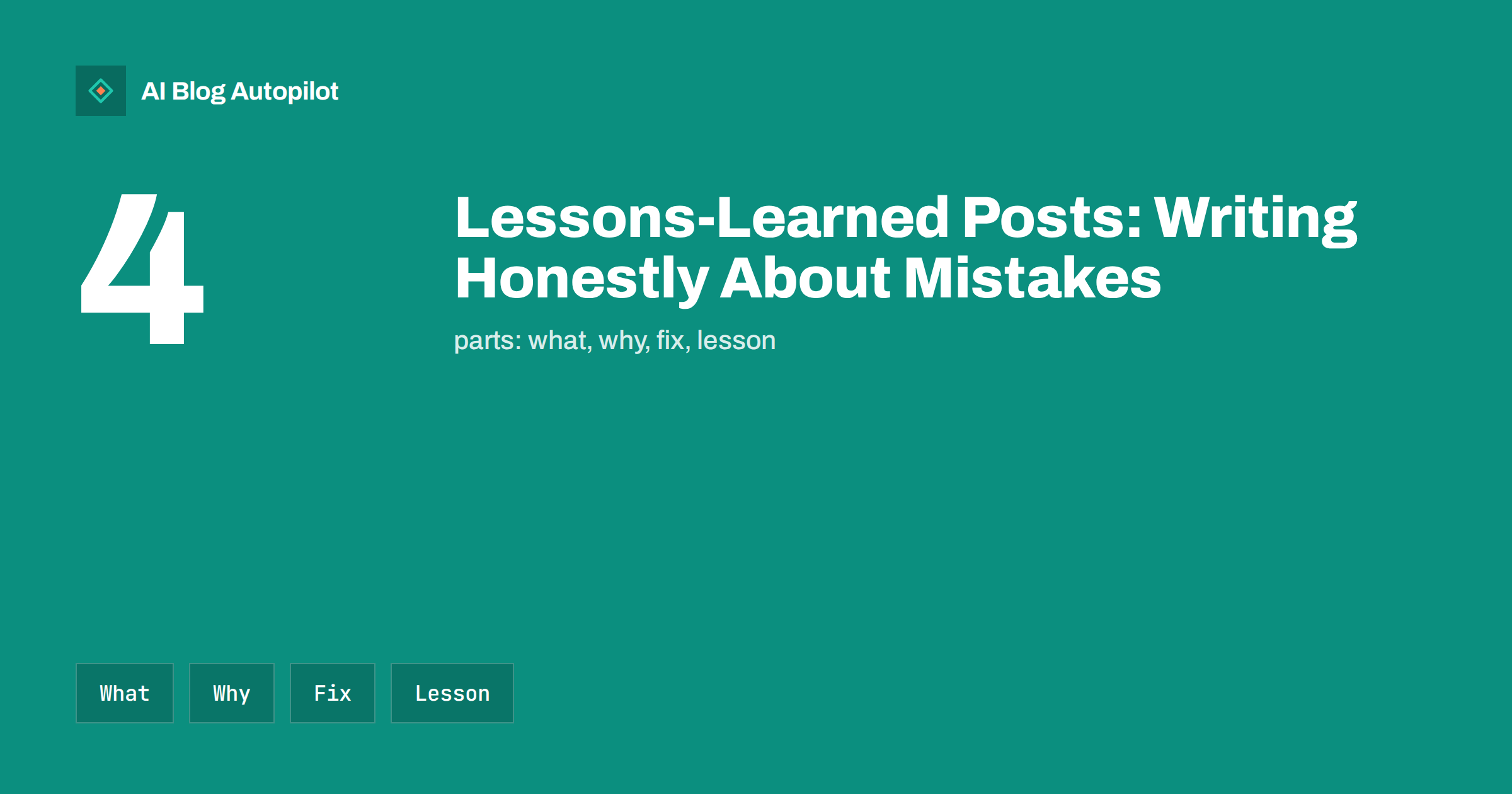
Short answer: a lessons-learned post tells the story of something that went wrong, or that did not work as expected, and explains what the business or the writer learned. It earns trust because it shows real experience and honesty. To write one well, choose a mistake that is useful to your reader, tell it plainly without blaming others, explain the cause, show what you changed and finish with a clear rule that readers can apply.
Most business blogs show success. Case studies praise a result, and product posts list strengths. Readers know that real work includes mistakes, so a blog that never mentions any can feel polished and distant. A well-written account of an error, a failed test or a wrong guess does the opposite. It shows judgement, and it teaches in a way that a perfect story cannot. This article explains how to write such posts with care.
The format suits owners, agencies, freelancers and teams. It also fits well with the search guidance that rewards first-hand experience, since only someone who did the work can describe what really happened.
Think about search as well. People type questions such as “what went wrong when we” or “mistakes to avoid when” into search boxes, and they want answers from people with real experience. A post that matches such a question and delivers a clear lesson can bring steady visits for years, long after the mistake itself is forgotten.
Why these posts work
People learn from stories of trouble. A reader who faces a similar choice wants to know what to avoid, and a post that answers this is useful at the moment that they search for it. Such posts also attract readers who are looking for honest advice, rather than for a sales pitch.
They show experience. A statement such as “we changed all our page titles at once and lost a third of our clicks” cannot be invented by someone who has not done it, and readers sense that. The article on E-E-A-T on a blog that publishes automatically explains why first-hand evidence matters for trust.
Finally, they humanise the business. A team that can talk about its mistakes calmly appears confident, not weak. Customers often prefer to deal with people who admit problems and fix them, rather than with those who claim never to have any.
Keep a simple log of slips and surprises as they happen, with a line on the date, what went wrong and what you did. When it is time to plan content, the log gives you real stories at once, and the details are fresh and accurate, because you wrote them when the events were clear and not from a vague memory.
Choosing the story
Pick a mistake that has a lesson of wider use. A forgotten step in a launch, a wrong estimate of time, a test that gave the opposite result or a decision that cost money are all good candidates. A small slip with no lesson is not worth a post.
Think about the reader. Who would benefit from reading about this, and what would they do differently afterwards? If you can name the reader and the change, you have a post. If not, keep the story for a conversation instead.
Check that the story is yours to tell. If it involves a client, a supplier or a colleague, think about their privacy and their feelings. You may need permission, and you may need to change details or leave out names. If in doubt, tell a story about your own decisions only.
Include one piece of evidence that readers can check or picture, such as a screenshot of a report, a before and after figure, a short timeline or a quote from an email with private details removed. Concrete detail is what separates a believable story from a general opinion, and it helps the reader to trust the lesson.
Structure of a good post
A simple structure works well. Start with what you planned, so that the reader knows the goal. Say what happened, with the facts and, if you can, the numbers. Explain why it went wrong, as far as you understand. Show what you did to fix it and what changed afterwards. End with the lesson, stated as a clear rule or checklist.
Keep the order clear, and use headings so that readers can scan. A short summary at the top, in the style of the answer-first approach in answer-first writing, helps those who want the lesson at once. Add details below for those who want the story.
Use a calm tone. Avoid drama, and avoid the opposite, which is to joke the problem away. Say what happened in plain words, as you would explain it to a colleague who wants to avoid the same trouble.
Be honest, not self-punishing
The aim is honesty, not a public confession. Take responsibility for your part, and do not blame others or circumstances without reason. But avoid exaggerating the fault. A post that dwells on how foolish you were can bore readers and worry customers.
Give the facts first, and your judgement second. For example, “we scheduled the emails for the wrong time zone, and 4,000 people received them at 3 a.m.” is clear and honest. Then say what you learned: “we now test every schedule with a single message first.” That tells the reader what to do.
Be careful with numbers. If you quote a loss or a gain, make sure that it is accurate, and say how you measured it. If you do not have exact figures, say so, and use words such as about or roughly. The advice in how to write a case study that persuades without exaggerating applies here too.
Protecting people and the business
Consider the legal and commercial side before you publish. Do not reveal confidential information, customer data or details covered by a contract. Do not make claims about others that you cannot support. If a mistake caused harm to someone, think about whether and how to speak of it, and consider asking for advice.
If the mistake touched customers, tell them first, rather than let them discover it in a blog post. A post should not be a substitute for a proper apology or a fix. Where relevant, link to the official notice, as in how to handle corrections on a blog.
Think about timing. A post written in the heat of a problem may be too raw. A few weeks later, you will see the cause more clearly, and you will be able to say what really changed. Writing after the fix also lets you report the result.
Offer a way to avoid the mistake that costs little. Many problems are prevented by a single check, such as a test message, a backup before a change or a second pair of eyes on a figure. If the fix is small, say so, because it encourages readers to act on it today rather than to file it away for later.
Make the lesson usable
The end of the post is what readers remember. State the lesson as a rule: “Before any site-wide change, test it on five pages and wait two weeks.” Add a short checklist, a template or a link to a guide that helps. A post that ends with a concrete step has more value than one that ends with a sigh.
Link to related guides on your blog. A story about a failed migration can link to a checklist for moving a blog safely, and a story about a social media slip can link to advice on scheduling. This helps readers who want to go deeper, and it ties the post into your wider content, as explained in internal linking on autopilot.
Invite replies. Ask readers whether they have met the same problem, and what they would add. Their answers may give you material for a follow-up, and they show that the post has touched something real.
Where it fits in your plan
Do not publish too many such posts. One or two a quarter is plenty for most business blogs, mixed with guides, news and case studies. Too many can make the business look unreliable, while too few leave the blog without any personal edge.
Use them to support key topics. If you write about a service, a post on a mistake that customers often make, or one that you made yourself, can bring in readers at the point where they have a question. The format sits well beside behind-the-scenes posts and opinion pieces.
Review the post later. If you find new facts, or if you change the way that you work, update it with a dated note. This keeps the story accurate, and it shows readers that you keep learning.
Finally, think about how the post will be shared. A title that clearly says what the lesson is will be easier to share than a vague one, and a short summary at the top gives social posts a clear line to quote. Write the lesson in a sentence that stands alone, and you have the first line for your social posts.
Checklist before you publish
Ask a few questions. Is the story true and complete enough? Does it protect the privacy of others? Is the cause explained fairly? Does it show what changed? Does it end with a rule that a reader can use? Would you be comfortable if the people involved read it?
Ask someone else to read it, ideally someone who was involved or who knows the field. They may spot a fact that is wrong, a tone that is too harsh or a detail that should be left out. A short review before publishing is better than a correction after.
Keep the headline honest and plain. Avoid shock words, and say what the post offers, for example “What we learned from a failed site move”. Readers should know that it is a lesson and not a sales page.
How AI Blog Autopilot helps
AI Blog Autopilot writes full SEO articles for your WordPress blog on the topics that you set, and shares each one to your social networks, which leaves you free to write the personal posts that only you can write, such as a lessons-learned story. The writer is instructed never to make up statistics, quotes or sources. See the pricing page for plans.
Related reading
- Behind-the-Scenes Posts: Showing How Your Business Works
- How to Handle Corrections on a Blog
- Storytelling in Business Blog Posts Without the Fluff
The bottom line
A lessons-learned post tells what happened, why, what changed and what readers can do. Be honest without drama, protect other people and end with a rule that is easy to apply.
FAQ
Will admitting a mistake hurt my business?
Done calmly, it usually builds trust. Focus on what you learned and what changed, and tell affected customers directly first.
How often should I publish such posts?
One or two a quarter is plenty for most business blogs, mixed with other formats.
Can I write about a client’s mistake?
Not without their agreement. Write about your own decisions, or remove identifying details.
What should a good lessons-learned post end with?
A clear rule, checklist or next step that readers can apply, ideally linked to a related guide.
Does this kind of post help SEO?
It can, since first-hand experience is a quality signal and readers search for honest advice, but it should support, not replace, your core guides.