ENEnglish
 LTLietuviškai
 DEDeutsch
 FRFrançais
 RUРусский
 ESEspañol
 PLPolski
 ITItaliano
 UKУкраїнська
 CSČeština
 PTPortuguês
 JA日本語
JA日本語 LVLatviešu valoda
 ETEesti
 HUMagyar
 IDBahasa Indonesia
 TRTürkçe
 HIहिन्दी
 ELΕλληνικά
 ARالعربية
 THไทย
THไทย VITiếng Việt
 RORomână
 MSBahasa Melayu
 BNবাংলা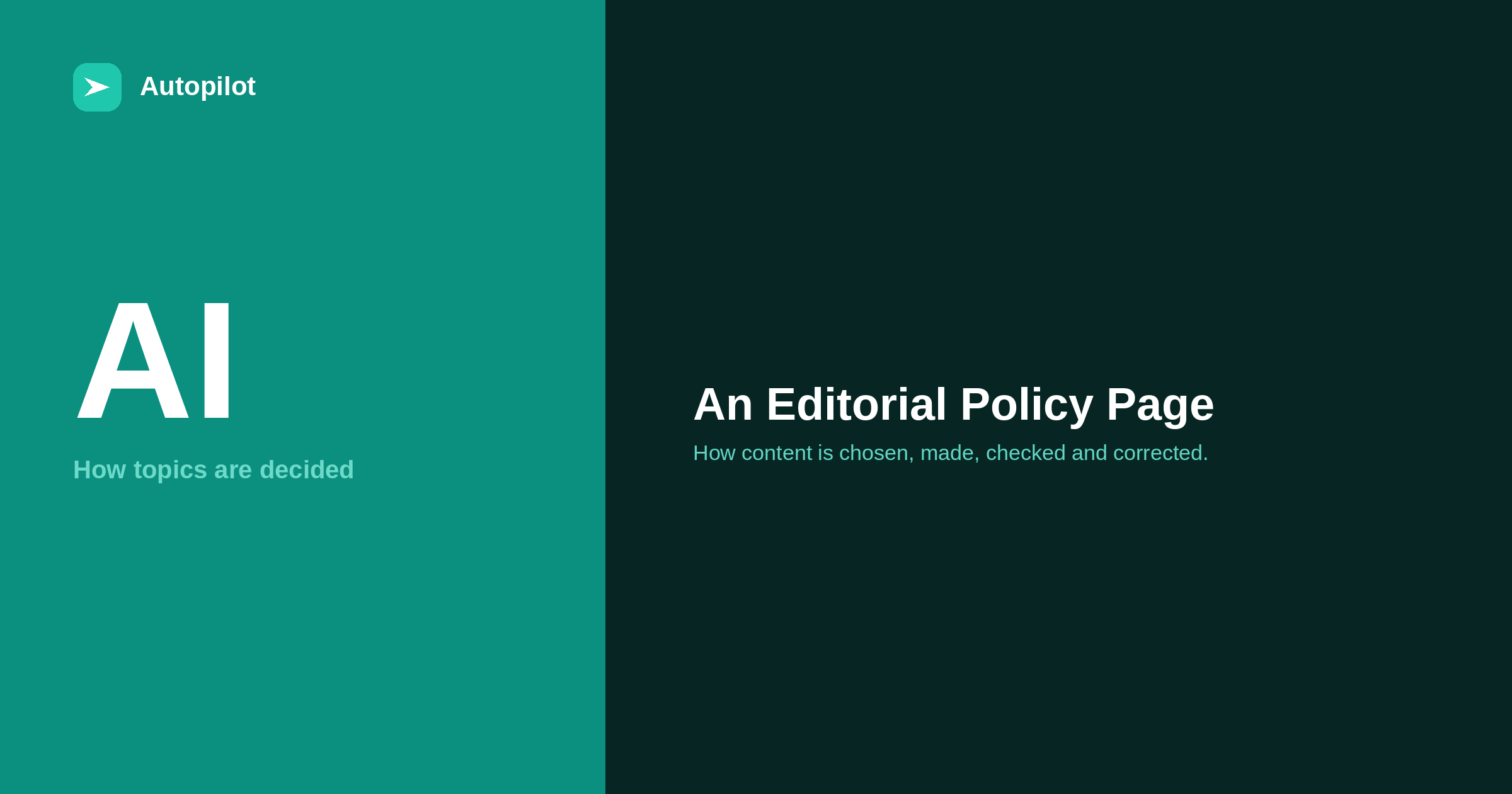
Short answer: an editorial policy page explains how the blog’s content is chosen, produced, reviewed, fact-checked and corrected, and who is responsible. Include how topics are selected, how articles are drafted including any automation, who reviews them and with what expertise, how facts and sources are checked, how commercial interests are handled, and how readers can report errors. Keep it short and honest, link it from the footer and the about page, and update it whenever the process changes. A policy is only worth having if it describes what actually happens.
An editorial policy is a public description of how a publication works. Newspapers have long had them; business blogs rarely do.
For a blog that uses automation, publishes at volume, or writes about subjects where accuracy matters, a short policy answers readers’ questions before they ask them, and gives the team a standard to meet.
What to include
A useful policy covers six areas, each in a short paragraph.
| Section | Answers |
|---|---|
| Topics | How subjects are chosen and why |
| Production | How articles are drafted, including tools |
| Review | Who checks articles and what expertise they bring |
| Accuracy | How facts, sources and figures are verified |
| Independence | How commercial interests are handled |
| Corrections | How errors are reported and fixed |
Add who is responsible overall: a named person or role.
Topics
Say how topics are chosen: customer questions, search research, the business’s expertise. Readers reasonably wonder why a business writes about a subject; a clear answer builds trust.
Production and automation
Describe how articles are drafted. If automated tools are used, say so plainly and describe the human part: who sets the instructions, who reviews, who adds material from experience.
Being straightforward about this is better than silence or euphemism — disclosing how content is produced covers why.
Review and expertise
Say who reviews articles and what qualifies them. For sensitive subjects — money, health, law — say that articles are reviewed by someone qualified, and name the role.
This section only has value if it is true. Do not describe a review process that does not happen.
Accuracy and sources
Explain how facts are checked: primary sources, current official information, dates on figures, links to sources. Say that prices and product details link to live pages where possible.
fact-checking before you publish covers the practice behind the policy.
Independence and commercial interests
A business blog has an obvious interest in its own products. Say so, and explain how you handle it: comparisons disclose your own product, sponsored content is labelled, affiliate links are marked, and claims about results are not made without evidence.
Corrections
Tell readers how to report an error and what happens next: how quickly you respond, how corrections are made, and whether significant corrections are noted on the article. handling corrections covers doing it well.
Where to put it
Link the policy from the footer and from the about page, and from author bios where relevant. Keep the URL stable so it can be linked from articles when needed — the about page.
A sample policy
A short policy for a small business blog might read as follows.
Topics: we write about questions our customers ask us and subjects where our team has direct experience. Production: articles are drafted with automated tools from our standing instructions, then reviewed and completed by our team. Review: every article is checked by a member of staff who works in the subject; articles about pricing or contracts are checked by the account manager responsible. Accuracy: we link to primary sources and to our live pricing page rather than repeating figures that change. Independence: where we compare our product with alternatives, we say so, and we do not publish claims about customer results we cannot evidence. Corrections: report errors to the address below; we respond within three working days and note significant corrections on the article.
That is under two hundred words and answers every question a careful reader is likely to have.
Using the policy internally
The policy is also a brief for the team. New writers, reviewers and agencies should read it first; it tells them what the blog promises readers and therefore what their work must meet.
When something goes wrong, check it against the policy. If the process described was not followed, fix the process. If the policy did not cover the situation, extend it. Either way, the policy improves along with the work.
Sponsored content and affiliates
If the blog ever publishes sponsored articles or uses affiliate links, the policy should say how they are labelled. Clear labels on each article and a statement in the policy are expected by readers and, in many places, required by advertising rules. Paid links should also be marked for search engines as sponsored.
Policies for several languages
Multilingual blogs should publish the policy in each language, adapted where the process differs — for instance, a different reviewer for each language. A reader in one market should be able to read how content in their language is produced and checked.
Who owns the policy
Name one person or role responsible for the policy: keeping it current, making sure the process matches it, and answering questions about it. Without an owner, policies drift out of date quietly, and the gap between what the page says and what happens grows until someone notices.
The owner does not need to do all the work described in the policy. They need to know whether it is happening and to update the page when it changes.
Tone
Write the policy in the same plain voice as the rest of the blog. Legalistic language suggests the page is there for protection rather than for readers. A short, direct policy reads as a genuine commitment.
Checking against reality
Once a year, pick a few recent articles and trace them through the process the policy describes. Were they reviewed as stated? Were sources linked? If not, fix the process or the policy, whichever is wrong.
Keeping it true
A policy describing a process nobody follows is worse than none. Review it whenever the process changes — a new tool, a new reviewer, a new category — and at least yearly.
An honest policy does not guarantee trust or rankings. It makes accountability visible, which readers and guidance both value.
Related reading
If this was useful, these cover the questions that usually come next.
- Disclosing how content is produced — why a policy beats labels
- Handling corrections — the corrections section in practice
- The about page — the companion page
The bottom line
Describe how topics are chosen, how articles are drafted including any automation, who reviews them and with what expertise, how facts are checked, how commercial interests are handled, and how errors are corrected. Name who is responsible, link the page from the footer and about page, and keep it true to what actually happens.
FAQ
What is an editorial policy?
A public description of how a publication chooses, produces, reviews, fact-checks and corrects its content.
Does a business blog need an editorial policy?
It is useful for blogs that use automation, publish at volume or cover subjects where accuracy matters.
Should the policy mention AI tools?
If they are used, yes, plainly, along with the human review and additions that follow.
Where should the policy be linked?
From the footer, the about page and, where relevant, author bios.
How long should it be?
A short paragraph per section is enough: topics, production, review, accuracy, independence and corrections.
How often should it be updated?
Whenever the process changes, and at least yearly.