ENEnglish
 LTLietuviškai
 DEDeutsch
 FRFrançais
 RUРусский
 ESEspañol
 PLPolski
 ITItaliano
 UKУкраїнська
 CSČeština
 PTPortuguês
 JA日本語
 LVLatviešu valoda
 ETEesti
 HUMagyar
 IDBahasa Indonesia
 TRTürkçe
 HIहिन्दी
 ELΕλληνικά
 ARالعربية
 THไทย
 VITiếng Việt
 RORomână
 MSBahasa Melayu
 BNবাংলা
Short answer: A garage, tyre shop or car service can use AI Blog Autopilot to publish seasonal guides and local articles and share each one to its social networks. Give the product your services, area, prices to avoid, seasonal topics and plain tone, review the first articles for technical and price details, and start on Starter with eight articles a month.
Car owners search at the moment of need: a warning light, a strange noise, winter tyres, an annual inspection, a failed battery on a cold morning. The garage that answers those questions clearly, in the customer’s town, often wins the booking. But garages are busy workshops, and the person who knows the answers is under a car, not at a keyboard.
This guide shows how a workshop can use AI Blog Autopilot to keep a blog and social channels active without taking time from the bay. Product facts come from the home page, networks page and pricing page. Facts about your garage, such as prices, services and warranties, come from you, so treat the advice as a plan to adapt.
What customers search for and why a blog helps
Most searches about cars fall into a few groups. People look for a service near them, such as brake repair or air conditioning recharge. They look for the cause of a symptom, such as a vibration at speed. They compare options, such as winter tyres or all-season ones. They ask about costs and timing, and they check reviews.
A blog can answer the second, third and fourth groups with honest articles. When a driver reads a clear guide on what a brake warning means and when to book, the garage that wrote it is the one they remember. The article does not replace the workshop’s expertise; it shows it.
The home page says Autopilot writes 2,000 to 3,000-word SEO articles planned around real search queries, with FAQ, tags and SEO meta. That suits this kind of content, since many car questions need a thorough answer. The article on Autopilot for local service businesses covers the wider pattern.
Topics that suit a workshop
Start with the seasons. Autumn brings articles on checking lights, wipers and tyres before winter. Winter brings battery care, starting problems and de-icing tips. Spring covers tyre changes, washing off salt and air conditioning checks. Summer covers cooling systems, long trips and holiday checks.
Add service explanations: what a full service includes, how often to change oil, what brake pads and discs do, how to tell when tyres are worn and what happens during an annual inspection. Add decision guides, such as repair or replace, new or used parts and when a warning light means stop now.
Add local content too. Mention the town and the roads your customers use, local conditions such as salted winter roads or coastal air, and the courtesy services you offer. Use the keywords people use, which are often simple: car service near me, tyre change, brake repair. The article on seasonal content planning shows how to plan a year.
Facts you must supply
The home page says the writer is instructed never to make up statistics, quotes or sources. Even so, it cannot know your garage. Give it a fact sheet with your services, brands you work with, opening hours, address, booking method, warranty terms and anything you do not do.
Decide what to say about prices. Many garages prefer not to publish prices in articles, because they change. If so, write in the brief that articles should not quote prices and should invite readers to ask for a quote. If you do publish a price list, keep it in one place and update it when it changes.
Be careful with technical claims. Articles about safety, such as brakes and tyres, must be accurate. A mechanic should read those before they go live. Rules about inspections, tyre depth and legal requirements differ by country and change, so state where your readers are and check that wording. The article on a fact-check checklist for Autopilot articles offers a routine.
Set up the brief
The home page says you give Autopilot topics with weight, keywords, audience and tone. For a garage, give the highest weight to the services that bring the most profit, such as servicing, tyres and brakes, and a smaller weight to general car care.
Describe the audience. Most customers are not mechanics. They want plain answers, without jargon, and reassurance that they will not be overcharged. Write the tone as honest, practical and friendly. Add phrases you never use, such as scare tactics about safety to push a sale.
Add your area to the keywords. Include the town, neighbouring areas and the names customers use for them. Add a few questions heard at the counter. These real questions make the best article topics, since other customers have the same ones. The article on setting up topics in Autopilot explains weights and keywords.
Connect the blog and the right networks
If your garage has a WordPress site, the home page says to click Connect and approve it in WordPress, or paste an application password. If you have no website, you can start social-only and add a blog later, with your plan moving with you.
Choose networks by where your customers are. Facebook is widely used by local customers, and a local business page can reach people near you. Other networks may matter if you serve fleets, which may prefer LinkedIn, or a community that uses Telegram or Viber. The networks page says you connect each network once and that each gets its own text, length and timing.
Keep your business details consistent on every profile: name, address, phone and opening hours. Visitors who find you on a social network should see the same details as on your site. The article on consistent social profiles gives a checklist.
A review habit that fits a busy workshop
Workshops cannot give long hours to review, so make it short and regular. Set twenty minutes each week, at the quietest time. Read each article for three things: is the technical content right, does it match your services and prices policy, and does it sound like you?
Start with approval switched on, which the home page says you can do at any time. After a few weeks, when the articles need few changes, consider AUTO, the default. Even then, keep a monthly look at the content map, the calendar and network matrix that the home page describes, to see that everything went out.
Ask the mechanic to review safety content only, so that expert time is spent where it counts. The office manager can check tone, opening hours and links. Dividing the review keeps each person’s task small.
Choose a plan and measure
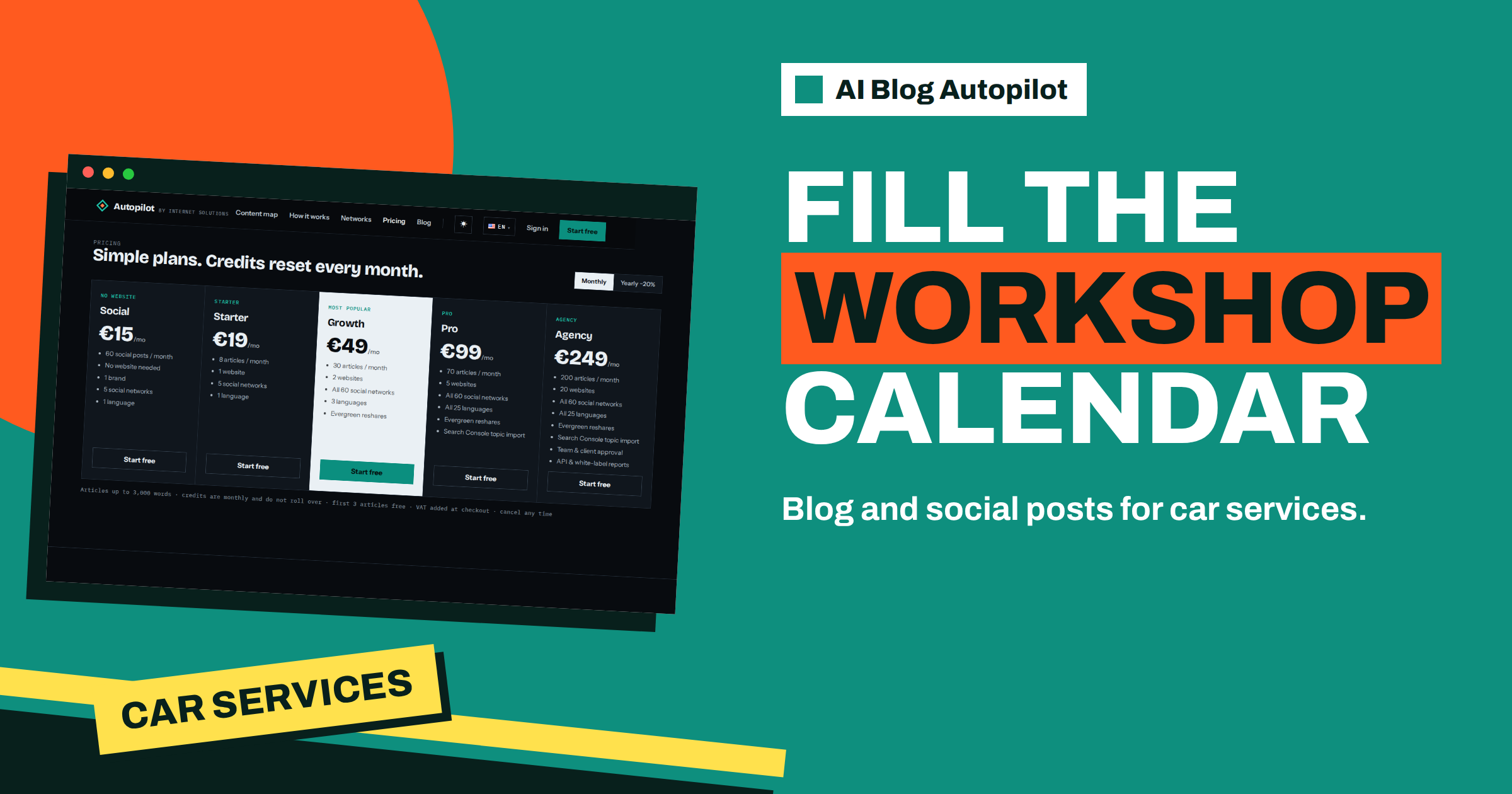
For most garages, Starter is the right beginning: 19 euros a month with 8 articles, 1 website, 5 social networks and 1 language, according to the pricing page. Eight articles is two a week, enough to build a steady library. If you have no website, the Social plan at 15 euros offers 60 social posts a month.
Measure in terms a workshop understands: calls, bookings and messages that mention the blog or a post. Ask new customers how they found you, and note answers in a simple list. Check your site statistics for visits to service pages after an article appears. Results build slowly, so judge after three months, not three weeks.
Consider a short story. A two-bay garage in a small town has a simple website and a Facebook page that has not been updated since the summer. The owner writes a brief with six topics: winter tyres, battery care, brake checks, servicing intervals, air conditioning and pre-holiday checks. He asks his mechanic to read the brake and tyre articles each week and his sister, who does the books, to check the rest. In the first month, approval stays on. By the third month the articles need few edits. The owner notices that several new customers mention an article on winter tyres, and the calendar is fuller in the weeks before the first frost.
The lesson is that the blog works as a seasonal reminder. It reaches drivers at the moment they start worrying, and the garage’s name is already in their mind.
Handling reviews and reputation
Customers judge a garage by reviews as much as by articles. A blog cannot replace honest reviews, but it can support them. Mention in your articles how customers can leave feedback, and keep your profiles consistent so that people find the right place. Reply to reviews politely, including the critical ones, and do not argue in public.
Use real questions from reviews as topics. If several customers praise a clear explanation of a repair, or complain about not knowing what a service included, you have found a topic for the next brief. Articles that explain what is done, in what order and why it takes the time it does build trust before the customer arrives.
Do not publish fake testimonials or invent customer stories. Where the brief mentions customer examples, say that they must be general and not name real people. The article on fact-checking AI content explains why every specific claim should be verified.
Use local partners to widen the reach. A tyre supplier, a car wash, a nearby body shop or a local business club may be glad to share a useful article. Send them the link when a guide is relevant to their customers, and offer to link back to theirs. These small exchanges build local authority and bring readers who trust a neighbour’s recommendation.
Finally, plan for the quiet weeks. Garages often have seasonal dips, and articles about services that fill them, such as air conditioning checks before summer or pre-holiday inspections, can smooth the calendar. Look at last year’s bookings, mark the slow weeks and ask Autopilot’s topic weights to favour the services you want to sell then.
How AI Blog Autopilot helps
The product writes the seasonal guides, adds FAQ, tags and SEO meta, runs a quality check and shares each article to your networks with its own text and timing, so the workshop can stay busy under the bonnet. Try it with the three free articles on AI Blog Autopilot, no card needed, and see the plans on the pricing page.
Related reading
- Autopilot for Local Service Businesses
- Seasonal Content Planning for a Business Blog
- Fact-Checking AI Content: A Practical Routine
The bottom line
A garage should plan seasonal and local topics, give the product a fact sheet and a prices policy, have a mechanic check the safety content, begin on Starter with approval on and judge the results by calls and bookings over a few months.
FAQ
Is AI Blog Autopilot suitable for a small garage?
Yes. Starter lists 8 articles a month for 19 euros, and the Social plan works without a website.
Will articles quote my prices?
Only if you supply them. Say in the brief whether to avoid prices and invite readers to ask for a quote.
Who should check technical content?
A mechanic should read safety articles, such as brakes and tyres, before they go live.
Can I start without a website?
Yes. Social-only mode creates native posts, and you can add a blog later with your plan moving with you.
How long before it brings bookings?
Search takes time, so judge after about three months using calls, bookings and customer mentions.