ENEnglish
 LTLietuviškai
 DEDeutsch
 FRFrançais
 RUРусский
 ESEspañol
 PLPolski
 ITItaliano
 UKУкраїнська
 CSČeština
 PTPortuguês
 JA日本語
JA日本語 LVLatviešu valoda
 ETEesti
 HUMagyar
 IDBahasa Indonesia
 TRTürkçe
 HIहिन्दी
 ELΕλληνικά
 ARالعربية
 THไทย
THไทย VITiếng Việt
 RORomână
 MSBahasa Melayu
 BNবাংলা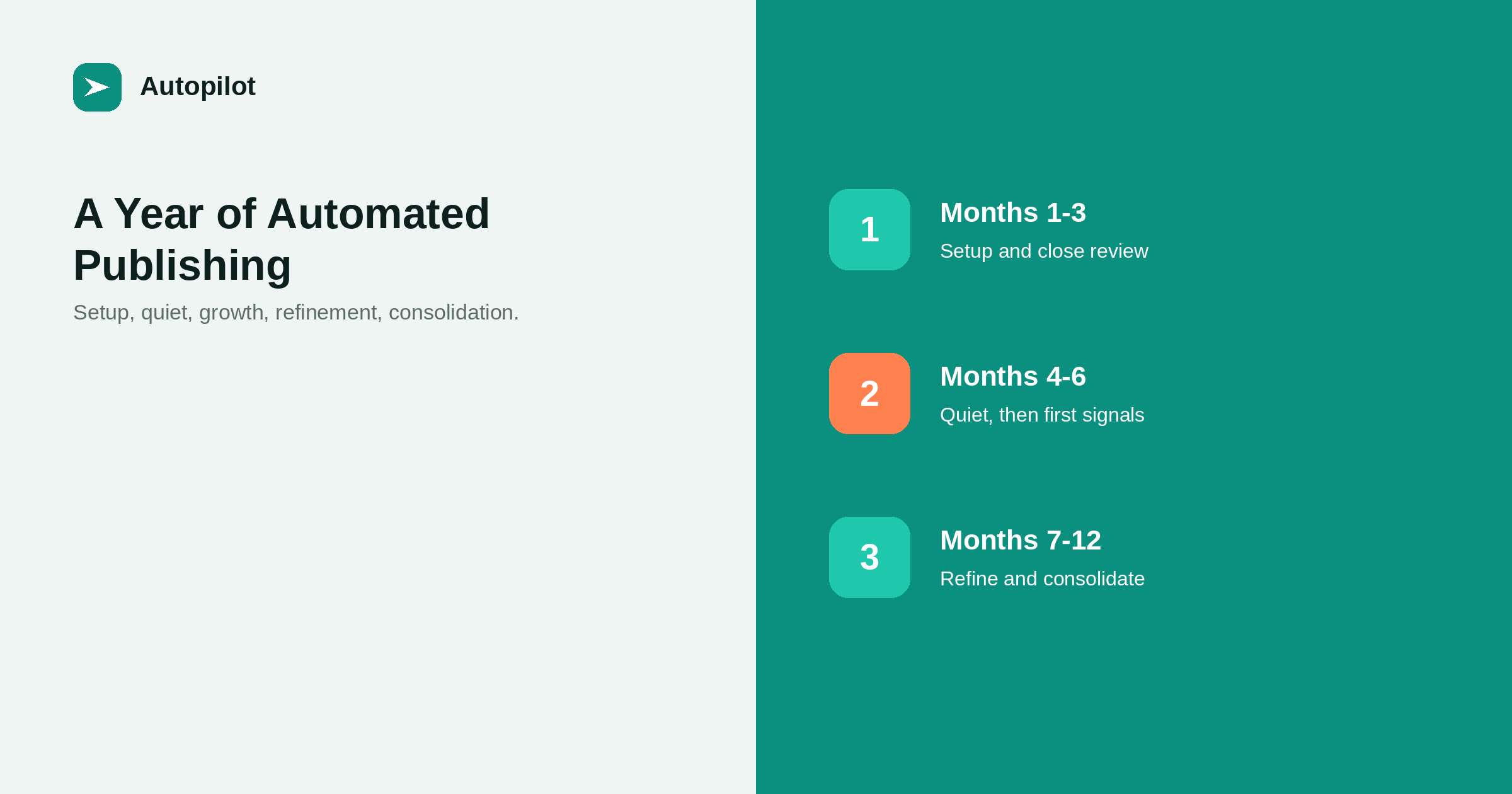
Short answer: a typical first year has recognisable stages, though timing varies widely by site, subject and competition. Months one to three are setup and close review, refining instructions. Months four to six are often quiet in results while pages are indexed and settle, with impressions starting to rise. Months seven to twelve usually bring clearer signals, and are the time to refine topics, merge overlaps, refresh early articles and judge outcomes. No stage or outcome is guaranteed; this is a pattern, not a promise.
People starting automated publishing often ask what to expect. The honest answer is that results vary widely and nobody can promise any, but the shape of a first year is fairly consistent.
Knowing that shape helps avoid the two most common mistakes: giving up in the quiet months, and changing everything at the first sign of a dip.
The stages at a glance
A rough outline, with wide variation between sites.
| Period | Focus | What you usually see |
|---|---|---|
| Months 1–3 | Setup, instructions, close review | Pages indexed, little traffic |
| Months 4–6 | Consistency, additions | Impressions rising, early clicks |
| Months 7–9 | Refinement, first review | Clearer patterns in what works |
| Months 10–12 | Consolidation, planning | A basis for judging the year |
New domains and competitive subjects move more slowly; established sites and specific subjects can move faster.
Months one to three
The work is setup: strategy, instructions, connection, and close review of every article. Corrections are frequent at first and should fall as instructions improve — the first 90 days.
Results are minimal. Pages are being discovered and indexed.
Months four to six
Often the quietest stretch emotionally: the work is routine, and results are still small. Impressions typically begin to rise as pages settle, and some specific articles start receiving clicks — how long a new post takes to rank.
This is when many blogs are abandoned. Keep publishing and adding experience.
Months seven to nine
By now there is usually enough data to see patterns: which subjects gain impressions, which articles attract clicks, which produce enquiries. Use it to refine the topic plan, doubling down on what works — planning a quarter of content.
Check for overlaps that have crept in and merge them.
Months ten to twelve
Refresh the earliest articles, which were written before instructions were refined. Audit the archive lightly — auditing a blog. Judge the year against the outcome measure set at the start, and plan the next year.
What tends to help
Across blogs, a few things consistently help: steady publishing, specific questions rather than broad topics, first-hand additions in each article, internal links, and review that improves the instructions over time.
What tends to hurt
Starting at maximum volume before instructions are refined, stopping review, overlapping topics, generic articles with nothing added, and frequent changes of direction before results can show — the mistakes people make when automating.
Keeping a record through the year
A short monthly note makes the end-of-year judgement much easier: articles published, corrections per article, impressions and clicks, enquiries, and one observation. Twelve such notes show the shape of the year clearly and make it obvious which changes coincided with improvements.
Without them, the year becomes a blur of impressions and anecdotes, and decisions about the next year rest on memory rather than evidence.
Where time goes over the year
Time spent tends to fall through the year as instructions improve and routines settle. The first months need close attention; by the second half, many blogs run on a steady weekly routine — running a blog in two hours a week describes one.
If time spent rises instead, something is wrong: instructions that are not improving, review that keeps finding the same problems, or volume that has outgrown capacity.
Planning year two
Year two builds on what year one revealed. Focus on the subjects that produced outcomes, refresh what has decayed, merge what overlaps, and consider adding a language, a format or a distribution channel if capacity allows. Keep what worked, and change one or two things at a time so you can see their effect.
Honest expectations
Some blogs see meaningful results within the first year; others take longer, particularly on new domains or in crowded subjects. A few never produce much, usually because of subject choice, weak articles or inconsistent publishing. Knowing that range in advance helps set realistic targets and avoid disappointment.
The effect of consistency
The single factor most within your control is consistency. A blog publishing steadily all year, with review and additions, is in a very different position at month twelve from one that published heavily for two months and then stopped. Consistency does not guarantee results, but its absence almost guarantees disappointing ones.
If one thing is protected through busy periods, it should be the publishing rhythm, even at a reduced pace.
Comparing with alternatives
At the end of the year, compare the cost and output of the automated approach with what the alternatives would have cost for the same volume and quality — a freelancer, an agency, doing it by hand. Count review time honestly. That comparison, alongside outcomes, is the fair basis for deciding how to continue.
Celebrating progress
Mark the small milestones along the way: the first article receiving regular clicks, the first enquiry that mentions an article, the first time a salesperson sends one to a prospect. They keep motivation up through the slow months, and they are genuine signs the blog is starting to work.
Judging the year
Judge against the outcome the blog exists for, compared with where you started, and allow for the slow start. A blog showing rising impressions, a growing share of articles receiving clicks, and some enquiries by month twelve is on a reasonable path, even if totals are modest.
Nothing here is guaranteed. Some blogs move faster, some slower, and some subjects are harder than others.
Related reading
If this was useful, these cover the questions that usually come next.
- The first 90 days — the first stage in detail
- How long a new post takes to rank — why the middle months are quiet
- Measuring whether a blog is working — judging the year
The bottom line
Expect setup and close review in the first three months, quiet results with rising impressions in months four to six, clearer patterns in months seven to nine, and refreshes, consolidation and judgement in the last quarter. Keep publishing through the quiet stretch, refine rather than restart, and remember that timing varies widely and nothing is guaranteed.
FAQ
What results should I expect in the first year of automated blogging?
Results vary widely. A common pattern is little traffic in the first months, rising impressions from around months four to six, and clearer patterns later in the year.
When do most blogs give up?
Often in months four to six, when work is routine and results are still small.
When should I refresh early articles?
Towards the end of the first year, since they were written before instructions were refined.
How should I judge the first year?
Against the outcome measure set at the start, compared with the starting point, allowing for the slow start.
Does a new domain take longer?
Usually yes, as do competitive subjects.
Is this timeline guaranteed?
No. It is a common pattern; individual results vary.