ENEnglish
 LTLietuviškai
 DEDeutsch
 FRFrançais
 RUРусский
 ESEspañol
 PLPolski
 ITItaliano
 UKУкраїнська
 CSČeština
 PTPortuguês
 JA日本語
 LVLatviešu valoda
 ETEesti
 HUMagyar
 IDBahasa Indonesia
 TRTürkçe
 HIहिन्दी
 ELΕλληνικά
 ARالعربية
 THไทย
 VITiếng Việt
 RORomână
 MSBahasa Melayu
 BNবাংলা
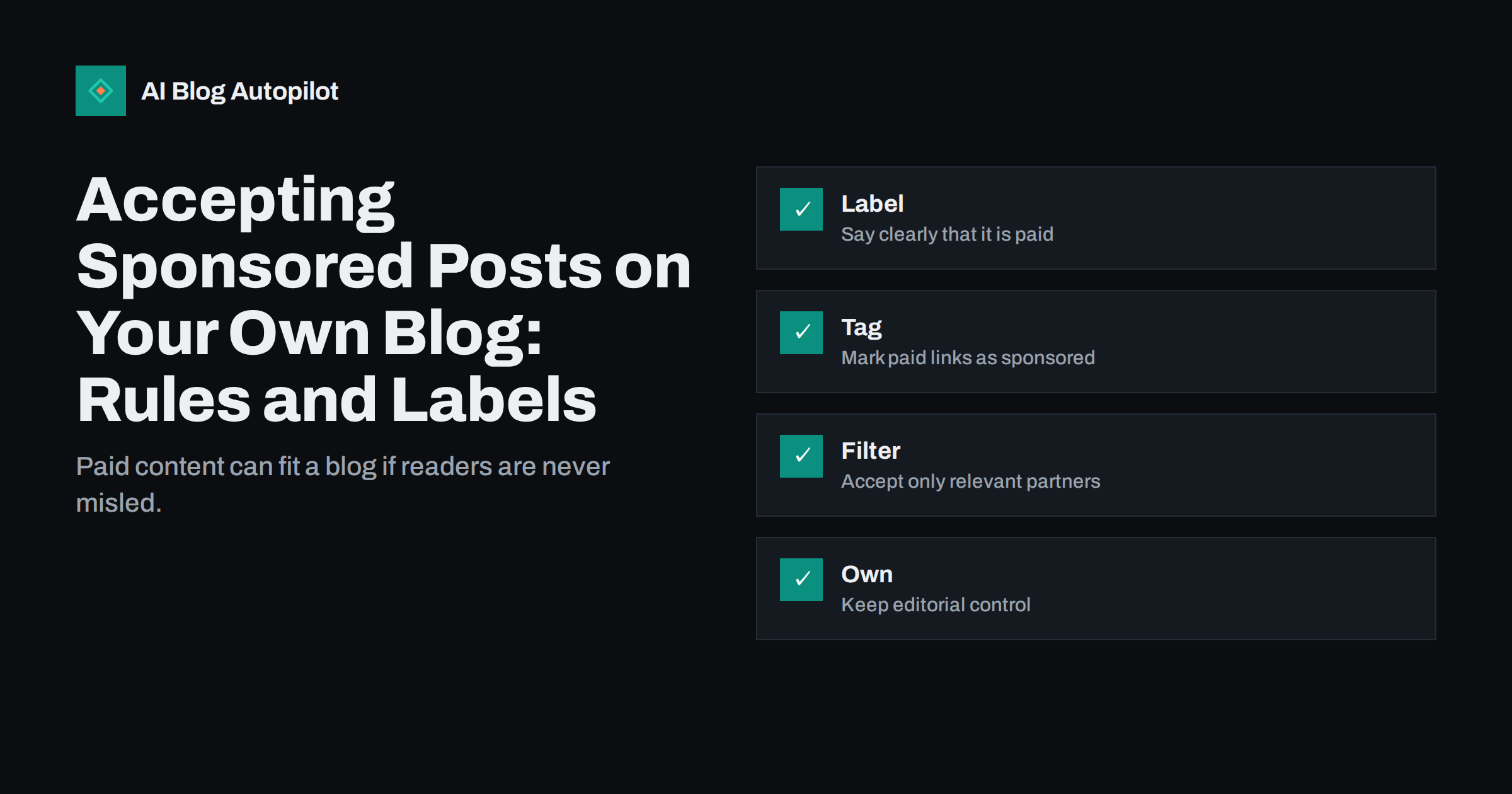
Short answer: a blog can accept sponsored posts if readers are never misled. Label each paid article clearly at the top, mark paid links with the sponsored attribute, accept only partners that fit your topic and audience, keep editorial control over facts and tone, and follow the advertising rules of your country. Decline offers that ask for hidden links, fake independence or content unrelated to your site, because they can harm both reader trust and search visibility.
Once a blog has steady readers, offers begin to arrive: pay for an article, a link inserted into an old post, a “guest contribution” with a paid link. Some of these can be a legitimate source of income, and some are plain link schemes. The difference lies in honesty. A reader should always know what is paid, who paid for it and why it is on your site, and search engines should be told the same.
Decide whether you want paid content at all
Start with your own principles. A blog earns trust by being independent. Paid content can fit alongside that trust if it is clearly separate and relevant, but it can also gradually turn the site into an advertising space. Ask what the blog is for, who reads it and what they would think if they saw a sponsored post. If a regular reader would feel betrayed, the offer is wrong, however good the fee.
Write a short policy for yourself before you answer any offer. State which topics you accept, which you refuse, how many sponsored posts per month you allow and what you require from partners. A short public page, similar to the one described in our guide on writing an editorial policy page, makes it easier to say no and reassures readers.
Be realistic about the kinds of offers you will see. Many arrive as templated emails promising “high-quality guest content” or “partnership opportunities”, and ask for a price per link. Treat these with caution. Look for signs of a link scheme: an unrelated topic, a request for specific anchor text, a refusal to be named in the article or an offer to pay extra for an older page with traffic. A good partner explains who they are, why the content suits your readers and accepts your label without argument.
Label every paid post clearly
Disclosure must be easy to see and easy to understand. Put a plain statement at the top of the article, such as “This article is sponsored by [name],” before the main text, in normal-sized type. Do not hide it in a footer, in small grey text or behind vague words such as “partner content” unless that term is clearly explained. Repeat the disclosure in the page’s preview on listing pages and in any social posts that share it, so that the label travels with the content.
Rules about advertising disclosure vary by country and are enforced by consumer and advertising authorities. This article is general information, not legal advice. Check the guidance from the authority in your country, follow the platform rules for any social post and keep records of agreements. Our article on affiliate links on a blog describes similar disclosure habits.
Tag paid links the way search engines ask
Search engines ask publishers to mark links that were paid for with the sponsored attribute, so that they are not counted as an editorial vote. Use rel=”sponsored” on every paid link, and where relevant add nofollow as well. Links that come from user-generated areas should use the matching attribute. Our guide to nofollow, sponsored and UGC links explains which to use when.
Do not sell links that pass authority and hide the arrangement. Selling links to influence rankings goes against search engine guidelines and can lead to a manual action or lost visibility. This includes inserting paid links in old articles, offering “do-follow” posts at a premium and publishing text that exists mainly to carry a link. If a partner insists on untagged links, decline the deal.
Think about the reader’s journey too. If a sponsored post sends visitors to a page that disappoints them, the disappointment is attached to your name. Visit the page the link points to, check that it loads, matches the promise in the article and respects privacy rules. If the partner changes the page later, you may need to revisit the post, so note a review date and remove or update the article if the page becomes misleading.
Choose partners and topics with care
Accept sponsored content only from businesses that you can honestly describe to your readers and that fit your subject. A site about small-business blogging has no reason to host a post about unrelated products. Look at the partner’s website, read reviews, check how they treat customers and ask what they expect from the post. If you would not recommend them in your own words, do not publish them under your name, even with a label.
Be careful with sensitive areas. Content about health, money, gambling, loans, supplements and legal matters carries higher risk for readers and for your site, and may be restricted by law or by advertising networks. Refuse anything that makes claims you cannot check. A partner who demands guaranteed results, or wants you to state something you have not tested, is a warning sign.
Keep editorial control
Agree in writing what the sponsor can and cannot do. Typical terms are: you write or approve the text, the sponsor may check facts about their own company, you may refuse claims you cannot support and the label stays. If the sponsor writes the article, edit it for tone, accuracy and readability, and remove superlatives that you cannot back up. Make sure the article is useful on its own, so that a reader gains something even if they never click the link.
Do not accept conditions that promise a particular review verdict, forbid mention of competitors or require the post to stay unchanged forever. If a fact later turns out to be wrong, you must be able to correct it, as described in our guide to handling corrections on a blog. Keep the same quality standard that you use for your own writing.
Protect your site’s performance and structure
Sponsored posts should not drag down the rest of the site. Keep them in the same design as normal articles, with a distinct label, and avoid adding heavy scripts or tracking from partners without checking what they do. Consider whether to keep paid posts in their own category, and whether they should be indexed. If a post is purely promotional and of little value to readers, a noindex setting may be sensible, but remember that readers still see it, so the quality bar still applies.
Watch the proportion. If a large share of your pages are paid, search engines and readers may begin to see the site as an advertising platform. Keep sponsored posts a small fraction of your output, and make sure the rest of the blog stays focused on your own expertise. The risks of low-value content built around paid placement are explained in our article on site reputation abuse.
Consider what happens when a sponsorship ends. Decide in the agreement whether the post stays online, whether the link is removed after a period and whether the label remains. Some publishers keep paid posts permanently with the label, which is simple and transparent. Others remove the link after a fixed term, which should be stated in advance. Whichever you choose, apply it consistently, so that you do not end up with a mix of labelled and unlabelled posts that nobody can explain.
Pricing, agreements and records
Set a fee that reflects the work, the audience and the opportunity cost, not just the link. Put the agreement in writing: what you will publish, the date, the label, how long the post stays up, how corrections are handled and what happens if either side withdraws. Keep copies of emails, invoices and the final text. Check tax and invoicing rules for your country, because income from sponsored content is business income.
Review the arrangement after a few months. Did readers react well? Did the post bring useful visits to the sponsor? Did it affect the performance of your own pages? If the experience was positive, you can continue with careful limits. If not, stop, and learn from the experience. It is much easier to decline the next offer than to repair lost trust.
If you accept sponsored content, tell readers how you work. A short note on your editorial policy page, saying that paid posts are labelled, that links are tagged and that sponsors do not control your reviews or recommendations, helps people trust the rest of the blog. Revisit the note when practices change. Over time, a record of clear labelling and honest recommendations becomes one of the strongest assets a blog can have, and it is worth far more than any single fee.
How AI Blog Autopilot helps
AI Blog Autopilot writes full SEO articles for your WordPress blog from the topics, keywords, audience and tone you set, with FAQ sections, tags and SEO meta included, and it shares each one to your social networks. It keeps the independent editorial side of the blog active, so that sponsored posts remain a small, clearly labelled part of a larger body of your own work. Approval mode lets you read each article before it goes live. See the pricing page for plans.
Related reading
- Nofollow, Sponsored and UGC Links: Which to Use When
- Affiliate Links on a Blog: Disclosure, Tagging and SEO Basics
- Guest Posting: What Still Works and What Does Not
- Writing an Editorial Policy Page for a Business Blog
The bottom line
Paid posts can sit on a blog without harm if readers and search engines are told the truth. Label the post, tag paid links, choose relevant partners, keep editorial control and limit how much of the site is paid. When an offer asks you to hide the arrangement, the right answer is no.
GYIK
Do I have to label a sponsored post?
Yes. Readers should be told clearly, near the top, that the content is paid. Advertising rules also require disclosure in many countries, so check your local guidance.
Which link attribute should paid links use?
Use rel=”sponsored” on paid links, and nofollow as well if you wish. This tells search engines that the link was not an editorial choice.
Can I sell do-follow links?
Selling links that pass authority to influence rankings goes against search engine guidelines and can reduce your visibility. Tag paid links as sponsored.
How many sponsored posts are too many?
There is no fixed number, but keep them a small share of your output so the blog remains focused on your own expertise.
What should I do if a sponsor asks me to hide the label?
Decline. Hidden payment misleads readers and can breach advertising rules and search guidelines.