ENEnglish
 LTLietuviškai
 DEDeutsch
 FRFrançais
 RUРусский
 ESEspañol
 PLPolski
 ITItaliano
 UKУкраїнська
 CSČeština
 PTPortuguês
 JA日本語
JA日本語 LVLatviešu valoda
 ETEesti
 HUMagyar
 IDBahasa Indonesia
 TRTürkçe
 HIहिन्दी
 ELΕλληνικά
 ARالعربية
 THไทย
THไทย VITiếng Việt
 RORomână
 MSBahasa Melayu
 BNবাংলা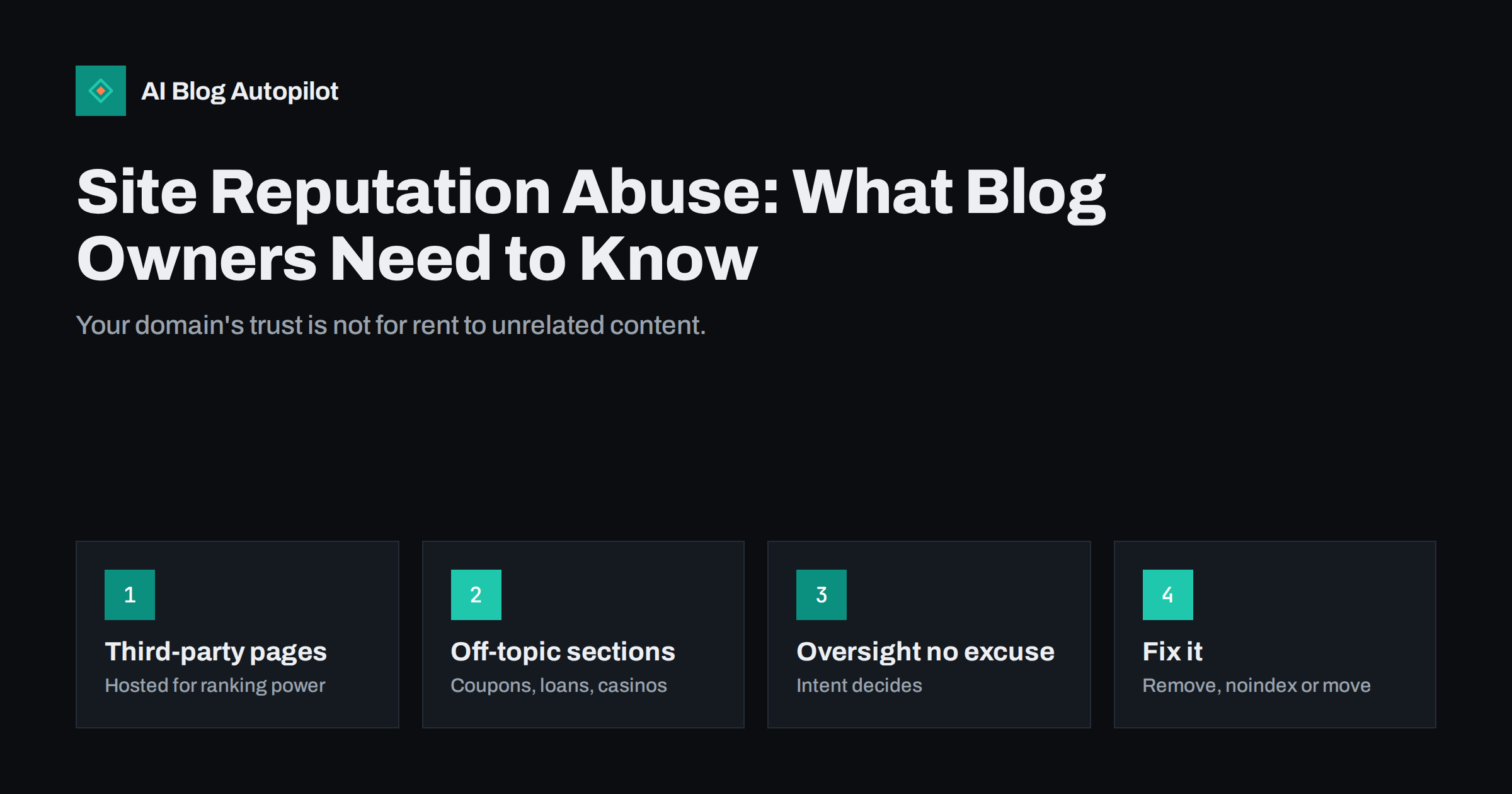
Short answer: site reputation abuse is Google’s name for publishing third-party content on a site mainly to exploit that site’s ranking signals, for example a respected blog hosting coupon pages, casino reviews or payday loan articles that have nothing to do with its normal topics. Google treats it as spam and can act against the affected section. A blog is safe when guest, sponsored and partner content fits its audience, is clearly labelled and is not published primarily to rank on the host’s reputation.
The policy became widely known in 2024, when several well-known news and media sites saw entire sections removed from search results. Many of those sections were run by outside companies: coupon directories, product review hubs and financial comparison pages placed on trusted domains. The pattern even had a nickname in the industry, “parasite SEO”. For ordinary blog owners the lesson is smaller in scale but just as relevant, because sponsored posts, guest articles and partner content are common income sources for blogs.
What the policy says
Google’s spam policies describe site reputation abuse as publishing third-party pages on a site in an attempt to abuse search rankings by taking advantage of the host site’s ranking signals. The key ideas are:
- Third-party content. The content is created by, or primarily for, someone other than the host, often in exchange for payment or a share of revenue.
- Ranking intent. The main purpose is to rank in search using the host’s established trust, rather than to serve the host’s readers.
- Little relation to the site. The content usually sits outside what the site is known for.
In late 2024 Google clarified an important point: involvement or oversight by the host does not make such content acceptable. Even if the site’s own staff edit or approve the pages, using third-party content to exploit the site’s ranking signals is still a violation. What matters is the purpose of the content, not who pressed the publish button.
Examples of what counts
Typical cases that fall under the policy include:
- A news site hosting a coupon section run by an outside coupon company.
- An educational site publishing payday loan reviews written for a lead generation partner.
- A medical or health site hosting third-party casino or betting pages.
- A sports site with a section of product reviews unrelated to sport, produced by an affiliate company.
- A respected blog selling “guest posts” on any topic, with no editorial connection to its audience, mainly so buyers can rank pages on its domain.
In each case, the content could not rank as well on its own new site. It borrows the host’s reputation, and readers who trust the host do not expect it.
What does not count
The policy is not about third-party content in general. Plenty of legitimate content is written by people outside the host organisation. According to Google, examples that are not site reputation abuse include:
- Wire service and syndicated news articles.
- User-generated content such as forum posts and comments.
- Guest columns and opinion pieces that fit the publication and its audience.
- Clearly labelled advertorial or sponsored content that is meant for the site’s readers rather than to manipulate rankings.
- Affiliate content that is part of the site’s normal, reader-focused coverage.
- Embedded third-party widgets and tools.
Even sponsored content can be fine. The difference lies in whether it belongs on the site and whether it is there for readers or for rankings. Paid links inside such content still need a qualifying attribute such as rel=”sponsored”, which is a separate rule under link spam.
Warning signs on your own blog
Most blog owners never come close to the large-scale cases that made headlines. Still, a few practices can drift into risky territory without much notice:
- Open guest post marketplaces. Accepting paid guest posts on almost any topic, especially from link sellers, turns a blog into a hosting service for other people’s rankings.
- Off-topic sections. A cooking blog that suddenly adds a “finance” or “crypto” section written by a partner is a classic pattern.
- Revenue-share sections run by someone else. A partner who supplies the content, controls the topics and takes most of the revenue is the setup the policy was written for.
- Sponsored posts without labels. Hiding the commercial nature of content damages reader trust and violates advertising rules in many countries, independent of search policies.
- Content readers would not expect. If your regular readers would be confused to find the page on your site, search engines may be too.
A quick self-check helps. For each page that was written by or for someone else, ask three questions. Would I publish this topic if nobody paid me? Does the page serve the people who normally read my blog? Is it obvious to a visitor who wrote it and why it is here? If any answer is no, the page deserves a closer look. Also review the search queries the section ranks for in Search Console. If a partner section brings traffic for terms that have nothing to do with your blog, that is exactly the pattern the policy describes.
How Google enforces it
Site reputation abuse is handled mainly through manual actions, and potentially through automated systems as well. When a manual action is applied, it usually targets the affected section or pages rather than the whole domain. The site owner sees it in the manual actions report in Search Console, together with a description of the issue.
Reconsideration is reviewed by people, so the request should be specific: which pages were affected, what you removed, noindexed or moved, and how you will prevent the problem from returning, for example with a published editorial policy. Vague promises tend to slow the process down.
Pages removed for this reason can disappear from search results entirely. The rest of the site may continue to rank normally, but trust is affected, and repeated or wider problems can lead to broader consequences. The impact is not only a lost section; it is also the time spent cleaning up and requesting reconsideration.
How to fix or avoid problems
If you have third-party content that may fall under the policy, you have several options:
| Option | When it fits | Notes |
|---|---|---|
| Remove the pages | Content has no value for your readers | Simplest and clearest; return 404 or 410 |
| Noindex the section | Partner content is useful to visitors but not meant for search | Keeps pages for direct visitors, removes them from search |
| Move it to the partner’s own site | The content belongs to the partner’s business | Do not redirect to keep rankings; let it build its own reputation |
| Bring it in line with your site | Content fits your topic but was produced carelessly | Rewrite for your audience, label sponsorship, add real editorial value |
Google has noted that simply moving abusive content to a subdomain or subfolder of the same site does not solve the problem, and redirecting it elsewhere to carry over its rankings is not a fix either. If you received a manual action, make the changes across all affected pages and then submit a reconsideration request explaining what you did.
Rules for guest and sponsored content
A simple editorial policy protects both your readers and your search visibility:
- Accept only topics that fit your blog. If the article would not belong on your site without payment, decline it.
- Edit everything you publish. Hold guest and sponsored articles to the same quality bar as your own.
- Label commercial content clearly. Use a visible “sponsored” or “partner content” note near the top of the article.
- Qualify paid links. Use rel=”sponsored” for links that were paid for, and rel=”nofollow” where appropriate.
- Keep control of topics and volume. Do not hand over a section of your site for someone else to fill.
- Publish your policy. An editorial or advertising policy page tells readers and partners how you handle commercial content.
Following these rules lets a blog earn money from partnerships without becoming a host for content that exists only to borrow its reputation.
Why the policy exists
From a reader’s point of view, the policy makes sense. People trust a known site because of its track record in a subject. When that site starts ranking for unrelated, often lower-quality commercial pages, searchers are misled about who stands behind the information. The policy protects that trust, and it also protects sites that compete fairly with their own content.
For blog owners, the practical takeaway is that your domain’s reputation is an asset you build over years. Treat it like one. It is worth more as the foundation for your own useful articles than as space to rent to unrelated content.
How AI Blog Autopilot helps
The safest way to grow a blog is with your own content on your own topics. AI Blog Autopilot plans articles from the topics, keywords, audience and tone you define, writes full SEO articles with FAQ, tags and meta descriptions, runs an automatic quality check, publishes to your WordPress site and shares each article to your social networks. Plans are on the pricing page.
Related reading
- Nofollow, Sponsored and UGC Links: Which to Use When
- Guest Posting: What Still Works
- Manual Actions Explained
- Editorial Policy Page
The bottom line
Site reputation abuse is about borrowed trust: third-party content placed on a respected site mainly to rank on that site’s reputation. Guest posts, sponsored articles and partner content are not banned, but they must fit your audience, be clearly labelled and serve your readers. If you find off-topic or outsourced sections on your blog, remove them, noindex them or move them to the partner’s own site, and keep your domain for content you stand behind.
GYIK
What is site reputation abuse in simple terms?
It is publishing third-party content on a trusted site mainly to rank in search using that site’s reputation, such as coupon, casino or loan pages on a news or niche blog that normally covers something else.
Are guest posts now against Google’s rules?
No. Guest posts that fit your blog’s topic and audience and are edited to your standards are fine. The problem is selling space for unrelated content whose main purpose is to rank on your domain.
Does editing third-party content myself make it safe?
Not by itself. Google clarified that first-party involvement or oversight does not change the assessment if the content is still intended to exploit the site’s ranking signals.
Will site reputation abuse affect my whole site?
Manual actions for this policy usually target the affected pages or sections. The rest of the site can continue to rank, but you should fix the issue and request reconsideration.
Is sponsored content allowed on a blog?
Yes, if it is relevant to your readers and clearly labelled, and paid links use rel=”sponsored”. Sponsored content becomes a problem when it is unrelated to your site and exists mainly to borrow your rankings.